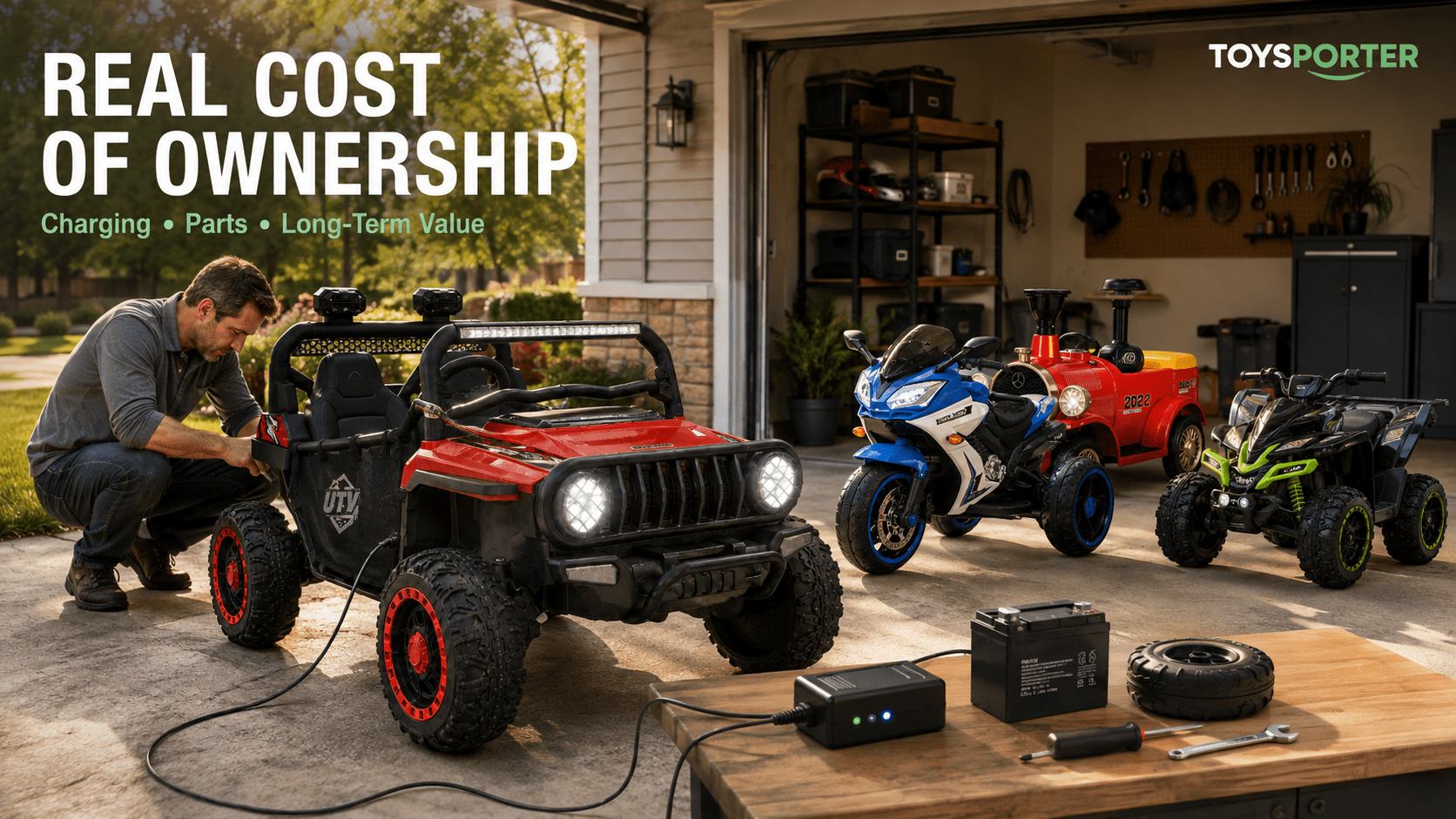
Every ride-on toy claims to be “realistic.” The packaging shows a child gripping a steering wheel with headlights blazing, and the product title is stacked with words like off-road, 4WD, and adventure. But if you’ve ever compared two ride-on vehicles side by side, you already know that “realistic” can mean very different things. One toy looks the part but drives like a wobbly plastic box on a hard floor. Another looks plainer but actually responds the way a small vehicle should – smooth acceleration, real traction, controls that do what they promise.
The short answer: a ride-on toy feels more like a real vehicle when its engineering – not its decoration – mimics how vehicles actually behave. That means how it accelerates, how it absorbs bumps, how the tires grip the ground, and how directly the controls respond. Lights, sounds, and a styled dashboard add to the experience, but they don’t change how the vehicle drives. The most realistic ride-on toys combine both: mechanical features that create a genuine driving feel, and sensory features that make the experience immersive.
The rest of this guide breaks that answer down – what actually changes the driving experience, what only changes the atmosphere around it, and how to tell the difference when you’re comparing ride-on cars, Jeeps, UTVs, motorcycles, or trains.
A Simple Framework: Four Types of “Realistic”
Not every feature that gets marketed as “realistic” affects the ride the same way. It helps to sort them into four categories before comparing any two toys:
Driving-feel features – change how the vehicle actually moves. Suspension, drive motors, acceleration behavior, and tires all fall here.
Comfort and control features – affect how the child (and the parent) interact with and manage the vehicle. Seating, steering response, and remote control systems fall here.
Sensory and visual realism – engage sight and sound without changing how the vehicle drives. Lighting, engine sound effects, and dashboard styling fall here.
Convenience features – improve the overall experience but are unrelated to how vehicle-like the ride feels. Bluetooth music, USB charging, and storage compartments fall here.
A ride-on toy can score high in category 3 and still drive like a shopping cart on a bad wheel. It can also look plain and still deliver a genuinely satisfying, vehicle-like ride because the mechanics underneath are doing the real work. Understanding which category a feature belongs to is the fastest way to evaluate any ride-on toy on its actual merits rather than its marketing copy.
The Features That Actually Change How It Drives
This is the category most buying guides skip, because it’s less photogenic than LED lights – but it’s the one that determines whether a ride genuinely feels like a vehicle or just looks like one in photos.
Suspension. A ride-on toy with real suspension – spring suspension or individual shock absorbers at each wheel – absorbs bumps from grass, gravel, and uneven driveways instead of transmitting every jolt straight to the child. This is one of the clearest differences between a toy that merely rolls forward and one that rides. Suspension is a mechanical feature, not a cosmetic one: it changes what the child physically feels with every bump, regardless of how the vehicle looks.
Drive motors and traction. How many motors a vehicle has, and whether power reaches two wheels or four, directly affects how it handles grass, slight inclines, and uneven ground. A single-motor toy on smooth pavement can feel adequate; the same toy on a bumpy lawn may bog down or lose traction. Dual motors and four-wheel-drive systems are why some ride-on vehicles handle a real backyard confidently while others are better suited to a driveway.
Acceleration behavior. Soft-start acceleration – a gradual ramp-up in speed rather than an abrupt jolt when the pedal or drive button is pressed – is a small detail with a big effect on how “real” a ride feels. Real vehicles don’t lurch forward the instant you touch the gas; a ride-on toy that mimics that gradual buildup feels controlled and predictable rather than jerky, which matters both for realism and for a new driver’s confidence.
Tires. Hard plastic wheels skate and slip; wider, wear-resistant rubber or foam-filled tires grip the ground the way real tires do. Tire type has a direct, physical effect on how planted a vehicle feels through turns and on uneven terrain – it’s one of the more underrated factors in ride quality.
Speed settings. Multiple selectable speeds don’t just add convenience – they let the driving experience scale as a child’s confidence grows, similar to how a driver eases into higher speeds as skill develops. A single fixed speed makes every ride feel the same; two or three selectable speeds create a genuine sense of progression.
Features That Improve Comfort and Control
These features shape how a child interacts with the vehicle and how much a parent can manage that interaction – they’re less about raw driving feel and more about how confident and secure the ride feels for both parent and child.
Seat design and seat belts – a properly fitted seat with a secure belt keeps a child stable through turns and stops, the same way a seat and belt do in a full-size vehicle.
Steering response – a steering wheel that visibly and directly changes the direction of the front wheels (rather than one that spins loosely for effect) reinforces the connection between the child’s actions and the vehicle’s movement.
Parental remote control with dual-mode operation – a 2.4GHz remote that lets a parent take over speed, steering, and braking, then hand control back to the child, is one of the more distinctive features that makes the experience feel like a real, graduated driving process rather than a one-speed toy. Parents can dial in a lower top speed for a new rider and increase it as the child’s coordination improves.
Wide-stance, low-center-of-gravity chassis – a wider wheelbase resists tipping on turns, which lets a child actually corner at speed rather than creeping through every turn out of instability.
Features That Create Visual and Sensory Realism
These features don’t change how the vehicle drives, but they shape how immersive the experience feels – and they’re a legitimate part of what makes a ride-on toy feel like a real vehicle, even though they sit in a different category from the mechanical features above.
Working LED headlights that actually illuminate add to the sense of driving a real vehicle, especially during early morning or evening play.
Engine start-up sounds and a working horn replace silence with the audio cues a child associates with real vehicles – the sound of a car “starting” when the ignition switch or start button is pressed is a small detail that does a lot of work for immersion.
A functional dashboard with volume controls, indicator lights, or a horn button gives a child something to actually operate, rather than a flat printed design.
A real ignition key on some models is a good example of a purely sensory feature that still meaningfully changes how a child experiences “starting” the vehicle – turning a physical key feels categorically different from pressing a plastic button, even though both simply complete a circuit.
It’s worth being direct here: these features are genuinely valuable for the play experience, but they don’t make a vehicle handle better on grass or absorb a bump more smoothly. A toy could have every sensory feature on this list and still ride poorly if the suspension, motor, and tires underneath are weak.
Convenience Features That Round Out the Experience
Bluetooth speakers, USB and AUX inputs, FM radio, storage compartments, and rocking or story modes all add genuine value to a ride-on toy – kids and parents both tend to enjoy them – but they belong in their own category. None of them affect how the vehicle drives or how immersive the “I’m operating a real vehicle” feeling is. They’re better understood as entertainment add-ons layered on top of the core riding experience, useful for keeping a child engaged during charging breaks or slower rides, but not a factor in judging how vehicle-like a ride-on toy actually feels.
Cosmetic vs. Functional: A Quick Reference
Feature
Changes how it drives?
Changes the sensory experience?
Category
Spring suspension / shock absorbers
Yes
Some
Driving feel
4WD / dual motors
Yes
No
Driving feel
Soft-start acceleration
Yes
Some
Driving feel
Wide, textured tires
Yes
No
Driving feel
Multiple speed settings
Yes
No
Driving feel
Seat belt and seat design
Some
No
Comfort & control
Parental remote (dual-mode)
Some
No
Comfort & control
LED headlights
No
Yes
Sensory realism
Engine start-up sound / horn
No
Yes
Sensory realism
Dashboard with working controls
No
Yes
Sensory realism
Real ignition key
No
Yes
Sensory realism
Bluetooth / USB / FM radio
No
Some
Convenience
Storage compartment
No
No
Convenience
Which Features Should Parents Prioritize?
If the goal is genuinely realistic driving, prioritize suspension, motor configuration, tire quality, and acceleration behavior first – these are the features that determine how the vehicle actually performs on grass, gravel, or a bumpy driveway, and they matter regardless of your child’s age. If the goal is an immersive experience for a younger child who’s more interested in pretend play than performance, sensory features like lighting, sound, and a working dashboard may matter more than raw driving capability. Most well-built ride-on vehicles combine both to some degree, which is why comparing specific specifications – suspension type, motor count, top speed, tire material – is more useful than comparing marketing language alone.
It’s also worth setting expectations early: these are child-sized electric toys built to simulate aspects of real driving within a safe, speed-limited range, not scaled-down real vehicles. The most realistic ride-on toy still tops out at a few miles per hour, still requires adult supervision, and still exists within a category built around safety first. Realism here means a more convincing, more engaging simulation of driving – not a literal substitute for one.
For cars and Jeeps/UTVs, four-wheel suspension, motor configuration, and tire type dominate the driving-feel side, while a working dashboard, remote-controlled dual-mode driving, and lighting carry most of the sensory realism. A two-seater UTV built with an enclosed cab, lockable doors, and 4WD traction tends to feel more like a genuine off-road vehicle than a single-motor ride-on car on the same terrain, simply because more of its engineering is doing real mechanical work rather than decorative work.
For motorcycles, realism works differently because balance, not suspension, is the central mechanical challenge. Training wheels for stability, a soft-start motor, and ergonomic handlebars matter more than suspension travel, while engine sounds and working headlights carry much of the sensory realism.
For trains, which are typically trackless and pedal- or button-operated, realism leans more heavily toward the sensory side – music, story modes, and lighting – since the driving mechanics are simpler by design and the play pattern is closer to a mobile activity center than a performance vehicle.
If you’re specifically choosing between a Jeep-style UTV and other options, theoutdoor ride-on Jeep buying guide covers model-specific considerations, and once a Jeep is in the driveway, theguide to teaching a child to drive a ride-on Jeep walks through building real driving confidence stage by stage. For terrain-specific questions,where ride-on motorcycles and trains work best is a useful next read, and keeping the mechanical side of realism intact over time comes down to routine care – theUTV and Jeep maintenance guide covers tire, suspension, and battery upkeep that keeps a ride feeling as good in year two as it did on day one.
Final Thoughts
A ride-on toy feels like a real vehicle when its mechanics do real work – suspension that absorbs bumps, motors that deliver genuine traction, acceleration that ramps up smoothly, and controls that respond the way a child expects. Lighting, engine sounds, a working dashboard, and even a real ignition key add meaningful immersion on top of that foundation, and they’re worth valuing for what they are: the sensory layer that makes the experience feel complete. The most satisfying ride-on vehicles for kids get both halves right – a driving feel that holds up on real backyard terrain, and a sensory experience that makes every ride feel like an event.
Frequently Asked Questions
What single feature makes the biggest difference in how realistic a ride-on toy feels?
Suspension tends to have the most noticeable effect, because it directly changes what a child physically feels with every bump on grass, gravel, or an uneven driveway – a difference you notice within the first few seconds of riding, unlike features you only notice occasionally, like lighting.
Are engine sounds and working headlights just gimmicks?
Not exactly – they don’t change how the vehicle drives, but they meaningfully affect how immersive the experience feels for a child, particularly younger children who engage heavily in pretend play. They’re a legitimate part of the overall experience; they just belong in a different category than mechanical features like suspension or motor configuration.
Does a higher top speed automatically make a ride-on toy feel more realistic?
Not on its own. Speed without stable suspension, decent tires, and controlled acceleration can feel unstable rather than realistic. A moderate top speed paired with smooth acceleration and good traction usually feels more like genuine driving than a higher top speed on a toy that bounces or slides on turns.
Do remote-controlled ride-on toys feel less realistic to the child than fully manual ones?
Not necessarily – a dual-mode remote system is often what makes the progression to real driving feel authentic. A child typically starts by riding while a parent controls the vehicle, then gradually takes over steering and speed, similar to how driving skills build in stages in real life.
Is a ride-on toy with more features always more realistic?
No. A toy loaded with entertainment features like music and lighting can still ride poorly if the suspension, motor, and tires are weak. The features that matter most for realism are the mechanical ones – suspension, drive system, tires, and acceleration – not the total feature count.
Do ride-on Jeeps, UTVs, cars, and motorcycles all achieve realism the same way?
No. Cars, Jeeps, and UTVs lean on suspension and motor configuration for driving-feel realism; motorcycles rely more on balance-focused stability features; trackless trains lean more heavily on sensory features like music and lighting since their driving mechanics are simpler by design.