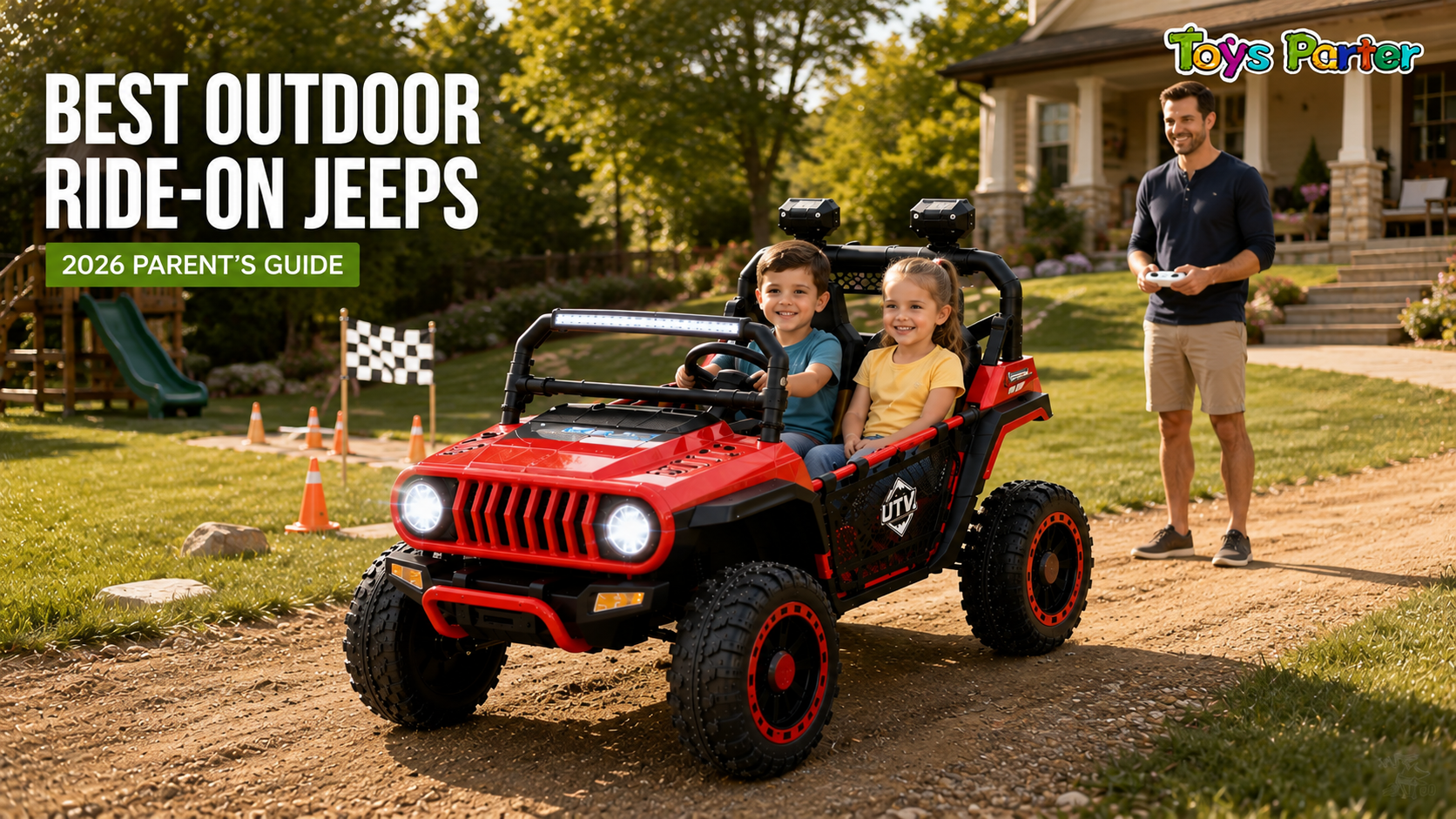
A ride-on Jeep is one of the few kids’ gifts that pulls children away from a screen and out into the yard. It rewards imaginative play, it survives well past the birthday it was given for, and – if you pick the right one – it handles real grass, real gravel, and real hills instead of stalling the first time a wheel leaves the pavement.
That last part is where a lot of purchases go sideways. Plenty of ride-on “Jeeps” look rugged in photos but are really smooth-floor toys in disguise. This guide is about the ones built for outdoor use in typical American backyards, driveways, and cul-de-sacs – how to judge them, what actually matters, and how the models available fromToysporter’s ride-on UTV collection fit different families.
Quick Answer: What to Look for in an Outdoor Ride-On Jeep
If you only read one section, read this. A ride-on Jeep is genuinely built for the outdoors when it has:
4-wheel drive (4WD) and real suspension – the single biggest predictor of whether it can climb grass and packed dirt instead of spinning out.
A 24V battery – 24V systems hold their power on terrain far better than lighter 12V toys, which sag on the first incline.
A parent remote control – so an adult can steer, slow, or stop the vehicle from a distance while a young child learns.
Adjustable speed settings plus soft-start – start a beginner slow, open it up as confidence grows, and avoid jerky launches.
An age/weight rating that fits your child – with room to grow, not a snug fit on day one.
A recognized safety certification (in the U.S., ASTM F963) and secure hardware like a seat belt and lockable doors.
Match those six things to your child’s age and your outdoor space and you’ll avoid almost every common regret. The rest of this guide shows you how to weigh them.
What Counts as an “Outdoor Ride-On Jeep”?
“Ride-on Jeep” gets used loosely, so it helps to be precise. In practice, the Jeep-style models parents shop for are UTV-style off-road ride-ons: a wide, stable body, an open or roll-cage cab, side-by-side seating, and a motor tuned for outdoor terrain. They look and drive like a scaled-down off-road vehicle rather than a sidewalk cruiser.
Here’s how the main ride-on styles compare, because the right choice sometimes isn’t a Jeep:
Ride-on style
Typical seats
Best for
Terrain it likes
Off-road Jeep / UTV
2
Siblings or friends, all-terrain outdoor play
Grass, dirt, gravel, pavement, gentle inclines
Ride-on truck
1–2
Road-style and flat-surface driving
Pavement, driveways, packed surfaces
Ride-on ATV / quad
1
Solo outdoor adventure
Grass, dirt
Ride-on motorcycle
1
Balance practice and solo riding
Smooth, flat surfaces
If you want two kids to ride together and you care about grass and dirt, the Jeep/UTV format is usually the strongest all-rounder. If you have one child and smooth pavement, aride-on truck or a soloride-on ATV may suit you better – worth knowing before you spend.
For a deeper walk-through of the category as a whole, thekids ride-on UTV buyer’s guidecovers the fundamentals in detail.
How We Define “Best” (So You Can Judge Any Jeep)
There’s no single “best” ride-on Jeep for every family – only the best fit for your child and your space. Rather than crown one winner, this guide scores Jeeps against nine consistent criteria:
Outdoor terrain capability – 4WD, suspension, and tire grip
Age and size fit – age range, weight limit, and usable seat space
Battery and runtime – voltage, capacity, real playtime, and charge time
Speed and speed control – top speed, adjustable settings, soft-start
Parental control and safety – remote override, lockable doors, seat belt, certification
Seating capacity – one rider or two
Comfort and ride quality – suspension and seat width
Durability and ownership – build quality, replaceable battery, warranty, returns
Value and gifting suitability – features per dollar and years of use
Use these as your own checklist. A Jeep that scores well across all nine – not just on top speed or looks – is the one that’s still getting driven next summer.
Toysporter’s Outdoor Jeep Lineup at a Glance
A note on transparency first: Toysporter runs a focused Jeep lineup rather than a sprawling catalog of look-alikes. The in-stock outdoor Jeeps are built on one well-equipped 24V, 2-seater off-road platform, offered in a few colorways and trim variations. That’s actually good news for buyers – you’re choosing a color and styling rather than gambling on wildly different quality between a dozen SKUs. (The occasional clearance off-road UTV and SUV models rotate in and out of stock; check theclearance section for current availability.)
Here’s how the core outdoor Jeep platform measures up against the criteria above:
LED headlights, top light bar, working horn, Bluetooth/USB/MP3, rocking mode
Ownership
2-year warranty, free U.S. shipping, 40-day returns
Price
$299.99 (regularly $529.99)
Verified U.S. customer ratings across the Jeep variants sit around 4.4–4.5 out of 5 stars. Below, we match the color/trim variants to the kind of buyer each suits best.
Best Outdoor Ride-On Jeeps, Matched to Your Family
Because these share a platform, the differences that matter come down to styling, color availability, and which variant has the track record you want to see. Here’s how to choose.
Best All-Rounder for Two Kids: The 24V 2-Seater Off-Road Jeep
For most families shopping for an outdoor ride-on that two children can share, the standard24V 2-seater off-road Jeep is the sensible default. It carries the widest set of verified reviews of the variants, comes in Dark Grey, Hot Pink, and Racing Red, and delivers the full feature set – 4WD, spring suspension, the 2.4GHz parent remote, three speeds, and the 19.88-inch two-seat cabin.
Best for: siblings or a child-plus-friend, ages 3–8, on grass, driveway, or park terrain.
Why it fits the criteria: strong across terrain, seating, safety, and value; the 4WD-plus-suspension combination is what makes it a true outdoor Jeep rather than a smooth-floor toy.
Consider if: you want the variant with the deepest pool of parent feedback before you commit.
Best for Bigger or Older Kids: The “For Big Kids” Jeep
If your child is on the taller or older end of the range, the24V off-road Jeep built for big kids is positioned squarely at that buyer. Mechanically it’s the same capable 24V 4WD platform with the wide two-seat cabin – the framing simply leans toward families whose kids need the extra room now and want a vehicle that won’t be outgrown next season.
Best for: a single older child who wants space to spread out, or two kids where one is approaching the upper age range.
Why it fits the criteria: prioritizes age/size fit and comfort while keeping the same terrain and safety strengths.
Keep in mind: stay under the 120 lb limit – for two riders, that’s the combined weight. If your child is close to the cap, size it carefully. Theride-on sizing guide for bigger kidswalks through the math.
Best for a Specific Color or Styling Preference
Buy-in from the future driver is underrated. If your child has a strong opinion on color, thegrey-green off-road Jeep variant adds another styling option on the same proven platform. Because the mechanics are consistent across variants, letting your child pick the look is a fair – and genuinely motivating – tiebreaker.
Best for: gift buyers who want a specific finish, or a child with a favorite color.
Why it fits the criteria: identical terrain, battery, and safety performance; color is the only real variable.
When a Jeep Isn’t the Right Answer
Being honest about fit matters more than making a sale:
One child, smooth pavement, no siblings sharing? A single-seatride-on ATVor aride-on truck may serve better and cost less.
Child under 3? These Jeeps are rated 3–8. A younger toddler can ride under supervision in full remote mode, but a smaller starter ride-on is often the better first vehicle.
No outdoor space at all? An off-road Jeep is built for terrain, not indoor hallways. Browse the fullelectric ride-on range for smaller-footprint options.
Outdoor-Use Considerations Most Buyers Overlook
This is where an outdoor Jeep succeeds or disappoints – and it’s rarely about the spec sheet.
Your terrain decides everything. 4WD and spring suspension let these Jeeps handle grass, packed dirt, gravel, and gentle inclines. They are not built for steep slopes, deep mud, loose sand, or wet, slick surfaces. Map your yard honestly before you buy. The breakdown ofwhat terrain a ride-on UTV can really handle is worth reading first.
Driveways and cul-de-sacs are ideal. A flat, enclosed paved area is the easiest place for a new driver to build confidence before graduating to grass. If your only space is a busy street frontage, plan supervised sessions in a safer spot.
Plan for the seasons. 24V batteries hold up better than 12V in cold weather, but extreme heat and cold still shorten battery life. Store the Jeep indoors – a garage or shed – between rides to protect the battery and finish.
Measure your storage before you buy, not after. A 2-seater off-road Jeep has a real footprint. Confirm you have a garage corner, shed space, or covered area to park it. A ride-on that lives out in the weather ages fast.
Charge for the long game. Give the battery a full ~12-hour charge before the first ride to condition it, and recharge after each session rather than storing it drained. Theride-on battery care and charging guide covers this in detail, and theUTV and Jeep maintenance guidecovers tires, doors, and long-term upkeep.
Safety and Supervision
An outdoor ride-on Jeep is a genuine vehicle for a child, and it deserves genuine ground rules. The models in Toysporter’s lineup are ASTM F963 certified – the leading U.S. toy safety standard – and include a reinforced seat belt, lockable doors, soft-start acceleration, and a 2.4GHz parent remote that lets an adult take full control of speed, steering, and stopping.
That hardware supports supervision; it doesn’t replace it. A few habits make outdoor riding far safer:
Keep an adult present and within remote range for every ride, especially with new or younger drivers.
Start beginners on the lowest speed setting and only step up as their control improves.
Set clear no-go zones – no driveways near the street, no slopes, no wet surfaces.
Buckle the seat belt every time, and confirm doors are latched before moving.
Agree on a simple stop signal so a child knows to brake on command.
For a ready-made rulebook you can adapt to your household, see theride-on UTV and Jeep safety guide for parents. No ride-on toy can guarantee safety on its own – supervision and sensible limits do the real work.
Common Mistakes Parents Make
Buying on top speed. A faster motor matters far less than a good battery and real suspension. Day-to-day happiness comes from runtime and ride comfort, not a marginally higher mph.
Choosing 12V for outdoor terrain. Lighter systems sag on grass and inclines. For genuine outdoor use, 24V is the practical floor.
Ignoring the weight limit for two riders. The 120 lb cap is combined. Two growing kids can hit it faster than you’d expect.
Forgetting storage. No indoor space means a weather-worn Jeep within a season.
Skipping the return window as a safety net. A 40-day return policy exists precisely so you can confirm fit and quality at home. Use it as your backstop.
Before You Buy: Quick Checklist
☐ Child is within the 3–8 age range and under 120 lbs (combined for two riders)
☐ You have outdoor space – grass, driveway, cul-de-sac, or park
☐ You want 2-seater capacity for siblings or friends (or you’d prefer a solo alternative)
☐ You value a parent remote for supervision and beginner control
☐ You have indoor storage to protect the battery and finish
☐ Your terrain is grass, dirt, gravel, or pavement – not steep, muddy, sandy, or wet
☐ The vehicle is ASTM F963 certified with a seat belt and lockable doors
☐ You’re comfortable using the 40-day return window as your safety net
If most of these are checked, an outdoor ride-on Jeep is a strong fit. Start from theride-on UTV collectionto compare colors, or browse thebest sellers to see what other U.S. families are choosing. If you’re timing a purchase around a birthday or holiday, theJeep ride-on buying and savings guide covers current pricing and when to buy.
8. FAQ Section
What is the best outdoor ride-on Jeep for kids?
The best outdoor ride-on Jeep is one built for real terrain: 24V power, 4-wheel drive, spring suspension, a parent remote, adjustable speeds, and a recognized safety certification like ASTM F963. Toysporter’s 24V 2-seater off-road Jeep meets all of these and suits most families with children ages 3–8. The “best” model for you is the one whose age fit, seating, and terrain capability match your child and yard.
What age is a ride-on Jeep best for?
Most 2-seater off-road ride-on Jeeps are designed for children ages 3 to 8, with a maximum combined weight of 120 lbs. Younger toddlers can ride under supervision in full remote-control mode, where an adult manages speed and steering. Children around 5 and up usually have the coordination for confident solo driving on a low or middle speed setting.
Can two kids ride in a ride-on Jeep at the same time?
Yes. The off-road Jeeps have a 2-seater cabin with a 19.88-inch seat width, built for two children side by side. Keep the combined weight of both riders under the 120 lb limit.
How long does the battery last on a ride-on Jeep?
The 24V 7.5AH battery provides up to about 2 hours of playtime per charge, depending on rider weight, terrain, and speed setting. A full initial charge – around 12 hours – helps condition the battery for a longer overall lifespan.
What terrain can a kids’ ride-on Jeep handle outdoors?
With 24V 4WD motors and spring suspension, these Jeeps handle grass, packed dirt, gravel, and pavement, plus gentle inclines. They are not designed for steep slopes, deep mud, loose sand, or wet, slippery surfaces.
Are ride-on Jeeps safe for young children?
When used with supervision, yes. Toysporter’s Jeeps are ASTM F963 certified and include a reinforced seat belt, lockable doors, soft-start acceleration, three speed settings, and a 2.4GHz parent remote with full override. Certification and hardware support safety, but adult supervision and clear ground rules do the real work.
Do you need a big yard for an outdoor ride-on Jeep?
No, but you need some open outdoor space – a backyard, driveway, cul-de-sac, or nearby park with grass, dirt, or pavement. Flat, enclosed paved areas are ideal for new drivers. You’ll also want indoor storage, such as a garage or shed, to protect the Jeep between rides.
Is a ride-on Jeep better than a ride-on ATV or truck?
It depends on your family. A Jeep/UTV is the best all-rounder for two kids and mixed outdoor terrain. A single-seat ATV suits solo outdoor adventure, and a ride-on truck is well suited to road-style play on flat, paved surfaces. Choose based on rider count and terrain, not just looks.