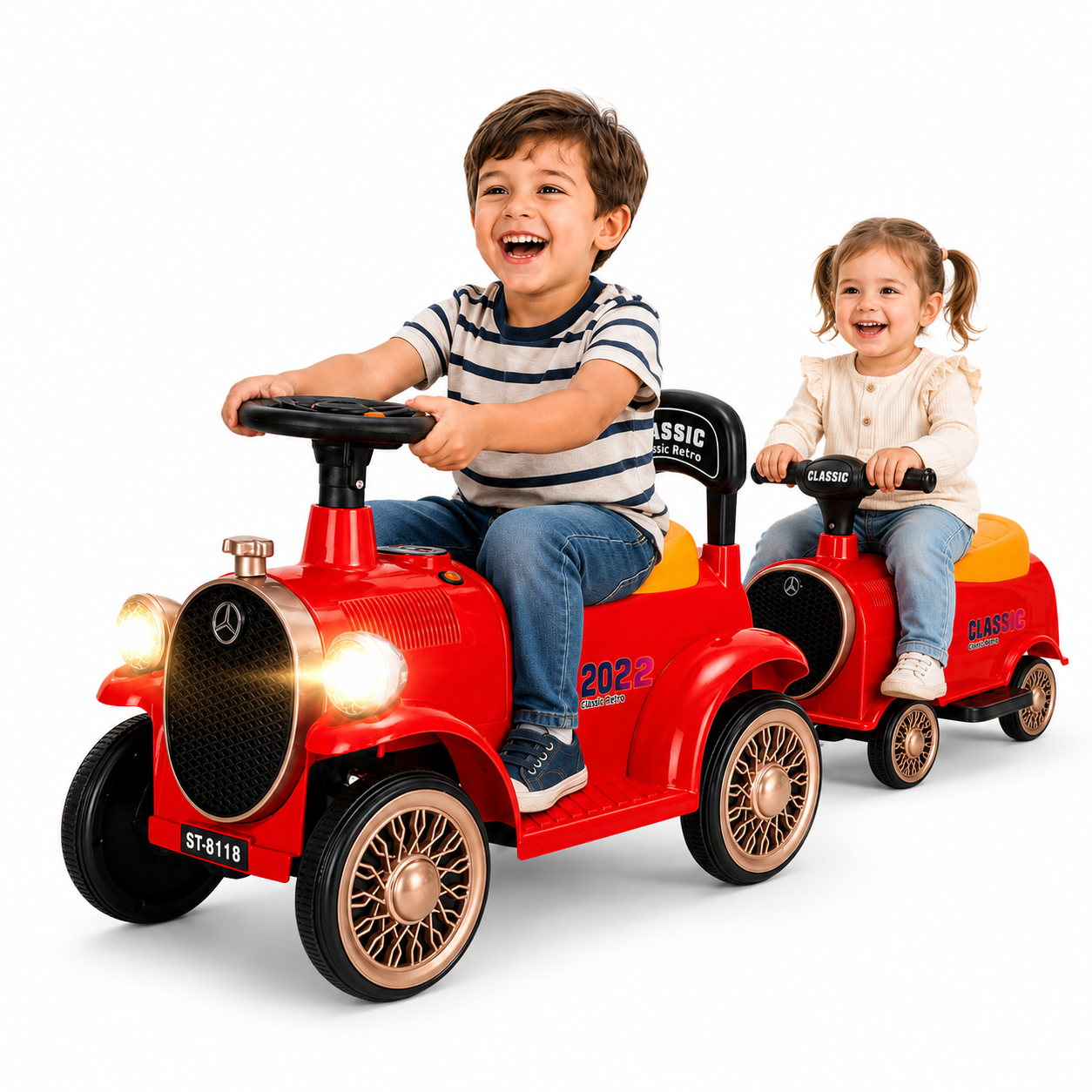
What Is a Ride-On Train?
A ride-on train is a battery-powered, motorized toy vehicle styled after a classic locomotive - complete with a rounded “engine” body, a smokestack that often doubles as a steering wheel, and a caboose-style rear seat for a second rider. Unlike a wind-up or push-along train, a ride-on train has its own rechargeable battery and electric motor, so a child can drive it independently at a safe, controlled speed using a foot pedal.
Because it doesn't run on physical tracks, a ride-on train is technically a “trackless train” - a subcategory of electric ride-on toys that also includes ride-on cars, motorcycles, and ATVs. The train styling is what sets it apart: it's built to feel like driving a train, with train-specific sound effects, a whistle, and a shape kids recognize instantly.
Trackless Ride-On Trains vs. Traditional Track-Based Train Sets
Parents comparing this category to classic wooden or plastic track train sets (the kind built around a fixed loop of track) are really comparing two different toy categories. Here's how they differ in practice:
| Factor |
Trackless Electric Ride-On Train |
Traditional Track Train Set |
| How it moves |
Battery-powered motor, child-driven with a foot pedal, goes anywhere |
Runs only on assembled plastic or wooden track |
| Play space needed |
Any flat surface - driveway, patio, living room, sidewalk |
Fixed track layout that takes up floor space |
| Setup per session |
None - just charge and ride |
Track must be assembled (and often reassembled) |
| Physical activity |
Encourages active, gross-motor outdoor play |
Mostly seated, fine-motor tabletop play |
| Typical age range |
Roughly 2–8 years, depending on model |
Often 3+ for smaller pieces, no upper limit |
| Lost or broken parts |
Minimal - one self-contained vehicle |
Track pieces and couplers are easy to lose |
Many parents keep both: a tabletop track set for imaginative indoor play and a ride-on train for active outdoor time. They serve different developmental purposes rather than replacing each other.
Who a Ride-On Train Is Built For
Ride-on trains are designed around a wide age window because the driving mechanism - a simple foot pedal with forward and reverse - is easy enough for a toddler to learn but still enjoyable for a school-age child. Real-world use tends to fall into a few common patterns:
- Younger toddlers (around 2–4 years) usually ride as a passenger in the caboose seat while a parent or older sibling drives, or use the vehicle at its slowest speed setting.
- Preschool and early elementary kids (roughly 4–8 years) are typically the ones driving, using the foot pedal independently once they understand start, stop, and reverse.
- Two-seater models are built specifically for siblings or a parent-and-child pair, with the front “engine” seat for the driver and the rear caboose for a passenger.
Because these are motor-driven vehicles rather than push toys, always check the manufacturer's listed weight capacity and age recommendation on the specific product page before buying, and supervise early rides the same way you would a first bike or scooter.
Key Features That Matter When Choosing a Ride-On Train
Motor Power and Speed
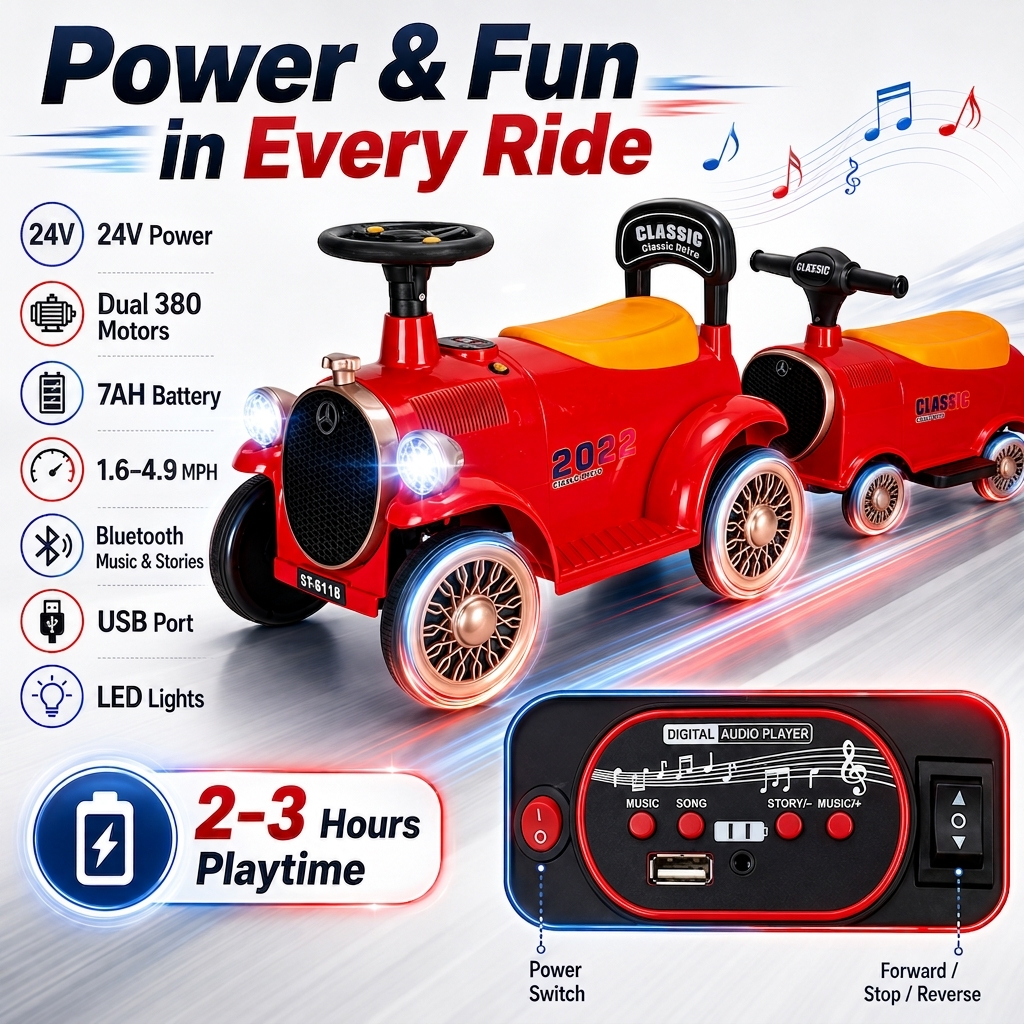
Ride-on trains are typically powered by dual electric motors (commonly rated around 380W each) running on a rechargeable 12V or 24V battery system. Speed is usually adjustable within a range of roughly 1.6–4.9 MPH - closer to a fast toddler walk than a run - and driving is controlled through a simple foot pedal with forward and reverse, so there's no hand throttle for a young child to manage. As a general rule, lower-voltage, lower-speed settings suit first-time riders and smaller spaces, while the higher end of the range gives older kids a bit more excitement without leaving a comfortable, controllable speed.
Seating, Storage & Number of Riders
Most ride-on trains on the market are built as two-seaters: a front “engine” compartment for the driver and a connected caboose-style seat behind it. Many models also include under-seat or caboose storage space, which is genuinely useful for stashing small toys, snacks, or a water bottle during longer play sessions in the yard.
Entertainment Features
Beyond the ride itself, most ride-on trains include built-in entertainment designed to extend play value: Bluetooth music playback, pre-loaded stories or children's poems, a USB port for connecting a phone or tablet, and LED headlights that also work well for early evening rides. These features matter more than they might seem - they're a big part of why a ride-on train tends to hold a child's interest longer than a purely mechanical ride-on toy.
Safety Certifications & Stability
Look for a ride-on train that meets ASTM F963 and CPSIA safety standards - the two benchmarks used for U.S. toy safety testing, covering everything from structural integrity to battery safety and material compliance. An anti-tip chassis design, a low center of gravity, and a wide wheelbase all reduce the risk of the vehicle tipping during turns, which matters more with two riders on board than with one.
Tires & Terrain Compatibility
Ride-on trains typically come with multiple durable, wear-resistant tires (often eight across the full vehicle) designed to grip smooth and semi-smooth surfaces - wood flooring, driveways, asphalt, brick paths, and rubberized playground surfacing. They're not built as off-road vehicles, so grass, gravel, and uneven dirt will slow the vehicle down and drain the battery faster than a paved surface. If your primary play area is a lawn or unpaved yard, an ATV-style ride-on with off-road tires will generally perform better than a train.
How to Choose the Right Ride-On Train for Your Family
Match Power and Speed to Your Child's Confidence
A child who has never driven a motorized ride-on toy before will generally do better starting at the lower end of the speed range, where stopping and steering feel forgiving. Kids who already have experience on a ride-on car or bike can usually handle the upper speed setting from day one.
One Rider or Two?
If you're buying for siblings, or for a parent-and-child pair, a two-seater train removes the “whose turn is it” problem almost entirely - one child drives while the other rides along in the caboose, and they can switch seats. For a closer look at how families actually split time and seating on a two-seater train, our 2-Seater Ride-On Train Sibling Sharing Guide walks through real setup and turn-taking strategies parents use.
Indoor, Outdoor, or Both?
Ride-on trains handle transitions between surfaces well - think hardwood floors to a driveway, or a garage to a sidewalk - which makes them a strong fit for families who split play time between indoor and outdoor spaces. If your child will mostly ride on grass or an unpaved yard, weigh that against a 4-wheel-drive ride-on car or ATV instead, since those are built with off-road tires and suspension specifically for that terrain.
Ownership Guide: What to Expect After You Buy
Assembly
Ride-on trains typically arrive partially assembled, with final assembly limited to attaching wheels, the steering-wheel smokestack, and the seat - most parents complete setup in well under an hour with basic tools, which are usually included. One detail worth knowing in advance: on some models, the steering column bolt hole can sit slightly off-center; if a bolt doesn't thread smoothly, rotating the steering wheel 180 degrees before reattaching it usually solves the alignment issue.
Charging & Battery Care
- Charge fully before the first ride - batteries typically ship with a partial charge, and a full initial charge (often 8–12 hours) helps establish good long-term battery health.
- Expect roughly 20–40+ minutes of active riding time per full charge, depending on rider weight, terrain, and speed setting.
- Recharge after each use rather than letting the battery run completely flat, and store the charger somewhere it won't get wet if the train lives in a garage or shed.
- Battery packs on most models are replaceable, which extends the usable life of the vehicle well beyond the original battery's lifespan.
Storage Between Rides
A garage, covered patio, or shed is ideal. Ride-on trains are built for outdoor play but not for prolonged exposure to rain or direct sun, both of which can degrade plastic body panels and battery performance over time.
Cleaning & Long-Term Care
Wipe the body panels and seat down with a damp cloth and mild soap as needed, and periodically check tire tread and wheel bolts for wear, especially if the train sees regular use on rougher pavement like brick or asphalt.
Safety Considerations Every Parent Should Know
- Always supervise young or first-time riders, particularly near driveways, streets, or slopes.
- Respect the manufacturer's stated weight capacity - exceeding it affects both stability and battery performance.
- Confirm ASTM F963 and CPSIA certification on the product page before purchasing; these standards specifically address battery safety, structural stability, and material safety for U.S. toy sales.
- Keep riding areas free of steps, pools, and steep inclines, since a ride-on train's anti-tip design is built for flat and gently sloped surfaces, not stairs or drop-offs.
- Reserve the higher speed setting for children who have already demonstrated they can stop and steer reliably at the lower setting.
Ride-On Train vs. Other Electric Ride-On Toys
A ride-on train is one option within ToysPorter's wider Electric Vehicles collection, which also includes ride-on cars, ATVs, UTVs, trucks, and motorcycles. If a train isn't quite the right fit, here's how it stacks up against the other most-compared categories:
| Vehicle Type |
Best For |
| Ride-On Train |
Two riders sharing one vehicle, mixed indoor/outdoor surfaces, no-track imaginative play |
| Ride-On Car (12V/24V) |
Kids who want a realistic driving experience, with 4×4 options for grass and light off-road use |
| Ride-On Motorcycle |
Kids drawn to two-wheeled styling, with training wheels for balance and stability |
| Ride-On ATV / UTV |
Backyard and off-road terrain, rougher ground, side-by-side seating for two |
Parents cross-shopping trains and motorcycles often find it useful to compare motor power and safety features side by side - see our Ride On Motorcycle collection for a similar breakdown of 12V and 24V options.
Frequently Asked Questions
What age is a ride-on train suitable for?
Most ride-on trains are designed for a broad range of roughly 2–8 years old, since younger children can ride as passengers while older kids drive independently using the foot pedal. Always check the specific weight limit and age recommendation listed on the product page, since these vary by model.
Do I need to buy separate tracks for a ride-on train?
No. A ride-on train in this category is trackless - it's a battery-powered vehicle that drives on any flat surface, not a toy that runs on assembled plastic or wooden track. This is one of the main differences between a ride-on train and a traditional train set.
How fast does a ride-on train go?
Speeds are adjustable and typically range from about 1.6 to 4.9 MPH, depending on the model and voltage - roughly the pace of a brisk adult walk at the top end, which keeps rides exciting but controllable for young drivers.
How long does the battery last on a full charge?
Ride time varies with rider weight, terrain, and speed setting, but many families get somewhere in the range of 20 minutes to over an hour of active riding per full charge. Charging typically takes 8–12 hours, and it's best to charge fully before the very first ride.
Can two kids ride at the same time?
Yes, on two-seater models. The front “engine” seat is for the driver and the rear caboose seat is for a passenger, which makes these a popular choice for siblings. See our 2-Seater Ride-On Train Sibling Sharing Guide for tips on managing turn-taking.
Is a ride-on train safe for outdoor use?
Yes, when used on appropriate surfaces and with supervision. Look for models certified to ASTM F963 and CPSIA safety standards, with anti-tip chassis design and puncture-resistant tires. Ride-on trains perform best on smooth-to-moderate surfaces like driveways, sidewalks, and patios rather than grass, gravel, or steep terrain.
What's the difference between a ride-on train and a ride-on car?
Functionally, both are battery-powered ride-on vehicles with similar motors, speeds, and safety features. The main difference is styling and seating: a ride-on train is shaped like a locomotive with a connected caboose seat built for two riders, while most ride-on cars are single-seat or side-by-side designs styled after real vehicles.
Do ride-on trains need much assembly?
Most arrive partially assembled, with final setup limited to attaching the wheels, steering wheel, and seat - typically completed in under an hour with the included tools.
Explore More Ride-On Toys & Buying Guides
For a deeper walkthrough of everything covered above - plus model-specific advice - read our full Ride-On Train for Kids: The Complete Parent Buyer's Guide.
Worried a ride-on toy will lose its appeal after a couple of weeks? Our article on why kids get bored of ride-on toys - and how to prevent it covers practical ways to keep any ride-on vehicle, train included, in regular rotation.
If your child is on the taller or heavier side for their age, check our size guide for bigger kids before choosing between a train, car, or ATV.
Browse the full Electric Vehicles collection or the Ride On Motorcycle collection to compare every ride-on style side by side, or return to the ToysPorter homepage to see current deals across all categories.
Have a question we haven't covered here? Visit our FAQs page or contact our team directly - we're happy to help you match a ride-on train to your child before you buy.