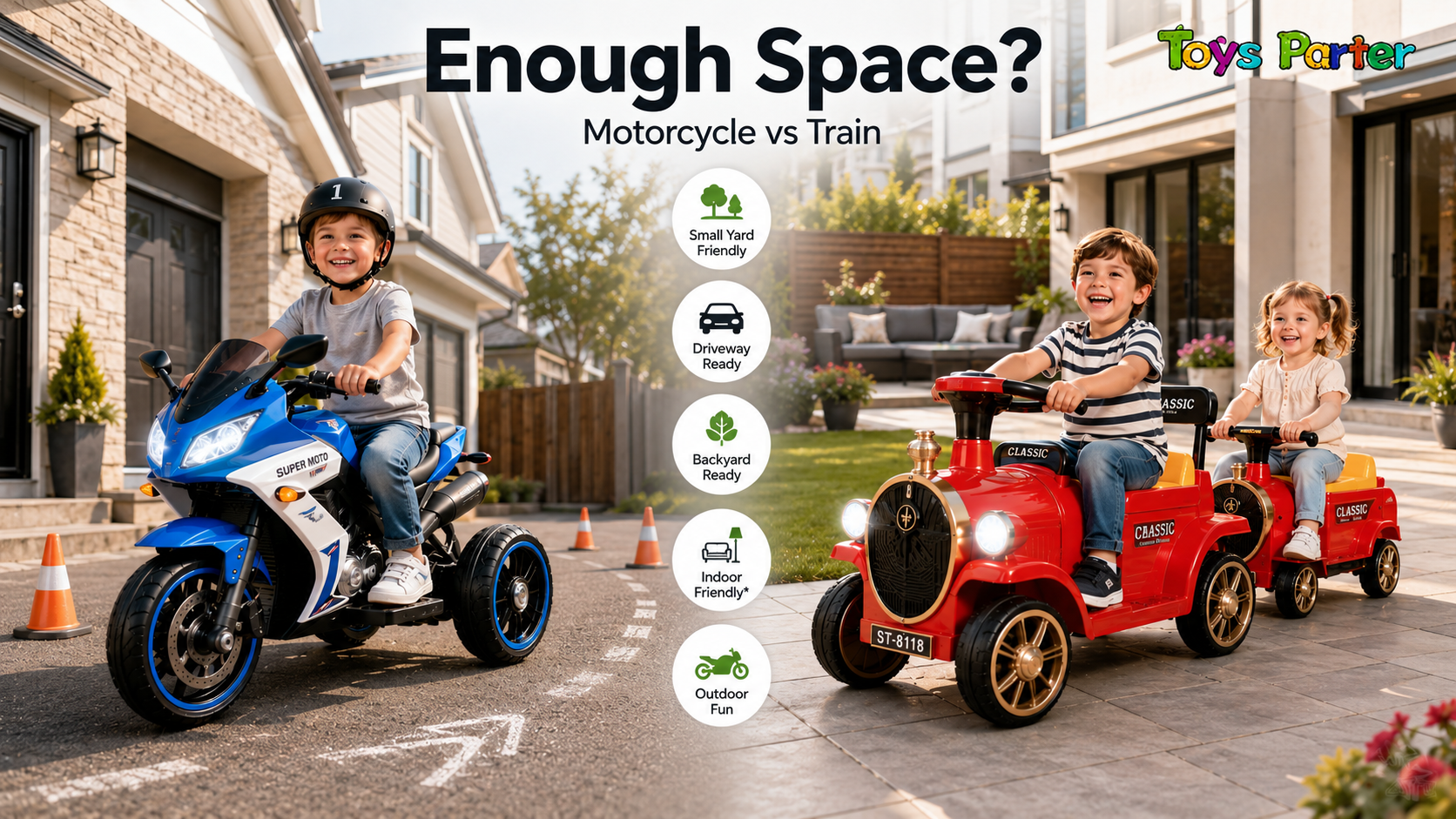
Before a single dollar gets spent, most parents shopping for a ride-on toy are quietly asking themselves a question they rarely type into a search bar directly: “will this even work where we live?” A townhouse with a narrow driveway, an apartment complex with a shared courtyard, a suburban yard with a slope – every home is different, and a ride-on toy that’s a perfect fit for a wide-open cul-de-sac can be a source of frustration in a tighter space.
This guide breaks down exactly how much room aRide-On Motorcycle orRide-On Train actually needs, and how to make smaller or trickier spaces work well instead of assuming they won’t.
How Much Space Does Each Vehicle Actually Need?
Manufacturers rarely publish a minimum “riding radius,” so here are the practical figures we share with Toysporter customers based on typical turning behavior for each vehicle type.
Space Type
Ride-On Motorcycle
Ride-On Train
Minimum comfortable turning space
Roughly a 12–15 ft diameter circle
Roughly a 15–18 ft diameter circle (longer with carriages attached)
Ideal riding surface
Smooth pavement, packed dirt, short grass
Smooth, flat, hard surfaces – patios, driveways, sidewalks
Minimum straightaway for building confidence
About 20–25 ft
About 15–20 ft (less balance-dependent, so shorter runs still feel satisfying)
Storage footprint when parked
Compact – similar to a large stroller
Longer, especially with carriages; similar to a small wagon train
Do You Need a Backyard?
No – a backyard helps, but it isn’t a requirement for either vehicle. A driveway that’s at least one and a half car-widths wide, a cul-de-sac, a quiet street corner, or a paved area at a nearby park all work well. What matters more than total square footage is having a flat, obstacle-free surface long enough for a few consecutive turns or a short straightaway, and low or no vehicle traffic nearby.
Small Yard or Narrow Driveway Setup Tips
Use a figure-eight or oval path instead of a straight line – it makes better use of a compact space and keeps riders turning, which is good balance practice on a motorcycle.
Mark a simple boundary with chalk or cones so a young rider has a clear, visual sense of where riding is allowed.
For trains, park along a fence or wall line when not in use – the footprint is longer than a motorcycle, so a dedicated parking spot prevents it from blocking a walkway.
Apartment and Townhouse Living: What Actually Works
Families in apartments and townhomes are some of the most common ride-on toy shoppers who worry unnecessarily about space. A shared courtyard, a quiet section of parking lot away from traffic, a community clubhouse patio, or even a covered garage on a rainy day can all work for short riding sessions. The realistic expectation to set is shorter, more frequent riding sessions in a shared or semi-public space, rather than the extended solo backyard sessions a single-family home allows.
Confirm with your HOA or property manager whether ride-on toys are permitted in shared outdoor areas – policies vary widely.
Riding in a shared space means supervision matters even more, since other residents, cars, and pedestrians share the same area.
A train’s zero learning curve (see our comparison guide below) tends to suit shorter, supervised sessions in shared spaces especially well, since there’s no extended practice period needed.
Indoor Riding: When It Works and When It Doesn’t
Both vehicle types can be ridden indoors on hard flooring at low speed, but with real limitations. A ride-on train on smooth hardwood or tile, at the lowest speed setting, works reasonably well in an open living or basement space – this is part of why trackless, low-speed trains are popular as indoor rainy-day options. A ride-on motorcycle indoors is riskier: tipping is more likely near furniture, and most homes don’t have enough clear floor space for the turning radius a motorcycle needs to feel enjoyable rather than cramped.
If indoor use matters to your buying decision, that alone is a meaningful point in favor of a train over a motorcycle for smaller or apartment-style homes.
Terrain Considerations Beyond Flat vs. Sloped
Grass
Short, dry grass is manageable for both vehicle types at low speeds, though a motorcycle handles it slightly better due to its tire design. Wet or long grass reduces traction and battery efficiency for both, and is best avoided.
Gravel and Dirt
Motorcycles tolerate light gravel and packed dirt reasonably well in short stretches. Trains are not designed for gravel – their lower ground clearance and multi-wheel tracking work best on hard, even surfaces, and gravel can affect coupling stability between carriages.
Slopes
Mild slopes (a gentle driveway grade) are fine for both. Steeper slopes should be avoided for trains especially, since the added weight of a second rider or carriages can make controlled stopping harder on an incline.
A Simple Pre-Purchase Space Checklist
Measure your intended riding area – does it comfortably fit the turning diameters above?
Identify the surface type – pavement, packed dirt, and short grass all work; loose gravel and long wet grass don’t.
Check for a flat, low-traffic space, even if it’s smaller than a full backyard.
If you live in an apartment or townhouse, confirm shared-space policies before buying.
Plan a parking spot for when the vehicle isn’t in use, especially for a train with carriages attached.
Real-World Example: Making a Small Space Work
A family in a Chicago townhouse with a driveway just wide enough for one car assumed a ride-on toy wouldn’t work for them at all. In practice, a chalk-marked oval loop covering the driveway and a short stretch of quiet sidewalk in front of the house gave their son enough room to comfortably ride his motorcycle for 20–30 minutes most afternoons – far less space than they’d assumed was necessary, and well within the turning diameters outlined above.
Do I need a big backyard for a ride-on motorcycle or train?
No. A driveway, cul-de-sac, or nearby paved area with roughly a 12–18 ft turning space is enough for either vehicle. A large backyard is nice to have but isn’t required.
Can a ride-on train be used indoors?
Yes, on hard, flat flooring like hardwood or tile, at a low speed setting, in an open room with enough clearance. It’s one of the more practical indoor rainy-day options among ride-on toys.
Is a ride-on motorcycle safe to use indoors?
It’s possible on a large, clear hard floor, but generally not recommended – the turning radius needed and the tip-over risk near furniture make outdoor or garage use a better fit.
What surface is best for a ride-on toy?
Smooth, flat, hard surfaces like driveways, patios, and sidewalks work best for both motorcycles and trains. Motorcycles additionally tolerate short grass and packed dirt reasonably well.
Can apartment or townhouse families use ride-on toys?
Yes, with realistic expectations – shorter riding sessions in shared courtyards, parking areas away from traffic, or community spaces work well, provided property rules allow it.
Do slopes or hills cause problems for ride-on toys?
Mild slopes are fine for both vehicle types. Steeper inclines are best avoided, particularly for trains carrying two riders or multiple carriages, since stopping control is affected.