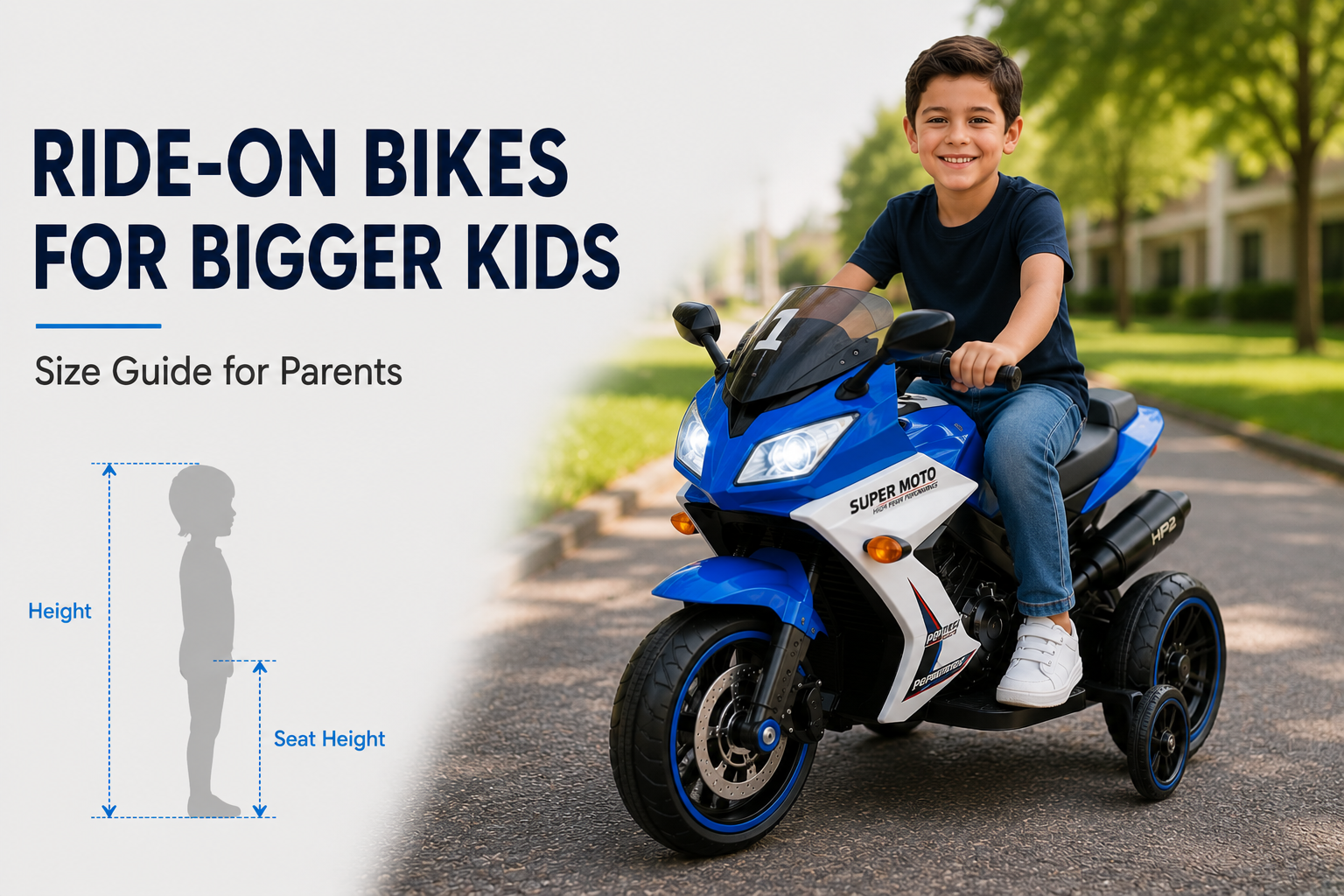
Every ride-on toy purchase comes with an age recommendation on the box. What the box doesn’t tell you is that children of the same age can vary by four or five inches in height and fifteen pounds in weight – and those differences matter enormously for whether a vehicle is actually comfortable, safe, and developmentally appropriate. A 4-year-old who’s tall for their age may have physically outgrown a vehicle rated to age 5. A 6-year-old who’s small for their age may still be perfectly sized for a vehicle marketed to younger children.
This guide shifts the focus from age to fit. It covers the specific physical signs that a child has outgrown a ride-on vehicle, how to measure for proper ergonomic fit, what weight capacity ratings actually mean in practice, and how to choose a larger vehicle that provides genuine long-term value rather than another purchase that’s outgrown in six months.
Why Height Matters More Than Age on Ride-On Toy Labels
Age recommendations on children’s ride-on vehicles exist primarily for safety and developmental appropriateness, not physical fit. A vehicle rated ‘3+’ has been designed to be safe for a child who has developed the motor coordination typical of a 3-year-old. It says nothing definitive about whether a specific 3-year-old fits the vehicle comfortably or whether a tall 5-year-old has already exceeded its physical dimensions.
The Variability Problem
Consider two children both aged 4. One is at the 25th height percentile for their age – approximately 38 inches tall. The other is at the 90th percentile – approximately 42.5 inches tall. That’s nearly a 5-inch difference between children of identical age. On a compact ride-on vehicle with a fixed seat position and handlebars, those five inches create a fundamentally different riding experience. The taller child may find their knees above the handlebar line, their legs cramped against the vehicle body, and their posture hunched forward in a way that’s uncomfortable and limits steering control.
This is why the most useful sizing information for any ride-on vehicle isn’t the age range – it’s the seat height, the handlebar reach distance, the leg room dimensions from seat to footrest, and the maximum weight capacity. These four measurements, compared against your specific child’s proportions, tell you far more than an age label.
Key principle: Evaluate ride-on vehicles by physical fit, not age label. A vehicle is appropriately sized when your child can sit with their back naturally upright, reach the handlebars without stretching forward, rest their feet flat on the footrests, and have their knees at or below handlebar height when seated.
Five Clear Signs Your Child Has Outgrown Their Ride-On Vehicle
1. Knees Rise Above the Handlebars When Seated
This is the most visible and unambiguous outgrown signal. When a child sits naturally in a ride-on vehicle and their knees are level with or higher than the handlebar, the seat-to-handlebar geometry has been exceeded. In this position, the child cannot steer cleanly – their leg movement interferes with handlebar movement, and the riding posture becomes contorted rather than natural. Beyond discomfort, this configuration reduces steering control in a way that creates genuine safety risk.
2. Feet Cannot Reach the Footrests Flat
The opposite problem – feet that dangle because the footrest platform is out of reach – is common in vehicles purchased for a child’s future size rather than their current fit. Without foot support, the child’s core stability during riding is compromised, they cannot brace naturally during sudden stops, and their legs fatigue faster during extended sessions. Footrest contact is a structural safety feature, not a comfort preference.
The correct fit has the child’s feet resting flat on the footrests with a slight bend at the knee – not fully extended and not cramped. This position allows the natural leg bracing that stabilizes the rider during acceleration and cornering.
3. The Child Sits Hunched or Leaning Forward
When a child consistently rides in a hunched posture with their torso pressed toward the handlebars, the vehicle’s handlebar-to-seat distance is too short for their torso length. Correct ergonomic fit has the child sitting upright with a slight, comfortable forward lean – not a compressed crouch. Sustained hunched posture during riding creates back discomfort that causes the child to abandon the vehicle faster, and also reduces their visibility and reaction time during navigation.
4. Riding Sessions Are Getting Shorter
A child who used to ride for 45 minutes but now loses interest after 10-15 minutes may be abandoning the vehicle partly because it’s become physically uncomfortable – even if they can’t articulate why. Physical discomfort from a too-small vehicle creates a diffuse sense of ‘this isn’t fun anymore’ that children attribute to boredom but is often a postural issue. If engagement has dropped alongside visible fit changes, the fit is likely the primary cause.
5. The Vehicle Feels Visually Too Small
Children are socially aware of their equipment from approximately age 5 onwards. A child who looks visibly crammed into a vehicle that was sized for a much younger child will often self-report that the toy is ‘babyish’ – which is partly social signaling but also often reflects a genuine physical experience of being constrained. If the vehicle looks small relative to the child even from a parent’s viewing distance, it almost certainly is.
Common sizing mistake: Parents frequently buy ride-on vehicles for the upper end of the stated age range rather than the child’s current size. A vehicle rated ‘2-5 years’ purchased for a 3-year-old tall for their age may already be at its physical comfort limit. Always check the specific vehicle’s seat height and handlebar reach dimensions against your child’s current measurements, not their projected size.
How to Measure Your Child for a Ride-On Vehicle
The Four Measurements That Matter
Before purchasing any ride-on vehicle for a larger child, take these four measurements and compare them directly against the product’s stated specifications. Most quality retailers list these dimensions on product pages – if they don’t, request them before purchasing.
Inseam length: Measure from the floor to the child’s crotch with the child standing straight. This determines whether the child’s legs will fit naturally against the seat with feet reaching the footrests.
Torso length (seated): Sit the child on a flat surface and measure from the seat base to the top of their shoulders. Compare this against the seat-to-handlebar distance on the vehicle.
Shoulder width: A child whose shoulders are significantly wider than the vehicle’s handlebar span will find their arms cramped inward during steering – a comfort and control issue.
Current weight: Compare against the vehicle’s rated weight capacity with a 10-15% safety margin. Running a vehicle consistently at 95% of its rated weight capacity degrades motor performance and shortens the vehicle’s useful life.
The Seated Fit Test
If possible, have your child sit on the vehicle in-store or at a friend’s house before purchasing. Observe: can they sit upright without leaning forward? Are the knees below the handlebar level? Can they reach the handlebars without stretching? Do the feet touch the footrests? A ‘yes’ to all four means the vehicle fits. A ‘no’ to any one means either the vehicle is too small or the child needs to grow into it – and purchasing ahead of current size is a risk that often results in an uncomfortable first year of ownership.
Weight Capacity: What the Rating Actually Means
Rated Capacity vs Comfortable Operating Weight
The weight capacity listed on a ride-on vehicle is the structural maximum – the point at which the frame, axles, and motor system have been tested to remain intact under load. It is not the comfortable operating weight, which is typically 85-90% of the rated maximum. A vehicle rated to 88 lbs performs optimally and at full rated speed up to approximately 75-80 lbs. As the child approaches the upper limit, motor performance degrades – particularly on outdoor terrain – and battery life shortens due to increased current draw.
For parents buying a vehicle intended to last 2-3 years, factor in the child’s projected weight over that period, not just their current weight. A child who weighs 55 lbs at age 6 will typically weigh 70-75 lbs by age 8. If the vehicle is rated to 66 lbs, it’s already approaching its useful weight ceiling at purchase.
Motor Load and Terrain Performance
Weight affects motor performance non-linearly on outdoor terrain. A motor that handles 60 lbs comfortably on pavement may struggle noticeably with 75 lbs on thick grass or a slight incline. This is because outdoor terrain multiplies effective load – the motor must work harder to overcome rolling resistance, maintain speed on imperfect surfaces, and climb gradients. For bigger children who want to ride on real outdoor terrain, choose a vehicle with a weight capacity that provides genuine headroom above the child’s current weight, not one where the child is at or near the maximum.
Ride-On Vehicle Size Reference: Height and Weight Guidelines
Child Height
Approx. Age
Recommended Vehicle Type
Key Spec to Check
Under 36 in.
2–3 yrs
Compact single-seat – 6V or 12V
Seat height under 12 in., parental remote
36–42 in.
3–5 yrs
Standard single-seat – 12V
Footrest reach, handlebar height
42–48 in.
5–7 yrs
Mid-size – 12V or 24V; ATV / motorcycle formats
Weight capacity 66 lbs+, terrain capability
48–54 in.
7–9 yrs
Full-size – 24V; ATV, UTV, or large motorcycle
Weight capacity 88–110 lbs, 4WD preferred
54 in. and up
9–12 yrs
24V large-format – ATV, UTV, or ride-on truck
Weight capacity 110–130 lbs, high-torque motor
Choosing the Right Larger Vehicle: Format Matters as Much as Size
When a child physically outgrows a compact ride-on car, the replacement decision involves more than simply finding a bigger version of the same thing. The larger vehicle formats that provide genuine long-term value for bigger children are often categorically different from the compact ride-on cars of the toddler years – and understanding which format suits your child’s riding style and outdoor environment makes a significant difference in how long the new vehicle stays relevant.
Electric ATVs and Quads for Bigger Kids
The ATV format is one of the most appropriate choices for children in the 5–10 age range who want genuine outdoor riding capability. A 24V quad with four-wheel drive and spring suspension handles the kinds of terrain that bigger children naturally seek out – garden paths, grass, mild inclines, and varied outdoor surfaces. The wider wheelbase and lower center of gravity of the ATV format is also inherently more stable for heavier riders than narrow motorcycle-format vehicles.
ToysPorter’sride-on ATV rangeincludes 24V models with weight capacities up to 130 lbs and 4WD configurations designed specifically for outdoor terrain use – appropriate for children well into the 8–12 age range when the vehicle is correctly specified.
Ride-On Motorcycles: The Right Fit for the Right Child
Motorcycle-format ride-ons suit bigger children who want the upright riding position, the speed-focused experience, and the solo-adventure play mode that the motorcycle format creates. The key sizing consideration for motorcycle formats is handlebar height relative to the rider’s seated torso – because the motorcycle rider sits more upright than an ATV rider, the handlebar-to-seat distance needs to match the torso length precisely for comfortable riding without hunching.
For bigger children aged 5 and above, thekids ride-on motorcycle range at ToysPorter includes 24V models rated for children up to age 10 with high-capacity motors suited to heavier riders on outdoor terrain.
UTVs and Ride-On Trucks: The Best Capacity Options
For the largest children in the ride-on category – those approaching or exceeding 80 lbs – UTV and ride-on truck formats typically offer the highest weight capacities, the most powerful motor configurations, and the widest seating dimensions. These formats sacrifice some of the sporting feel of ATVs and motorcycles in exchange for structural robustness and carrying capacity that genuinely serves older, larger children without motor strain.
Theride-on truck range at ToysPorterand the UTV collection are worth comparing for families with children aged 8–12 who want a vehicle that provides comfortable, capable outdoor riding at larger body sizes.
Ride-On Trains: The Unexpected Option for Bigger Kids
Ride-on trains with genuine 2-seater dimensions and 12V or 24V motor systems are sometimes overlooked for bigger children because of their visual association with younger toddler play. In practice, a well-sized 2-seater trackless train can comfortably accommodate children up to age 7 or 8 in the driver position, and the cooperative play dynamic of the 2-seater format becomes more rather than less socially engaging as children develop.
ToysPorter’sride-on train collection includes 2-seater models with generous seat dimensions and 12V motor systems capable of handling the weight of older, larger children at appropriate speeds.
Long-Term Value: Buying Once Rather Than Twice
The Upgrade Cycle Trap
Many parents fall into a predictable pattern: buy a vehicle sized for the child’s current age, discover within 12 months that the child has physically outgrown it, purchase a larger replacement, and repeat. Over a child’s active ride-on years (roughly 2–10 years old), this cycle can involve four or five separate purchases, each one made slightly reactively rather than proactively.
The alternative is understanding, at initial purchase, that the vehicle’s useful life depends on the child’s growth trajectory – and buying with more forward-looking sizing in mind. A 4-year-old who is tall for their age and is already at the 75th height percentile should probably not be starting with a vehicle rated to age 5. They should be on a vehicle whose physical dimensions and weight capacity comfortably accommodate a child 18-24 months further into their development.
Specifications That Indicate True Long-Term Value
Weight capacity significantly above the child’s current weight – ideally 30-40% above, to allow for growth without performance degradation.
Adjustable speed settings (via parental remote or onboard control) that allow the vehicle to be appropriate for the child’s current capability and grow with their confidence.
24V motor systems for children aged 5 and above – higher voltage means the vehicle handles increased rider weight and more demanding terrain without the performance ceiling that 12V systems reach quickly with heavier riders.
Terrain capability (spring suspension, 4WD, appropriate tyres) that allows the riding environment to grow more challenging rather than becoming exhausted within a fixed location.
Replaceable battery – a vehicle that accepts standard replacement batteries extends its useful life by years at low cost when the original battery degrades.
ToysPorter’sfull electric vehicles collectionlists complete specifications for all ride-on formats – including seat dimensions, weight capacities, motor voltage, and age ranges – making it straightforward to match a vehicle to your child’s current and projected size rather than relying on age labels alone.
Families comparing formats for a bigger child can also browseToysPorter’s current best-sellersto see which vehicles other parents are choosing for the 6–12 age range – the data reflects real-world purchasing decisions for older, larger children.
VisitToysPorter.com for the complete range of kids electric ride-on vehicles with free US shipping and a 40-day return policy – giving families time to properly assess fit and terrain performance before committing.
Frequently Asked Questions
What height is too tall for a standard ride-on car?
There’s no universal height cutoff because vehicle dimensions vary significantly by model. The practical signal is fit: when a child’s knees rise above the handlebar level when seated, the vehicle has been outgrown regardless of the child’s age or the vehicle’s stated age range. For most standard compact ride-on cars, children over approximately 44-46 inches tall will find the vehicle physically restrictive. At that height, ATV, motorcycle, or UTV formats with larger dimensions typically provide better fit and longer useful life.
Is it safe for a child to ride a vehicle above the stated weight limit?
No. Weight limits on ride-on vehicles are structural ratings – exceeding them creates risk of frame failure, axle stress fractures, and motor overload that can cause sudden loss of control. Beyond safety, running a vehicle at over-weight consistently degrades the motor, battery, and drivetrain at an accelerated rate. Always verify your child’s weight against the vehicle’s rated capacity, and choose a vehicle with meaningful headroom above the current weight for multi-year use.
Can a vehicle rated for ages 3-8 fit a tall 5-year-old comfortably?
Possibly, but you need to check the actual dimensions rather than the age label. Request or look up the specific seat height, footrest distance, and handlebar reach for the vehicle, then compare against your child’s inseam, torso length, and shoulder width. A tall 5-year-old at the 90th height percentile may have already exceeded the comfortable riding dimensions of a vehicle rated to age 8, while an average-height 5-year-old might have two comfortable years of use remaining in the same vehicle.
What ride-on vehicle formats work best for children aged 7-10?
For children aged 7-10, the formats with the best fit and engagement longevity are: 24V ATVs with 4WD and spring suspension for outdoor terrain riding; 24V electric motorcycles with high weight capacity for children who prefer the solo upright riding format; and ride-on UTVs or trucks for the highest weight capacities and most robust motor systems. All three formats offer weight capacities of 88-130 lbs, 24V motor systems, and terrain capabilities appropriate for older children’s more demanding riding styles.
How do I know if a ride-on vehicle will last my child another two years?
Check three things: First, is the child’s current weight at or below 75% of the vehicle’s rated maximum? If yes, there’s weight headroom for growth. Second, are the seat dimensions (height, width, handlebar reach) within a comfortable range for the child’s projected size in two years? Add approximately 3-4 inches of height and 10-15 lbs per year as a rough planning figure. Third, is the motor system (voltage, wattage) appropriate for the child’s growing physical demands and riding ambitions? If the vehicle fails two or three of these checks, an upgrade will likely be needed within 12 months regardless of current satisfaction.
At what point should I stop buying ride-on vehicles and transition to other outdoor activities?
Most children naturally transition away from electric ride-on toys between ages 10 and 12, as the format no longer provides sufficient challenge or social relevance. The transition point is organic rather than fixed – it typically coincides with interest in bicycles, scooters, or other self-propelled outdoor activities that offer the speed and social dynamics that battery-powered ride-ons plateau at. Many families transition through higher-powered ride-on formats (24V UTVs, large ATVs) in the 8-11 range before the child moves fully to pedal or kick-propelled alternatives.
The Right Vehicle for Every Size: Fit First, Age Second
The most common ride-on vehicle purchasing mistake is treating the age label as the primary selection criterion. For the vast majority of children, physical dimensions – height, inseam, weight, and torso length – are the meaningful variables that determine whether a vehicle is comfortable, safe, and worth the investment. A vehicle that fits properly and has meaningful weight and dimension headroom for growth will be used regularly and happily. One that’s already at the edge of its physical limits at purchase will be outgrown or abandoned within months.
The good news is that this is entirely preventable with the right information. Measure your child before purchasing, compare those measurements against actual vehicle specifications rather than age labels, and prioritize formats and motor specifications that genuinely serve your child’s current size and outdoor environment. A properly fitted 24V vehicle purchased at age 5 for a taller child will deliver more total riding value than two smaller vehicles purchased sequentially over the same period.
Browse the complete range of kids electric ride-on vehicles atToysPorter– with full specifications including weight capacity, seat dimensions, and motor voltage for every model – to find the vehicle that genuinely fits your bigger child rather than the one that just fits the age label.