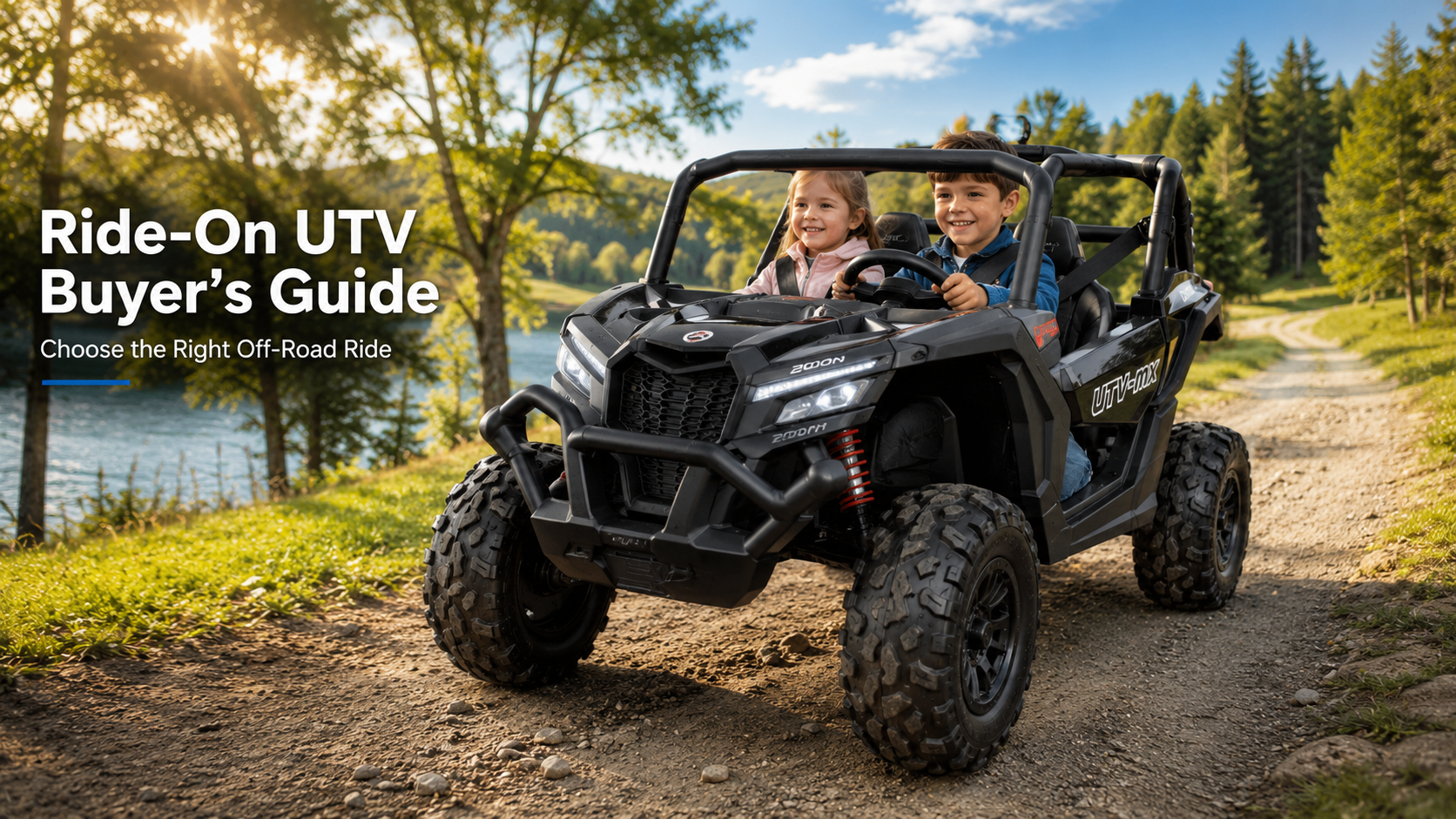
You’ve narrowed it down: your child wants an off-road ride-on, not just another basic ride-on car. Somewhere between the ATVs, the Jeep-style trucks, and the side-by-side UTVs, though, the choice gets confusing fast – especially since a lot of product listings use “Jeep,” “UTV,” and “off-road truck” almost interchangeably. Here’s what actually matters when you’re shopping this category, explained the way we’d explain it to a friend standing in our own warehouse.
This guide focuses onRide-On UTVs – the side-by-side, enclosed-cab category that includes most off-road Jeep-style two-seaters – and walks through every feature worth comparing before you buy.
What Exactly Is a Ride-On UTV?
A ride-on UTV (Utility Terrain Vehicle) is modeled after real-world side-by-side off-roaders – think Polaris RZR or Can-Am Maverick, scaled down and speed-limited for kids. The defining features are a wider, more stable body, a partially or fully enclosed cab, side-by-side two-seat capacity, and a more powerful motor built for uneven ground. Many of the off-road “Jeep” style ride-ons in our catalog share this same side-by-side, two-seater design, which is why the terms overlap so much in product names.
UTV vs. ATV vs. Jeep-Style Truck: A 30-Second Clarification
Before going further, it’s worth untangling the naming, since it trips up a lot of first-time shoppers.
Type
Seating
Body Style
Best For
Ride-On UTV
Side-by-side, 2 riders
Enclosed or semi-enclosed cab
Shared off-road play, siblings riding together
Ride-On ATV
Single rider (quad)
Open, straddle-seat
Solo speed and agility play
Jeep-style Ride-On Truck
1-2 riders, front-and-back or side-by-side depending on model
Open-top or soft-top, truck-shaped
Classic off-road styling, realistic driving feel
If you want the deeper mechanical and use-case comparison between a single-rider quad and a side-by-side, ourKids ATV vs. UTV comparison guide covers that decision specifically. This guide instead assumes you’ve already leaned toward the side-by-side, off-road experience and focuses on how to choose well within that category.
The Features That Actually Matter
Battery Voltage: 12V vs. 24V
Voltage is the single biggest performance factor in this category. A 12V UTV is fine for a younger or first-time rider on flat, forgiving ground. A 24V model brings real torque, better hill performance, and enough power for two riders plus uneven yard terrain – which is most of what a UTV is bought for in the first place. Our24V vs. 12V voltage guide breaks the decision down in more depth if you’re on the fence.
Cab Design: Doors, Roof, and Roll Structure
This is where UTVs and Jeep-style ride-ons genuinely differ from ATVs. Look for lockable doors (a real safety and “stay inside” feature, not just styling), a roof or soft-top for sun and light rain protection, and a roll-bar-style frame that adds structural rigidity even at low, kid-safe speeds.
Suspension and Tires
4-wheel independent suspension handles bumps and ruts noticeably better than 2-wheel or no suspension – worth prioritizing if your yard isn’t billiard-table flat.
Wider, deeper-tread tires perform better on grass and light gravel; smooth, narrow tires are really only suited to pavement and patios.
Higher ground clearance matters more than most parents expect – a UTV that scrapes on every root or rock gets parked fast.
Seating and Weight Capacity
Side-by-side seating means two riders share the total weight capacity, not double it. Check the combined weight limit against your two riders (or your one rider plus room to grow) rather than assuming the per-seat capacity doubles freely.
Parental Remote Control
A 2.4GHz parental remote with forward/reverse/steering override and a one-click emergency brake is close to standard in this category now, and it’s worth treating as a requirement rather than a bonus feature – especially with two kids aboard and less direct control than a single-rider ATV offers.
Entertainment Features
LED headlights, engine sound effects, and Bluetooth speakers are common across this category and genuinely do extend how long kids stay engaged. They’re not safety-critical, but they’re a reasonable tiebreaker between two otherwise similar models.
Age and Size Fit
Age Range
Recommended Setup
Notes
2-4 years
12V, parental remote as primary control
Younger rider should not be expected to steer independently yet
4-6 years
12V or entry 24V, remote available as backup
Good window to start transitioning to independent driving
6-8 years
24V, full manual driving capability
Most kids in this range want, and can handle, full control most of the time
Real Family Scenarios
Two Kids, One Big-Ticket Gift
A family in Ohio with a 4-year-old and a 7-year-old chose a 24V UTV specifically because it meant one purchase instead of two separate ride-ons, and the doors and seatbelts gave them enough confidence to let the older child “drive” the younger one around the yard under supervision.
The Uneven Backyard
A family in North Carolina with a sloped, root-covered backyard upgraded from a 12V ride-on car that kept getting stuck, to a 24V UTV with full suspension – the difference in how much of their actual yard became usable riding space was, in their words, “night and day.”
A Quick Pre-Purchase Checklist
Confirmed combined weight capacity covers both riders comfortably, with some room to grow.
24V if two riders, hills, or rough terrain are part of the picture; 12V is fine for flat, solo, younger-rider use.
4-wheel suspension if your yard isn’t consistently flat and smooth.
Working doors and a roll-bar-style frame, not just a body shell.
Parental remote with emergency brake, especially for a first off-road ride-on.
Where to Go From Here
If a single-rider quad still has your attention alongside the UTV, ourRide-On ATV collection is worth a look, and our Jeep-styleRide-On Truck collection covers the more open-body off-road options. Once you’re ready to compare specific in-stock models, ourBest Sellers page is a good starting point.
FAQ Section
What’s the difference between a ride-on UTV and a ride-on Jeep?
They overlap heavily. A ride-on UTV specifically means a side-by-side, two-seat, enclosed-cab design modeled on real UTVs. “Ride-on Jeep” is often used more loosely to describe any off-road-styled ride-on, including some models that are structurally the same as a UTV.
Is a 24V UTV too fast for a young child?
No, as long as it has speed-lock settings and a parental remote, which nearly all 24V UTVs in this category include. You can cap the top speed for a younger rider and increase it as they gain confidence.
Can two kids really ride a UTV safely at the same time?
Yes, provided the model’s combined weight limit covers both riders and both wear the seatbelts. The side-by-side design is specifically built for this, unlike a single-rider ATV.
Do ride-on UTVs work on grass and dirt, or just pavement?
Most UTVs with 4-wheel suspension and wider tires handle short grass and packed dirt reasonably well. Loose gravel, mud, and steep slopes are more limited – a full terrain breakdown is covered in a related guide.
How is a UTV different from a Jeep-style ride-on truck?
A UTV is specifically side-by-side seating with an enclosed or semi-enclosed cab. A Jeep-style truck may have front-and-back seating or a more open body style, even though both are marketed as off-road.
What voltage should I choose for a first-time off-road ride-on?
12V is a safe, controllable starting point for a younger or first-time rider on flatter ground. 24V is the better choice if two kids will ride together or your terrain includes hills or bumps.