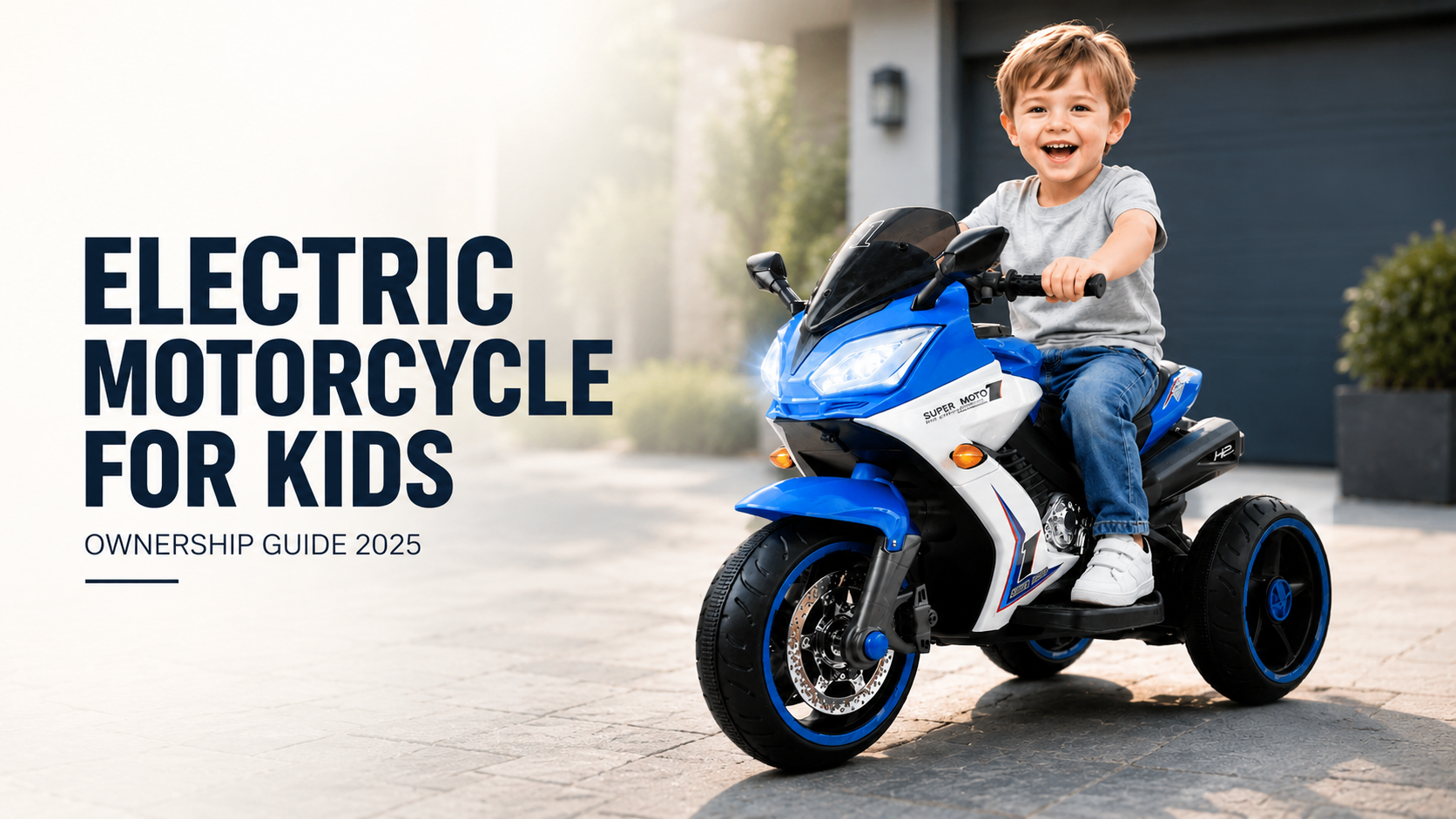
Buying an electric motorcycle for a child is the straightforward part. What happens next – assembly, that first ride, teaching a 3-year-old what ‘brake’ means, managing the battery through years of outdoor use, and knowing when the vehicle has genuinely run its course – is where most parents are on their own.
This guide focuses entirely on the ownership experience: what to do before the first ride, how to teach children at different ages to ride confidently, how to get the most from the battery, how to handle seasonal storage, and how to diagnose common issues before assuming the worst. It’s the practical follow-on to the purchase decision – everything that happens after the box arrives.
If you’re still in the research phase, the kids ride-on motorcycle buyer’s guide covers comparison shopping, voltage decisions, and safety certifications in detail before you commit to a purchase.
Unboxing and Pre-Ride Setup: Do This Before Your Child Sees It
Every parent who has assembled a kids electric vehicle in front of an impatient child knows what happens next: rushed assembly, missed steps, a disappointed child because the vehicle doesn’t work immediately, and a parent frantically reading instructions while a 4-year-old asks ‘is it ready yet?’ at 40-second intervals.
Do the setup the night before. Most quality ride-on motorcycles arrive 80–90% assembled and require only attaching handlebars, seating components, and making the battery connection. The full process typically takes 30–60 minutes with a Phillips screwdriver and a small wrench. Do a test ride yourself – slowly, in a low-clearance crouch – before the child sees the vehicle. Confirm the throttle responds, the brakes engage, the lights activate, and the remote control pairs and stops the vehicle cleanly.
Battery First Charge Protocol
The battery in a new ride-on vehicle has typically been in storage for weeks or months. Before the first ride, connect the charger and run a complete charge cycle – typically 8–12 hours. Do not partially charge and assume it’s ready. A first ride on a partially charged battery delivers shorter run times and creates a negative first impression that’s entirely avoidable.
Most sealed lead-acid batteries in kids electric vehicles reach their full capacity after 3–5 complete charge-discharge cycles. Expect the first few rides to deliver slightly shorter run times than the product’s stated battery life. By the fifth session, performance will reflect the true rated capacity.
Remote Control Pairing Check
Before handing the child the handlebars, verify that the parental remote control pairs correctly and that the stop function works at the far end of your intended riding area. Walk to the boundary of where your child will ride and press the stop command. If response is delayed or absent, you’re at the edge of reliable range – adjust your supervision position accordingly or choose a smaller riding area for early sessions.
Teaching Children to Ride: A Stage-by-Stage Approach
The most common first-ride mistake is giving a young child full control immediately. The child presses the throttle hard, the vehicle lurches forward, they panic and grip harder, the vehicle hits a wall or a sibling, and the whole experience becomes associated with anxiety rather than freedom. The staged approach below prevents this.
Stage 1 – Parent Drives, Child Steers (Ages 2–3)
For the youngest riders, separate the two skills entirely at first. Use the parental remote to control speed while the child focuses only on steering. Set maximum speed to the lowest setting – typically 1–1.5 mph – and let the child navigate a clear, flat area while you manage acceleration and stopping from the remote. This builds steering intuition without the throttle variable overwhelming their attention.
Verbal cues matter at this stage. Establish consistent language: ‘squeeze the brake,”turn the handlebar,”look where you want to go.’ Repeat these cues during every session. Children this age learn through repetition and need the same words each time to build reliable associations.
Stage 2 – Graduated Throttle Control (Ages 3–5)
Once the child can reliably navigate a clear path, introduce throttle control with the remote still set to a low speed maximum. Let them press the foot pedal or thumb throttle (depending on the model) while you retain the remote as a backup. At this stage, the child is learning that the vehicle responds to their input – this is the developmental breakthrough moment that changes everything.
Most children in this age range need 3–5 sessions to develop reliable throttle modulation. The initial tendency is to either press fully or not at all. Partial throttle – going slowly on purpose – is a learned skill that takes time to develop. Reward it explicitly: ‘I saw you go slowly around that corner – that was great riding.’
Stage 3 – Independent Riding (Ages 5+)
By the time a child has 15–20 hours of supervised ride time, the remote becomes a background safety net rather than an active control tool. Define the riding boundary clearly – ‘you can ride anywhere between the fence and the house’ – and maintain visual supervision while allowing full independence within that zone.
This stage is where the outdoor time value really compounds. A child who can independently manage their own vehicle within a defined area develops spatial judgment, confidence in managing a moving machine, and the habit of outdoor activity that carries well beyond the toy itself.
The 24V 3-wheel electric motorcycle suits this full progression particularly well because the three-wheel stability removes the balance variable from stage 1 completely – the child never has to think about tipping, only about steering and throttle.
Battery Ownership: Making It Last
Battery longevity is the single biggest factor in long-term value from a kids electric motorcycle. A vehicle with a degraded battery delivers half the run time, struggles on outdoor terrain, and creates the impression that the toy is ‘broken’ when the motor is actually fine. Most battery degradation is preventable with consistent habits.
The Three Rules of Lead-Acid Battery Care
Rule one: charge after every session, not just when the battery is flat. Partial discharge followed by full charge is kinder to lead-acid chemistry than deep discharge cycles. Rule two: never store a depleted battery. If the vehicle will be unused for more than two weeks – school term, winter storage, holiday travel – charge the battery fully first. A fully charged lead-acid battery self-discharges slowly over months; a depleted one sulfates within weeks. Rule three: use only the supplied charger. Third-party chargers with mismatched voltage profiles can overcharge the battery, causing heat damage that manifests as swelling and dramatically shortened service life.
Reading Battery Health
The first reliable signal of battery degradation is run time reduction. When a session that previously lasted 60 minutes now ends at 35–40 minutes under the same conditions and rider weight, the battery has lost meaningful capacity. At 50% of original run time, replacement is cost-effective. At 60–70% of original run time, you still have a functional battery – just calibrate expectations accordingly and plan sessions around the reduced duration.
A swollen or visibly deformed battery case indicates internal gas buildup and the battery should be removed and recycled immediately – it’s a safety concern, not just a performance issue.
Seasonal Care and Weather Considerations
Winter Storage
Ride-on electric vehicles are not designed for cold-weather operation below approximately 40°F. Cold temperatures reduce lead-acid battery discharge capacity by 20–40%, meaning the vehicle performs noticeably worse in cold conditions even with a fully charged battery. More importantly, riding on wet, icy, or frost-covered surfaces creates slipping and braking hazards that the vehicle’s tyres and limited braking system aren’t designed for.
The practical answer is indoor storage through winter months with the maintenance routine described above. A dry garage or utility room is ideal. Avoid storage areas with large temperature swings – repeated thermal cycling degrades battery capacity faster than consistent cold.
Summer Heat
High ambient temperatures accelerate self-discharge in lead-acid batteries and, at extremes, can cause electrolyte evaporation in unsealed batteries. Keep the vehicle out of direct sunlight during storage – a covered patio, garage, or shed is appropriate. After outdoor play in hot weather, allow the vehicle to cool to ambient temperature before charging. Charging a hot battery stresses it more than charging at room temperature.
Rain and Wet Surfaces
Most kids ride-on motorcycles have a water-resistance rating appropriate for light splashing – puddle encounters, light rain, garden sprinklers. They are not waterproof. Never allow the vehicle to be ridden through standing water deep enough to reach the motor or battery housing. After any wet session, wipe down the body and dry the wheel wells before storage. If the battery compartment shows any moisture ingress, allow it to air dry completely before charging.
Troubleshooting Common Issues Without Replacing the Vehicle
Vehicle Starts Then Stops Immediately
This almost always indicates a low battery rather than a motor or controller fault. Charge fully (8–12 hours), then retry. If the same behaviour repeats after a full charge, the battery has degraded below the voltage threshold the controller requires to sustain motor operation. Replace the battery before assuming the motor or controller is faulty.
Reduced Speed on Grass That Previously Worked Fine
Check the wheel fasteners first – loose rear wheel connections reduce motor torque transfer. Also check the tyre condition – split or partially deflated tyres create dramatically more rolling resistance. If hardware and tyres are sound, the issue is typically battery degradation under the higher current demand of outdoor terrain.
Remote Control Stopped Working
Replace the remote’s batteries before any other diagnosis. Remote controls run on AA or AAA cells that deplete without obvious warning. A fresh set of batteries resolves 80% of remote control issues that parents assume require vehicle service.
Squealing or Grinding From Rear Wheels
Small stones and debris lodge between the tyre and wheel housing on models with narrow clearances. Inspect both rear wheel assemblies after outdoor sessions on gravel or garden paths, and clear any debris before the next ride. If the sound persists after clearing debris, inspect the axle bearings for play – a small amount of lateral movement at the wheel indicates bearing wear that should be addressed before it damages the motor mounting.
For parents who want to explore the full current range – including comparing the 24V motorcycle against other ride-on formats – ToysPorter’s electric vehicles category lists all available models with specifications and current pricing.
Knowing When to Upgrade
A quality 24V kids motorcycle is designed to serve a child from age 2 to age 10. In practice, the vehicle’s useful life depends on how well it’s maintained, how heavily it’s used, and whether the child’s physical growth moves them outside the vehicle’s comfort envelope before the motor reaches end of life.
The upgrade signal to watch for isn’t simply age – it’s when the child’s knees start tucking above handlebar height during riding, when the seat is visibly uncomfortable for their torso length, or when the maximum weight rating is approached. At that point, the riding experience degrades and the child is more likely to abandon the vehicle than continue using it. That’s the natural transition point, not a fixed calendar date.
A well-maintained 24V motorcycle with a replaced battery can hold its resale value at 40–60% of the original purchase price. If the motor and frame are sound, listing it when the child transitions out of the age range recovers meaningful cost toward the next outdoor vehicle.
Browse ToysPorter’s best-sellers to see which vehicles current buyers are transitioning to as children grow out of the motorcycle format – the pattern is usually toward higher-powered ATVs or UTVs as children approach ages 8–10.
You can also visit ToysPorter.com directly for current promotions, clearance pricing, and the full range of kids electric ride-on vehicles with free US shipping and 40-day returns.
Frequently Asked Questions
How long should I charge a 24V kids motorcycle battery before the first ride?
Always run a full first charge before the first ride – 8–12 hours for a 24V lead-acid system. New batteries arrive partially discharged after storage and need a complete charge cycle before delivering their full rated capacity. Partial first charges lead to shortened initial run times that don’t reflect the battery’s true performance.
My child keeps pressing full throttle – how do I teach gentler riding?
Use the parental remote’s speed lock to set a lower maximum speed while the child develops throttle sensitivity. At a lower ceiling, pressing full throttle feels similar to partial throttle at full speed, which gives the child room to learn proportional control without the vehicle punishing over-enthusiasm with sudden acceleration. Reduce the ceiling gradually over several weeks rather than jumping to full speed.
Can a kids electric motorcycle be ridden in light rain?
Brief light rain during a session is manageable – the motor and battery housings have basic splash resistance on quality models. Riding through puddles deep enough to submerge the wheel hubs is not recommended, as water reaching the motor or battery housing causes corrosion damage over time. After any wet session, dry the vehicle before storage and charging.
How do I know if the battery needs replacing vs the motor?
Charge the battery fully, then check voltage with a cheap multimeter across the battery terminals – a healthy 24V lead-acid battery at full charge reads 25.5–26V or above. If voltage reads below 23V immediately after a full charge, the battery has lost capacity and should be replaced. If voltage is appropriate but the vehicle still lacks power, the motor or controller warrants investigation.
At what age do most children outgrow a kids ride-on motorcycle?
Physical fit – not age – is the more reliable indicator. When the child’s legs are visibly cramped in the riding position, or when their torso extends beyond the handlebar reach comfortably, the vehicle has been outgrown. For most children on a standard-sized kids motorcycle, this happens somewhere between ages 8 and 10 depending on their size. Regular fit checks every six months help identify the transition point before the experience becomes uncomfortable.
Where can I track my ToysPorter order?
You can track your order status directly on the ToysPorter order tracking page – enter your order number and email address to see real-time shipping updates.
The Long View: Getting Years of Value From a Kids Electric Motorcycle
The parents who get the most from a kids electric motorcycle aren’t necessarily the ones who bought the most expensive model. They’re the ones who set it up properly before the first ride, taught the skill progressively rather than handing over full control immediately, treated the battery as a piece of equipment requiring consistent maintenance, and stored the vehicle appropriately between seasons.
An electric motorcycle designed for ages 2–10, maintained well, can genuinely serve a child for 5–7 years – from a wobbly toddler pressing the throttle for the first time to a confident 9-year-old carving through the backyard at full speed. That’s exceptional value from any toy purchase, and it’s entirely achievable with the practices described in this guide.
The 24V Dual-Motor 3-Wheel Kids Electric Motorcycle at ToysPorter is the model this guide was written around – ASTM F963 certified, 380W dual motors, parental remote, LED lighting, and a three-wheel stability platform that works from the first ride through the full age range.
Explore the complete kids electric motorcycle range or browse all ride-on formats at ToysPorter to find the right vehicle for your child’s age, riding environment, and outdoor ambitions.