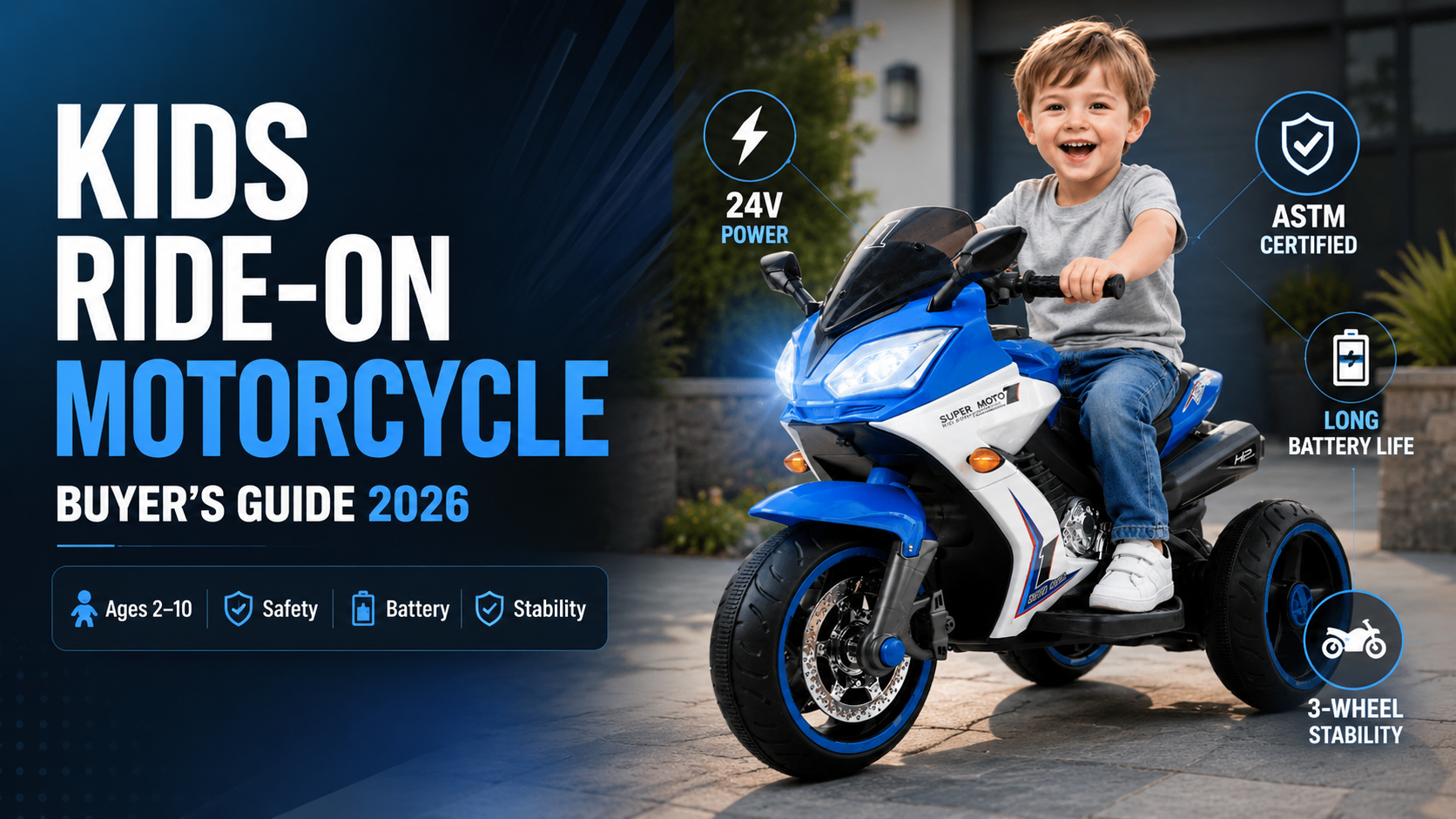
A ride-on motorcycle hits differently than other kids electric vehicles. There’s something about the two-wheeled silhouette — or the deliberately motorcycle-styled three-wheel format — that makes children sit up straighter, grip the handlebars with purpose, and feel genuinely cool in a way that a ride-on car rarely achieves. For the right child, it’s the most played-with outdoor toy in the yard. For the wrong configuration, it becomes a confidence problem within the first few rides.
This guide helps you avoid that gap. We cover the real differences between 12V and 24V systems, why the three-wheel format exists and whether it’s right for your child, what safety certifications mean in practice, and which features genuinely improve the riding experience versus which ones are packaging noise.
You can explore the current range ofkids ride-on motorcycles at ToysPorteralongside this guide — all models are ASTM-certified and ship free within the US.
Two Wheels vs Three Wheels: The Decision That Shapes Everything
Most parents shopping for a kids ride-on motorcycle encounter two primary formats: a traditional two-wheel motorcycle shape with training wheels bolted on either side, and a purpose-built three-wheel trike configuration where the two rear wheels are integrated as a permanent structural element. These feel similar at a glance but ride very differently.
Training Wheels on a 2-Wheel Frame
Training wheels on a motorcycle-shaped ride-on provide stability for a child who is still developing balance confidence but remove them as a transitional aid later — theoretically. In practice, most ride-on toy training wheels aren’t designed for removal. They’re structural components that hold the rear of the vehicle level. The benefit of this format is aesthetic: the bike looks like a real motorcycle when viewed from the side. The limitation is that training wheels on uneven outdoor surfaces can create a see-saw effect where one wheel lifts, reducing traction unexpectedly.
True 3-Wheel Trike Configuration
A purpose-built three-wheel design — one front wheel, two permanently spaced rear wheels — is a fundamentally more stable platform. The rear track width means the vehicle doesn’t rely on the rider’s weight distribution for balance at low speeds. For children aged 2–5 who are still developing spatial confidence, this is a more forgiving format. There’s no tipping dynamic to manage, which means the child’s entire attention goes to steering and throttle rather than balance anxiety.
The ToysPorter 24V kids motorcycle uses a dedicated three-wheel configuration with a wide rear stance, which is why it’s recommended comfortably from age 2. The stability isn’t borrowed from training wheels — it’s built into the geometry.
The24V 3-Wheel Kids Electric Motorcyclefeatures dual 380W motors on the rear wheels — one per wheel — which provides independent torque distribution and contributes to both traction consistency and cornering stability.
Battery and Motor: What 24V Dual 380W Actually Means
Why Voltage Matters Beyond Speed
24V versus 12V on a kids motorcycle isn’t primarily a speed question — it’s a torque question. Higher voltage means more current can be delivered to the motor under load, which translates to consistent performance on outdoor terrain. A 12V motorcycle on short, dry grass performs adequately. The same motor on wet grass, a gravel path, or with a heavier child in the 7–10 age range will bog down. A 24V system has more reserve power to push through resistance without the motor overheating or the vehicle stalling mid-ride.
Dual Motors: One Per Rear Wheel
A dual motor configuration — with one motor driving each rear wheel independently — does more than simply double power output. Independent rear wheel drive means each wheel can receive different amounts of torque based on road surface conditions. When one rear wheel loses traction on loose gravel or a damp surface, the other continues driving forward. On a single-motor system, traction loss at one rear wheel often transfers directly to a skid. Dual motors make the ride more predictable for a young rider and extend the range of terrain the vehicle handles confidently.
Soft-Start Technology
Quality 24V kids motorcycles include a soft-start system — the motor ramps up gradually rather than applying full torque the instant the throttle is pressed. For a young child who hasn’t yet developed precise throttle control, an instant-on motor causes jerky acceleration that can surprise and unsettle them. Soft-start creates a linear, predictable response that lets children build throttle intuition naturally without the toy punishing early mistakes.
12V vs 24V Kids Motorcycle: Head-to-Head Comparison
Spec
12V Single Motor
24V Single Motor
24V Dual Motor
Best Age Range
2–6 years
3–8 years
2–10 years
Outdoor Terrain
Pavement + dry grass
Pavement + grass
Mixed terrain
Motor Power
~100W
~200W
380W+ combined
Top Speed (est.)
2–3 mph
3–4 mph
3–5 mph
Soft-Start
Rarely
Some models
Typically yes
Battery Life
30–50 min
45–70 min
45–75 min
Ideal For
First-time riders
Intermediate riders
Long-term use 2–10
Age Suitability: Matching the Motorcycle to Your Child
Ages 2–3: Early Riders
At 2–3 years old, a child is physically able to sit on a motorcycle-format ride-on and enjoy a supervised ride. The key requirements for this age are a wide, stable wheelbase (three-wheel format), parental remote control to manage speed and direction, and a vehicle with a low seat height that allows the child’s feet to touch the footrests naturally without stretching. Speed should be limited to 1–2 mph during the learning phase.
Ages 4–6: The Peak Engagement Zone
Children in this range have the motor coordination to steer confidently, understand and follow basic rules about where to ride, and engage fully with the sound and light features. This is when a ride-on motorcycle delivers maximum value — the child is genuinely driving, not just being chauffeured. LED lights, engine sound effects, and a working horn become important at this stage because the child cares about the experience matching their imagination of what a motorcycle should be.
Ages 7–10: Continued Use and Growing Demands
Older children demand more from a vehicle. Higher combined weight, desire for more speed, and the wish to ride on terrain beyond a flat driveway all push the requirements up. A 24V dual-motor motorcycle handles this age group reliably where 12V single-motor alternatives reach their performance ceiling. Weight capacity is particularly important here — running a motor above its rated load accelerates wear and shortens the vehicle’s usable life.
Safety: The Non-Negotiable Checklist
ASTM F963 Certification
ASTM F963 is the US toy safety standard covering structural integrity, electrical component safety, chemical material restrictions, and age-appropriate design. Products certified to this standard have been independently verified — not self-declared. In the kids electric vehicle category, this distinction matters because the market includes a significant volume of uncertified imports that meet none of these standards in practice. Always verify independent certification before purchase.
Parental Remote Control
For children under 6, parental remote control is a genuine safety requirement. A young child approaching a hazard — a step, a kerb, a sibling — may not have the reaction time to brake independently. A parent with a 2.4GHz remote can stop the vehicle instantly from up to 30–100 feet away. The remote also doubles as a teaching tool: you control the speed while the child focuses on steering, then gradually hand over throttle control as their confidence builds.
Rear Stability Footrest
Quality kids motorcycles include footrests on both sides so the rider can plant their feet during low-speed manoeuvres. This is particularly important when the child is learning — having a stable foot position prevents the instinctive ‘foot dangle’ that catches on obstacles. Check that footrest width and height match the child’s leg length before the first ride.
Terrain and Real-World Performance
Driveways and Paved Surfaces
The baseline environment for any kids motorcycle. Performance is smooth and predictable on flat concrete or tarmac. Battery life is at its maximum on paved surfaces, and the motor is operating comfortably within its power band. This is the appropriate starting environment for any child’s first rides regardless of age.
Lawn and Garden
Short, dry grass is manageable for 24V models. The higher torque keeps momentum consistent through rolling resistance. Dense or wet grass requires a higher motor rating — single-motor 12V units will bog down; dual-motor 24V models push through. Avoid freshly watered lawn, particularly on slopes, as the combination of wet surface and gradient can overcome even well-specced motors.
Gravel and Packed Paths
Loose gravel is the most demanding common outdoor surface for ride-on vehicles. Individual wheel traction varies rapidly as stones shift underfoot. A dual-motor system compensates better than single-motor here because each wheel responds independently to traction changes. Keep speed low on gravel — 2–3 mph is more than sufficient for children to enjoy the experience without creating instability on shifting surfaces.
Maintenance and Long-Term Ownership
Battery Care
Always charge the battery fully after each ride and never store the vehicle with a depleted battery. Lead-acid batteries — the standard type in ride-on toys — sulfate when stored discharged, which permanently reduces capacity. A fully charged battery stored for the winter will self-discharge slowly over weeks; recharge it monthly during extended storage. Most 24V systems require 8–12 hours for a full charge from empty.
Motor and Drivetrain
Dual-motor systems generally require minimal maintenance. Check the motor mounting bolts after the first month of use — vibration from regular riding can loosen hardware that wasn’t fully torqued at assembly. Listen for any grinding or irregular sounds from the motor housings during operation; these typically indicate debris caught in the wheel assembly rather than motor failure.
Cleaning
Wipe down the body and frame with a damp cloth after outdoor sessions. Avoid pressure washing — water ingress into the motor housing or battery compartment causes corrosion that develops over weeks rather than immediately. Clean the battery terminals annually with a dry cloth; a light coating of petroleum jelly on the terminal posts prevents corrosion buildup.
When to Replace the Battery
A ride session that now ends in 30–35 minutes when it previously lasted 60+ minutes is the most reliable indicator of battery degradation. Replacement 24V batteries for quality ride-on vehicles are widely available and typically cost a fraction of the vehicle’s original price. Battery replacement is a better economic decision than vehicle replacement in most cases.
How a Kids Motorcycle Compares to Other Ride-On Formats
If you’re still deciding between a motorcycle and another ride-on format, the key differentiator is the riding experience the child is drawn to. A motorcycle ride-on is narrow, upright, and fast-feeling even at low speeds. It rewards children who want to feel like they’re piloting something, not just steering around a yard.
If your child is equally drawn to cars and trucks, ToysPorter’sfull electric vehicles rangecovers ATVs, UTVs, trucks, and more — each format creates a different kind of outdoor experience and some children respond much more strongly to one than another.
For something with a completely different aesthetic appeal, theride-on train range suits children who love the locomotive format and want a more social, seated riding experience — particularly popular for siblings who ride together.
Current promotions and seasonal deals on all ride-on formats are listed onToysPorter’s best-sellers page, which is updated regularly with discounted vehicles.
Frequently Asked Questions
What age is a ride-on motorcycle suitable for?
Quality 24V three-wheel kids motorcycles are suitable from age 2 with parental remote control at low speed settings, through to age 10 depending on the vehicle’s weight capacity. The three-wheel configuration removes the balance variable that makes two-wheel formats less appropriate for very young children. Always verify a specific model’s minimum and maximum age and weight ratings before purchasing.
Is a 3-wheel kids motorcycle safer than a 2-wheel with training wheels?
Generally yes, particularly for children under 5. A purpose-built three-wheel trike has its stability engineered into the chassis — the wide rear stance means the vehicle cannot tip sideways at normal riding speeds. Training wheels on a 2-wheel frame provide stability but can create a see-saw effect on uneven terrain where one training wheel lifts momentarily. For the youngest riders, the three-wheel format is the more reliable stability solution.
How fast does a 24V kids motorcycle go?
A 24V dual-motor kids motorcycle typically reaches 3–5 mph at maximum speed settings. Parental remote control allows speed to be locked to a lower ceiling — 1–2 mph for toddlers, graduated upward as the child develops confidence. Top speed varies with rider weight and terrain; heavier riders on grass will experience lower effective speeds than lighter riders on pavement.
How long does the battery last on a 24V kids motorcycle?
On flat pavement with a lighter rider at moderate speed, expect 45–75 minutes per full charge. On outdoor terrain with a heavier child at higher speeds, expect 40–55 minutes. Battery life decreases gradually over the battery’s service life. Proper charging habits — full charge after every session, no long-term depleted storage — maintain capacity closest to the original specification for longest.
Does a kids ride-on motorcycle work on grass?
A 24V dual-motor motorcycle handles short, dry grass well. Thick, wet, or long grass creates significantly more rolling resistance and should be avoided with lower-powered models. If your child’s primary riding surface is lawn rather than pavement, prioritize motor wattage over top speed when comparing models — torque on mixed terrain matters more than peak speed on pavement.
What safety gear does a child need for a ride-on motorcycle?
A properly fitted helmet is the minimum for any outdoor session. Cycling helmets and skateboard-style helmets both provide appropriate lateral and frontal impact protection for the speed range of kids ride-on motorcycles. Knee and elbow pads are recommended for children under 5 or for any child riding on hard paved surfaces where falls are more consequential. Closed-toe shoes prevent foot and toe injuries from ground contact during slow manoeuvres.
Final Verdict: Is a Kids Ride-On Motorcycle Worth It?
For children aged 2–10 who are drawn to the motorcycle format, a properly specced electric ride-on motorcycle is one of the most consistently used outdoor toys available. The combination of realistic appearance, genuine vehicle control, and sensory engagement — LED lights, engine sounds, horn, throttle response — creates an experience that holds a child’s interest far longer than most single-function outdoor toys.
The critical buying decision is voltage and motor configuration. A 24V dual-motor three-wheel motorcycle covers the full age range from early toddlerhood through middle childhood without the performance ceiling that 12V single-motor alternatives hit within a year or two. The upfront investment is higher; the total cost over the child’s active riding years is lower.
The24V 3-Wheel Electric Kids Motorcycle at ToysPorter — with dual 380W motors, soft-start technology, LED lighting, parental remote, and ASTM certification — represents the well-specced end of this category at a price point that reflects genuine engineering rather than packaging.
Browse the completekids ride-on motorcycle selectionor explore all electric vehicle formats at ToysPorter to find the right match for your child’s age, environment, and outdoor personality.
VisitToysPorter.com to see current promotions, clearance pricing, and free US shipping on all orders.