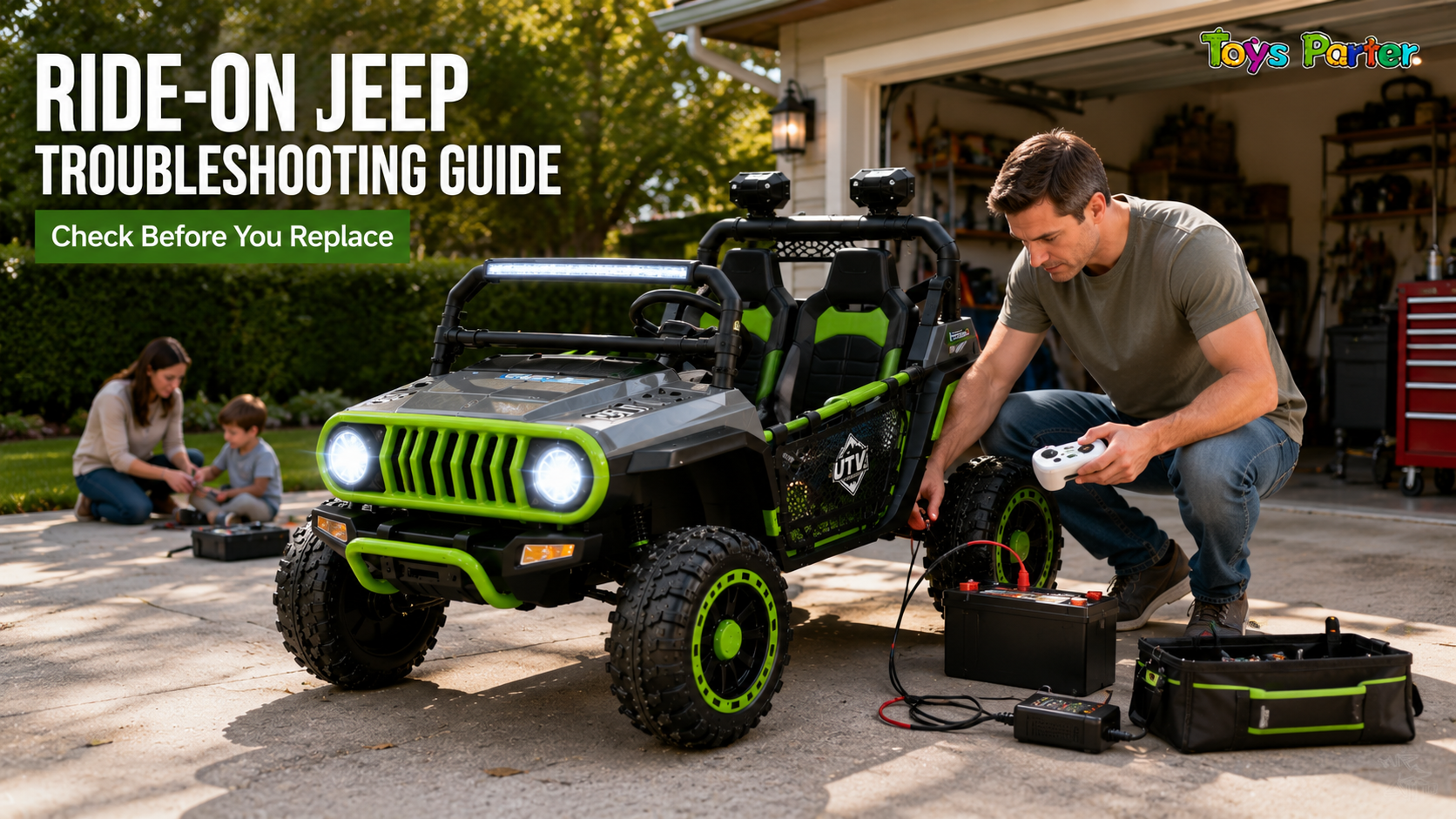
Here’s the good news first: most of the time, a kids’ ride-on Jeep that “won’t work” isn’t actually broken. The overwhelming majority of sudden failures come down to four everyday culprits – a battery that isn’t fully charged, a loose connector, a safety fuse that tripped from overloading, or a control that simply needs to be reset or re-paired. All four are things a parent can usually check in a driveway with no special tools.
This guide walks through the most common problems in the order you should check them, starting with the quickest fixes. It’s written specifically for off-road, Jeep-style ride-on vehicles – the two-seater, four-wheel-drive kind with lockable doors, spring suspension, and a parent remote – because those models have a few quirks (dual motors, higher power draw, two riders) that a basic single-seat ride-on car doesn’t.
A quick safety note before you start: power the vehicle off and unplug the charger before you inspect anything. Keep kids clear while you work. Stick to the checks below and your product manual – if a fix calls for opening the wiring or replacing an electrical part and you’re not comfortable doing it, that’s the point to contact the seller rather than improvise.
Start Here: A 60-Second Diagnostic
Before you chase the wrong problem, answer one question: what still works? The answer narrows things down fast.
What you’re seeing
Most likely area
Jump to
Nothing at all – no lights, no sound, no motion
Battery charge, connection, power switch, or main fuse
Problem 1
Lights and music work, but it won’t drive
Thermal fuse, pedal/shifter switch, or drive system
Problem 2
Drives, but only for a few minutes
Aging or undercharged battery
Problem 3
Won’t charge at all
Charger, charge port, or end-of-life battery
Problem 4
Pulls to one side / one wheel won’t drive
A single motor or its wiring (4WD models)
Problem 5
Grinding, clicking, or screeching
Gears, a loose wheel, or motor seating
Problem 6
Slows on grass or can’t climb the yard
Often normal – sometimes overload or low charge
Problem 7
Remote stopped controlling it
Remote batteries, pairing, range, or mode
Problem 8
Problem 1: Nothing Happens – No Lights, No Sound, No Movement
When the vehicle is completely dead, work through these in order:
Charge it fully, then test again. This sounds obvious, but a partial charge is the single most common cause. A brand-new ride-on often needs a full charge (many manufacturers recommend up to 12 hours) before its first use, and a battery that sat over the winter may read as “dead” until it’s fully topped up.
Do the charger warmth test. Plug the charger into the wall (not the vehicle) and let it sit for an hour. A working charger usually feels slightly warm; if it stays completely cold, the charger – not the vehicle – may be the failed part.
Check the battery connector. On most Jeep-style models the battery lives under the seat or hood. A connector that vibrated loose during rough play will kill all power. Unplug it, look for corrosion, and reseat it firmly.
Confirm the power switch or ignition key. Many of these vehicles have a real key or an on/off switch that doubles as the main power. If it isn’t fully engaged, nothing will respond.
Look for the main fuse. Some models have an inline fuse near the battery terminal (often a small black box on the red wire). A blown one cuts everything; check your manual for its location and rating before replacing it with the same type.
If lights and sound come back after any of these, you’ve found it.
Problem 2: The Lights and Music Work, but It Won’t Drive
This pattern – electronics on, wheels dead – usually means the battery has enough charge for the low-draw features but not the motors, or that a safety cutoff has kicked in.
A tripped thermal fuse is the classic cause on a two-seater. Many ride-ons include a thermal fuse that shuts the motors down when they overheat – and two kids aboard, thick grass, or a hill is exactly the load that triggers it. The fix is usually just patience: let it cool for 10–15 minutes and many will auto-reset. If it keeps tripping, you’re overloading it (see Problem 7).
Check the foot pedal and forward/reverse switch. These are high-use parts and frequent failure points. Grit under the pedal or a shifter switch that vibrated loose can break the connection to the motors.
Rule out a stuck drive system. If you can hear the motors trying but the vehicle won’t budge, the issue is mechanical, not electrical (jump to Problem 5 or 6).
Because doors, seatbelts, and speed limits all play into how hard these vehicles get pushed, it’s worth reinforcing the sameeveryday rules that keep an off-road ride-on safe – they also happen to prevent a lot of overload shutdowns.
Problem 3: It Runs, but Dies After a Few Minutes
Short runtime almost always points at the battery.
Age and charge cycles matter. Most ride-on batteries are sealed lead-acid and last a couple of years with normal use. A battery that once gave an hour and now gives five minutes is simply wearing out.
Deep discharge from storage is a battery killer. Leaving the battery flat for months – over a winter, say – permanently reduces its capacity. This is the most common reason a “barely used” ride-on has a weak battery.
Cold weather temporarily cuts performance. A battery will feel weaker on a 40°F morning than on a warm afternoon, and bounce back as it warms.
Prevention is far cheaper than replacement here, and it’s covered in depth in the guide tocharging, storing, and getting years out of a ride-on battery. The short version: charge fully before first use, recharge every few weeks even in the off-season, and store the battery indoors.
Problem 4: The Battery Won’t Charge
Test the charger first using the warmth check from Problem 1. Chargers fail more often than people expect and are the cheaper part to replace.
Inspect the charge port. A bent pin or debris in the port can stop the connection. Look before you assume the battery is dead.
If the charger works and the battery still won’t hold a charge, the battery has likely reached the end of its life. Replace it with the same voltage and terminal type, and connect it to the same terminals as the original.
A well-built off-road model is usually worth re-batterying rather than replacing – that’s part of what separates a durable vehicle from a disposable one, as theroutine upkeep guide for these vehiclesexplains.
Problem 5: It Pulls to One Side or One Wheel Won’t Drive
This one is specific to four-wheel-drive, dual-motor Jeep-style ride-ons, where each side has its own motor.
Isolate the motor from the control board. With the power off, swap the two motor connectors. If the dead side “moves” to the other wheel, the motor is the problem; if the same wheel stays dead, it’s the wiring or control board.
Check for a loose motor wire. Vibration can back a connector out. Reseat any loose motor connections firmly.
Confirm the wheel is properly retained. If a motor spins but the wheel doesn’t, the retainer nut holding the wheel to the axle may have loosened.
If you’ve isolated a failed motor, that’s a repairable part on most quality models – reach out to thesupport team for the correct replacement rather than guessing.
Problem 6: Grinding, Clicking, or Screeching Noises
Stripped gears are the usual cause of a grinding “blender full of rocks” sound. Plastic drive gears wear down fast when a vehicle is shoved from forward into reverse while still rolling. The fix is typically replacing the motor-and-gearbox assembly (they’re often sold as one unit). The prevention is a simple house rule: come to a full stop before switching direction.
A rhythmic clicking is often just a loose wheel nut or hubcap tapping as the wheel turns – an easy tighten-and-check.
A motor that clicks but won’t drive may not be seated correctly in the wheel; confirm the motor and its wiring are properly fitted.
Problem 7: It Slows Down on Grass or Won’t Climb the Yard
Before you treat this as a fault, know that it’s frequently normal. Ride-on vehicles are speed- and power-limited for safety, and many are designed primarily for flat, firm surfaces. Losing steam on a steep slope or in tall, wet grass is expected behavior, not a defect.
That said, check the honest causes first:
Low charge reduces power well before the battery is fully dead.
Overloading – two riders plus a hill plus thick grass – will bog down or trip the thermal cutoff.
If your yard is genuinely rough and the vehicle is chronically underpowered, the issue may not be a malfunction at all – it may be that a 12V model is being asked to do a 24V job. Thedifference between 12V and 24V power is the difference between “gets stuck on the lawn” and “climbs the backyard with two kids aboard,” which is exactly what the4WD off-road UTV modelsare built for.
Problem 8: The Parent Remote Stopped Working
The 2.4GHz parent remote is a safety net, so it’s worth getting it back online quickly.
Replace the remote’s own batteries – a dying remote is the most common cause and the easiest to miss.
Re-pair the remote. Many vehicles need the remote paired again after a battery swap or a power interruption. Follow the pairing steps in your manual.
Check range and interference. These remotes typically work within about 30 feet; walls and other 2.4GHz devices can cut that down.
Confirm the mode. If the vehicle is set to full manual, the remote override may be switched off. Toggle back to remote/dual mode.
When It’s Not Worth Fixing: Repair vs. Replace
Not every fix is worth the money, and it’s fair to say so. Here’s an honest way to think about it:
Situation
Usually worth repairing?
Charger failed
Yes – cheapest part to replace
Battery worn out on a well-built vehicle
Yes – re-battery and keep riding
Single motor failed, everything else solid
Often yes, especially on quality 4WD models
Stripped gearbox + weak battery on a cheap big-box unit
Frequently no – repairs approach the vehicle’s value
Cracked chassis or repeated failures across parts
Usually no – replace with something built to last
The pattern parents notice over time is this: with a genuinely durable off-road model, you replace the battery, not the vehicle. With a flimsy one, small failures pile up until replacing it makes more sense. If you’ve landed on replacing, thebuyer’s guide to off-road ride-ons covers what actually predicts longevity, and thecurrent best-selling models are a practical starting point.
How to Avoid Most of These Problems in the First Place
A short prevention routine heads off the majority of the issues above:
Charge fully before first use, then recharge every few weeks even in the off-season.
Store the battery indoors, away from freezing or baking temperatures.
Respect the weight limit – an overloaded motor trips fuses and wears out early.
Full stop before reverse to protect the plastic gears.
Keep it dry and wipe off mud, sand, and grit, which work their way into motors and switches.
Match the vehicle to your terrain so it isn’t fighting the ground every session.
Build these into a regularmaintenance habit and most ride-on Jeeps will run for several riding seasons.
9. FAQ Section
Why won’t my kids’ ride-on Jeep move even though the lights turn on?
When the lights and music work but the wheels don’t, the battery usually has enough charge for the low-draw electronics but not the motors, or a thermal fuse has tripped from overloading. Fully charge it, let it cool for 10–15 minutes if it was overworked, and check the foot pedal and forward/reverse switch.
How do I know if the problem is the battery or the charger?
Plug the charger into the wall by itself for an hour. A working charger usually feels slightly warm; if it stays cold, the charger has likely failed. If the charger warms up but the vehicle still won’t run after a full charge, the battery is the more likely culprit.
Where is the fuse on a ride-on Jeep, and how do I reset it?
Many models have a thermal fuse that auto-resets after cooling for 10–15 minutes, plus sometimes an inline fuse near the battery terminal (a small black box on the red wire). Check your product manual for the exact location and rating before replacing any fuse, and always replace with the same type.
My ride-on Jeep is slow – is it broken?
Often not. These vehicles are power- and speed-limited for safety and are designed mainly for flat, firm ground, so slowing on hills or in thick grass is normal. Rule out a low battery and overloading first; chronic underperformance on rough terrain may simply mean the model is underpowered for the yard.
Do I need to re-pair the parent remote after changing the battery? Frequently, yes. Many ride-on vehicles require the remote to be paired again after a battery replacement or power interruption. Replace the remote’s own batteries first, then follow the pairing steps in your manual.
How long do ride-on Jeep batteries last?
Most sealed lead-acid ride-on batteries last a couple of years with normal use. Letting the battery sit fully discharged for months is what shortens that most, so recharge every few weeks even during the off-season.
Can I leave a ride-on Jeep outside in the rain?
It’s best not to. Moisture and grit work their way into motors, switches, and connectors over time. Wipe the vehicle down after muddy play and store it – and especially its battery – indoors.
Is it worth repairing an older ride-on Jeep?
It depends on the vehicle and the failure. A worn battery, failed charger, or single motor is usually worth fixing on a well-built model. When repairs on a cheap unit start approaching its value – a stripped gearbox plus a dead battery, for instance – replacing it is often the smarter call.