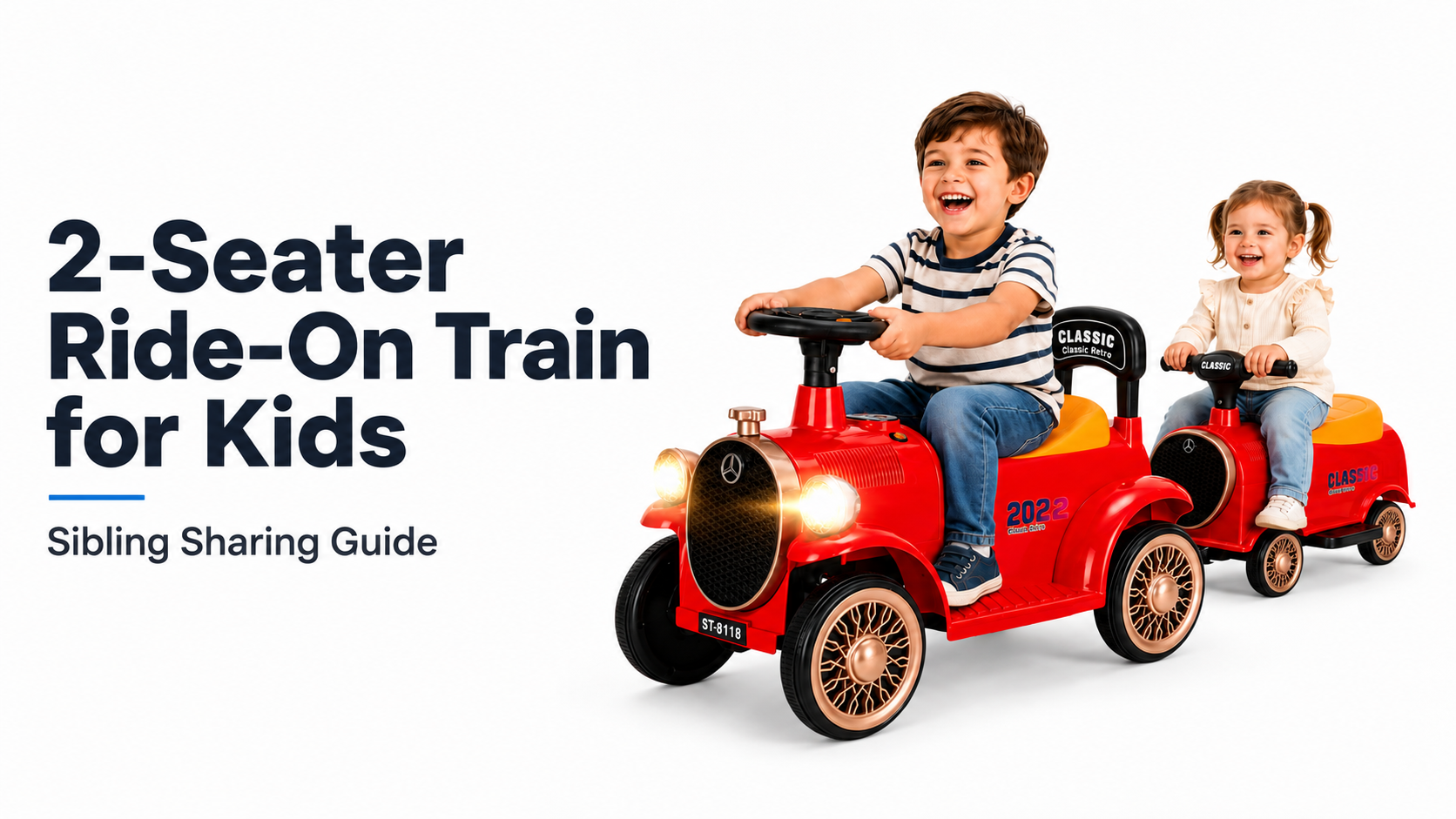
The appeal of a 2-seater ride-on train is obvious when you have two kids and you’re tired of mediating whose turn it is. One vehicle, two children, shared fun – it sounds like a clean solution. In reality, the two-seat format opens up questions the product listing doesn’t fully answer: What happens when one child is three and the other is six? Who controls the steering? What if they disagree on speed? How much heavier is managing two riders on one battery?
This article focuses specifically on the 2-seater experience – the shared riding dynamics, how to set up the vehicle for two children at different developmental stages, how combined weight affects performance and battery life, and the social value that makes this format genuinely different from buying two single-seat vehicles. It’s the practical companion to the purchase decision, written for parents who already know they want the train format.
If you’re still deciding whether a ride-on train is the right format altogether, thecomplete ride-on train buyer’s guide covers voltage decisions, terrain compatibility, age suitability, and safety standards in full before you commit.
Why the 2-Seater Format Changes the Experience Entirely
A single-seat ride-on train is a solo toy. One child in, one experience out. The 2-seater fundamentally changes the social dynamic: it becomes a shared vehicle, and shared vehicles create shared experiences. That distinction sounds minor until you watch two siblings choose to ride together every afternoon instead of competing for screen time or arguing over separate toys.
The imaginative play value of the 2-seater format is also qualitatively different. A child riding alone is the driver of their own train. Two children riding together create roles – driver and passenger, engineer and conductor, the one who honks and the one who watches the route. That division of roles is how young children build collaborative play, and a 2-seater vehicle structures that collaboration naturally without a parent having to engineer it.
The Social Case for One Vehicle Over Two
Many parents instinctively assume that two individual vehicles eliminates conflict – each child has their own, no sharing required. What happens in practice is the opposite: two separate vehicles create a race dynamic where each child is trying to go faster, get somewhere first, or be more impressive than the other. The 2-seater creates interdependence – neither child can go anywhere without the other – which builds cooperation rather than competition.
The more meaningful outdoor play moments tend to happen on shared vehicles precisely because the children have to navigate together. Who steers? When do we turn around? Can we go to the fence and back? These micro-negotiations are the building blocks of social development that individual vehicles don’t generate.
The2-Seater Trackless 12V Ride-On Trainfrom ToysPorter is specifically designed for this shared experience – a retro locomotive-style body wide enough for genuine side-by-side seating, with both riders facing forward in a configuration that supports cooperative rather than competitive play.
The Age Gap Question: What Works and What Doesn’t
The single most common parent concern about 2-seater ride-on toys isn’t the vehicle – it’s whether their children’s ages are compatible enough to share it comfortably. Here’s a practical framework based on developmental stage rather than just numbers.
1 to 2-Year Age Gap: The Ideal Configuration
Children 1–2 years apart in age are developmentally close enough that a single speed setting works well for both. Neither child is bored by the pace appropriate for the other. Both have similar physical dimensions relative to the seat and handlebar ergonomics. And critically, neither child is significantly larger than the other, which means the combined weight is distributed evenly and the motor operates within a consistent load range.
At this gap, the older child naturally takes the steering role and the younger one rides along – which is often exactly the arrangement both children prefer. The younger child gets to participate in something that feels grown-up and exciting; the older child gets the responsibility and control they’re developmentally ready for.
3 to 4-Year Age Gap: Manageable With Adjustment
A 3–4 year gap is workable but requires more active management. The older child will find the lower speed appropriate for the younger one frustrating unless the parental remote allows speed graduation. Use the remote to set a moderate speed ceiling – not the minimum, but not full throttle either – that gives the older child adequate momentum while remaining safe for the younger rider.
Physical size becomes a factor here too. A 7-year-old alongside a 3-year-old on the same seat may find the seating positions uncomfortable over time. Check the seat dimensions against the older child’s proportions before purchasing, and verify the combined weight falls within the vehicle’s rated capacity.
5+ Year Age Gap: Consider Separate Vehicles
Very large age gaps – 5 years or more – rarely produce a good 2-seater experience. The older child is physically too large for a comfortable side-by-side position, operates at a developmental level where slow shared riding feels restrictive, and the younger child isn’t yet able to ride independently if the older one decides they’re done. Separate vehicles or a format better suited to the older child’s age range is typically the better answer at this gap.
Age Gap and 2-Seater Compatibility at a Glance
Age Gap
Riding Compatibility
Management Needed
1–2 years
Excellent – natural driver/passenger fit
Minimal; one speed setting works
3–4 years
Good – manageable with remote control
Use speed lock; monitor seat comfort
5+ years
Challenging – size and pace mismatch
Consider separate vehicles instead
Weight, Battery, and Performance With Two Riders
How Combined Weight Affects the 12V System
A 12V battery system powering two riders draws more current than the same system powering one. The practical effect is a reduction in battery life and – more noticeably – a reduction in performance on outdoor terrain. On flat smooth surfaces, two light riders create only modest additional load. On grass, compacted garden paths, or with one heavier child, the motor works proportionally harder.
The ToysPorter 2-seater train has a combined weight capacity rated for two children within the target age range. Always verify that your children’s combined weight falls within this limit before extended outdoor sessions. Running a motor system above rated load consistently accelerates wear – particularly on the motor brushes and the battery’s internal resistance – shortening the vehicle’s service life.
Realistic Battery Life Expectations With Two Riders
On flat surfaces with two riders well within the weight limit, expect battery life to be approximately 15–25% shorter than the manufacturer’s stated single-rider figure. On outdoor grass terrain with children approaching the upper weight limit, the reduction may reach 30–35%. This is entirely normal and doesn’t indicate a problem – it simply means planning sessions around a realistic 40–55 minutes rather than the stated maximum.
Charge fully after every session. Two-rider sessions deplete the battery more quickly than single-rider use, which makes the ‘charge after every ride’ rule more important, not less. A depleted lead-acid battery stored between sessions without recharging degrades faster under the additional cycling stress of regular dual-rider use.
Setting Up for First Shared Ride: Avoiding the Common Mistakes
Establish the Roles Before the First Ride
Before two children get on the vehicle together, have a brief conversation about who drives and who is the passenger – and what ‘passenger’ actually means. Many first-ride conflicts happen not because of the vehicle but because both children wanted to hold the handlebars simultaneously. A clear role assignment before mounting prevents this.
For the first several sessions, keep the parent remote control speed at the lowest setting. Both children are learning a new experience together, and a slower, more manageable pace reduces the chance of a collision or a sudden stop that unbalances the passenger. Once both children are comfortable with the shared riding experience, increase the speed ceiling incrementally.
Physical Seating Setup
Adjust the vehicle’s position so both children can reach their respective footrests comfortably. In a 2-seater configuration, the driver’s foot pedal (or thumb throttle) should be within reach of the primary rider without stretching, and the passenger’s feet should rest on the footrest platform rather than dangling. Dangling feet can catch on the ground during tight turns, creating a trip hazard that’s entirely preventable with correct seating adjustment.
If one child is significantly smaller than the other, a firm cushion behind the smaller child’s back can bring them forward to a more ergonomically appropriate position. This is particularly relevant for toddler passengers alongside older driver siblings.
Riding Area Boundaries for Two Children
Define a clear riding boundary before the first shared session – ‘you stay between the patio and the garden gate.’ Two children on one vehicle generate more creative route planning than one child alone, which sometimes means more ambitious navigation toward areas that aren’t appropriate. The boundary conversation before the ride sets expectations that both children can reference during the session without requiring constant parental intervention.
For families exploring other ride-on formats alongside the train – to give each child a vehicle in different categories, or to expand the outdoor fleet –ToysPorter’s full electric vehicles range covers ATVs, motorcycles, and trains with free US shipping and a 40-day return window.
The Storage Seat: More Useful Than It Looks
The storage compartment built into the seat of the 2-seater train is frequently listed as a secondary feature, but parents who use it consistently find it one of the more practically valuable design decisions on the vehicle. Here’s how different families tend to use it.
Ride-Along Kit Storage
Children on longer outdoor rides often want to bring things with them – a favourite small toy, a snack, a water bottle. The storage compartment keeps these items accessible without the child holding them (which interferes with steering) or leaving them in the house (which creates trip interruptions to retrieve them). A child who can bring their ‘co-pilot kit’ with them stays outside longer.
Parent Essentials
The storage seat also works as a convenient location for the charger cable when the vehicle is in use, the remote control when not actively needed, or a pair of sunglasses. Small practical details like this reduce the friction of outdoor play sessions, which is one of the underappreciated factors in how often a ride-on toy actually gets used.
Structural Benefit
Beyond storage utility, the closed-top seat with integrated compartment provides more structural rigidity to the seat platform than an open bench design. This means the seat area flexes less under the combined weight of two riders, maintaining consistent geometry over years of use rather than developing the creaks and looseness that open bench designs often develop under sustained load.
Long-Term Value: Getting Years From One Vehicle
The economic case for a quality 2-seater train versus two individual vehicles is clearest over a 3–5 year ownership horizon. Two single-seat ride-ons at the entry level cost less upfront but require eventual replacement for each child as they grow. A single well-maintained 2-seater serves both children through their active riding years from one purchase.
The longevity factors that matter most for a 2-seater are battery maintenance (described above), keeping the combined rider weight within rated limits, and annual mechanical checks. Once per season, check that all four wheel bolts are torqued correctly, that the steering column connection is firm, and that the battery terminals show no corrosion. These checks take 10 minutes and prevent the gradual performance degradation that makes a vehicle feel ‘worn out’ years before it’s structurally at end of life.
A 12V kids train maintained properly – battery charged consistently, stored dry, wheels checked seasonally – realistically provides 3–5 years of active use before the motor or battery reaches genuine end of service. At that point, battery replacement extends the vehicle’s life at a fraction of replacement cost.
CheckToysPorter’s current best-sellers to see which ride-on vehicles are most popular with families at different stages – it’s a useful reference point for understanding what the next vehicle in a child’s outdoor fleet might look like as they age out of the train format.
VisitToysPorter.com for current pricing, seasonal promotions, and the full range of kids electric ride-on vehicles with free US shipping and ASTM F963 safety certification on all models.
Frequently Asked Questions
Can a 2-year-old and a 5-year-old share a ride-on train?
Yes, with some setup care. Use the parental remote to set a speed appropriate for the younger child – typically the lowest setting – and assign the 5-year-old as the driver and the 2-year-old as the passenger. Ensure the 2-year-old’s feet can reach the footrest platform rather than dangling. At a 3-year age gap, this configuration works well for shared sessions, though the older child will likely want solo rides at a higher speed when the younger one isn’t participating.
Does a 2-seater ride-on train need two children to operate?
No – a single child can ride in the driver’s seat and operate the vehicle normally. The 2-seater format simply means the vehicle is designed and structurally rated for two riders. A solo child on a 2-seater experiences the same ride as a single-seat model, just with a wider seat platform. Some children prefer the extra space; others find the wider body slightly less sporty in feel.
How much does combined rider weight affect battery life?
On flat surfaces, two children with a combined weight well within the rated limit create approximately 15–25% shorter battery life compared to the manufacturer’s stated single-rider figure. On outdoor grass terrain or with children near the weight limit, the reduction may reach 30%. Plan outdoor sessions around a realistic 40–55 minutes for regular 2-seater use on mixed terrain, and charge fully after every session.
Who should control the steering on a 2-seater ride-on train?
The older or more developmentally advanced child generally makes the most effective driver. They have better fine motor control for steering, better hazard awareness, and the coordination to manage throttle and direction simultaneously. The younger child in the passenger position still has a full, engaging experience – particularly when the vehicle has sound effects and LED lights that both children can respond to regardless of who’s steering.
What surfaces does the 2-seater 12V train work best on?
Short, dry grass and smooth paved surfaces – driveways, patios, and indoor hard floors – are the optimal surfaces. The 12V motor handles these terrain types reliably with two riders. Thick or wet grass increases motor load significantly and should be used with reduced sessions to prevent motor strain. Avoid loose gravel, deep mulch, and any uneven surface with gaps that could catch the wheel profile.
How do I track my order from ToysPorter?
Use theToysPorter order tracking page – enter your order number and email address for real-time shipping updates. Most US orders arrive within 3–5 business days after dispatch.
The 2-Seater Decision: When Shared Really Is Better
The 2-seater ride-on train earns its place as a family purchase when your children are within a manageable age gap, when you value the collaborative play dynamic over individual independence, and when the practical maths of one quality vehicle versus two lesser ones makes sense for your budget and storage reality.
It’s not the right choice for every family – very large age gaps, children with dramatically different riding preferences, or limited storage space all shift the balance toward individual vehicles. But for families with two young children who are close in age and who naturally gravitate toward shared activities, the 2-seater format delivers an outdoor play experience that individual ride-ons genuinely can’t replicate: the experience of going somewhere together.
Browse the fullride-on train collection or explore all of ToysPorter’s kids electric ride-on vehicles to find the right fit for your family’s outdoor space and your children’s ages.