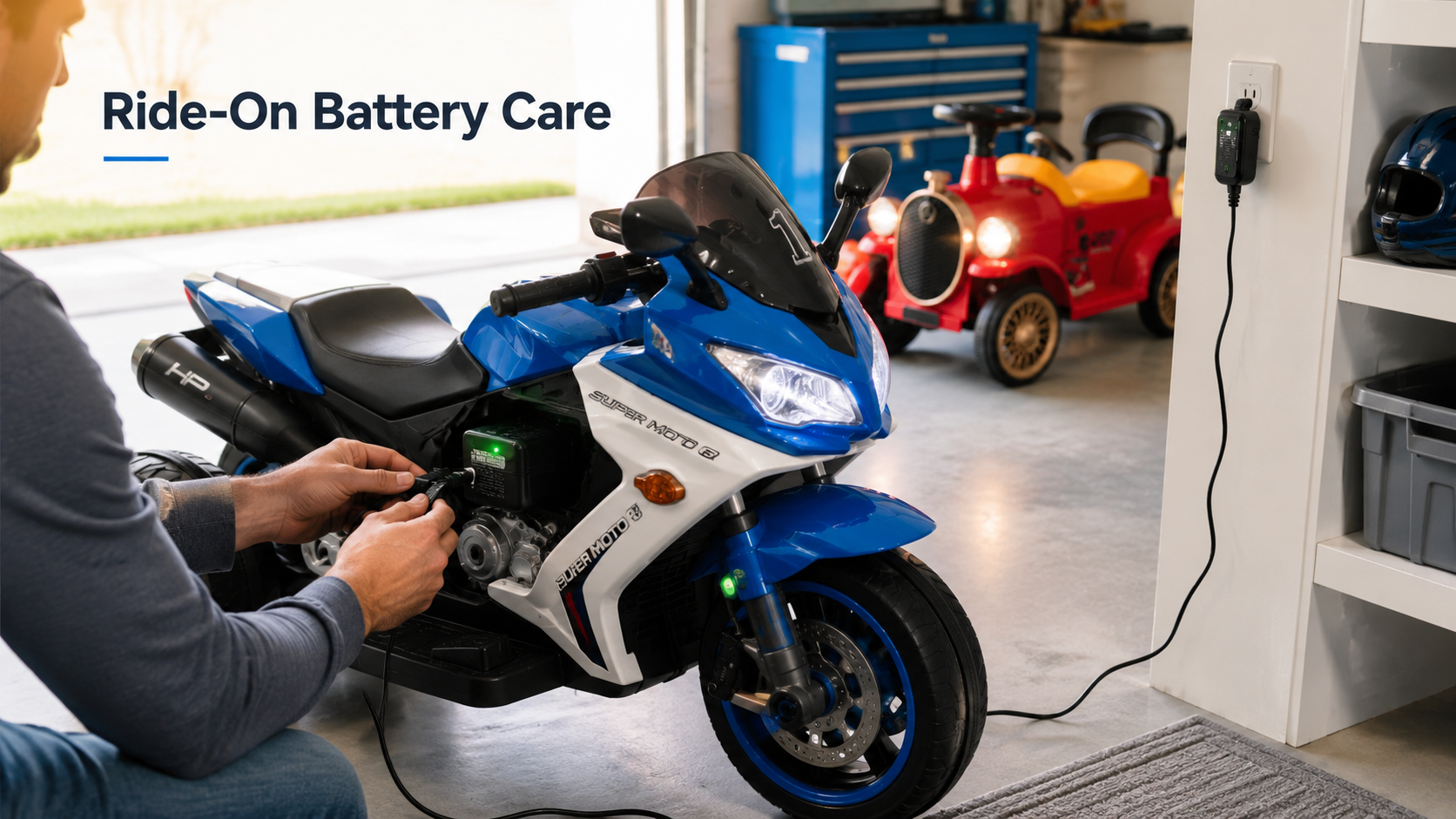
It’s a Saturday morning, the driveway is finally dry, and your kid is buckled onto their favorite ride-on motorcycle (or has commandeered the ride-on train, again) ready for the first real ride of the week – and nothing happens. No lights, no hum from the motor, just a disappointed kid and a parent wondering whether the battery is dead, dying, or just needs a charge. It’s one of the most common frustrations we hear about from ride-on toy owners, and almost all of it is preventable.
Every electric ride-on vehicle – whether it’s a kid-sized motorcycle or a two-seater ride-on train – runs on the same basic principle: a rechargeable battery pack that needs to be charged, used, and stored correctly to perform for years instead of months. This guide walks through exactly how to do that, using the same battery-care standards we share with Toysporter customers directly.
How Ride-On Toy Batteries Actually Work
Most kids’ ride-on vehicles use one of two battery types: sealed lead-acid (SLA) batteries or lithium-ion battery packs. Both are rechargeable, both are designed to be maintenance-light, and both are sized by voltage – typically 6V or 12V for ride-on trains and smaller motorcycles, and 24V for higher-performance motorcycle models built for more power and longer rides.
Voltage determines speed and power, not necessarily how long the battery will run per charge – that depends more on battery capacity (measured in amp-hours), terrain, rider weight, and how the vehicle is driven. A 24V ride-on with a strong motor on grass will typically drain faster than the same battery used on a flat driveway.
Feature
Sealed Lead-Acid (SLA)
Lithium-Ion
Typical charge time
8–12 hours
2–4 hours
Ride time per charge
1–2 hours
1.5–2.5 hours
Weight
Heavier
Lighter
Typical lifespan
1–2 riding seasons
2–4 riding seasons
Best suited for
Entry-level 6V/12V cars
Higher-performance 24V models
Charging Your Ride-On Toy the Right Way
The First Charge Matters Most
Batteries ship partially charged, not fully charged. Before the very first ride, plug in the battery and let it charge fully – typically 8 to 12 hours for lead-acid packs, less for lithium models. Skipping this step is one of the most common reasons a brand-new ride-on toy seems underpowered on day one.
A Simple Weekly Charging Routine
Charge after every ride, not just when the battery seems low – partial-charge cycles are gentler on both battery chemistries than deep discharges.
Use only the charger that came with the vehicle. Chargers are matched to voltage and chemistry, and mixing chargers between models is a common cause of premature battery failure.
Charge on a hard, flat, ventilated surface – a garage shelf or mudroom floor, not carpet or bedding.
Unplug once charging is complete. Most Toysporter chargers include an indicator light that changes color when charging finishes; leaving a battery on the charger for days at a time is unnecessary and, over years, can shorten its life.
How Long Should a Full Charge Last?
As a rule of thumb, 12V models – common on entry-levelRide-On Trains – run about 1 to 1.5 hours of continuous riding, while 24VRide-On Motorcycles typically run 1.5 to 2.5 hours depending on terrain and rider weight. Grass, gravel, and inclines all pull more power than a flat driveway or sidewalk, so expect shorter ride times outdoors on rougher ground. Our full breakdown of motorcycle power specs and what to expect ride-to-ride is covered in ourKids Ride-On Motorcycle Buyer’s Guide.
Signs Your Battery Needs Attention
Not every performance dip means the battery is dying. Here’s how to tell the difference between a battery that simply needs a full charge and one that’s reaching the end of its life:
Slower top speed after a full charge – often a sign the battery is aging and holding less capacity than it used to.
Shorter ride time than usual (for example, 20 minutes instead of the usual hour) even after a full overnight charge.
The vehicle won’t move at all, but lights and sound still work – this is sometimes a loose connector rather than a dead battery, and worth checking before assuming a replacement is needed.
A battery that feels warm to the touch after sitting unused – stop use immediately and consult the vehicle’s manual or contact customer support.
A battery pack that’s visibly swollen, cracked, or leaking – stop charging and using it immediately and replace it before the next ride.
Six Habits That Extend Battery Lifespan
Don’t let the battery sit fully drained for weeks at a time – deep discharge is harder on both SLA and lithium packs than regular partial cycles.
Top off the charge once a month during long breaks from riding, even if the vehicle isn’t being used.
Keep connectors clean and dry – wipe down the charging port occasionally, especially after outdoor rides on grass or dirt.
Avoid charging immediately after a hot ride in direct summer sun – let the battery cool to room temperature first.
Match riding terrain to the vehicle’s rated power. Using an entry-level 12V train on grass or gravel it wasn’t really designed for drains the battery faster and shortens its usable life.
Supervise charging, and never leave a charging battery unattended overnight in an occupied bedroom – the garage, mudroom, or utility area is the right spot.
Storing the Battery Between Rides and Seasons
Short-Term Storage (A Few Days to a Few Weeks)
For everyday breaks in riding – a rainy week, a family trip – there’s nothing special to do beyond making sure the battery isn’t left fully drained. A quick top-off charge before and after the break keeps it ready to go.
Winter Storage: The Step Most Parents Skip
This is where most preventable battery damage happens. Across much of the U.S., ride-on toys get parked in a garage or shed from late fall through early spring – and an unattended battery left at a low charge through a cold winter is one of the single biggest causes of a ride-on motorcycle or train that “suddenly won’t hold a charge” the following spring.
Charge the battery fully before storing it for the season.
Store it indoors if possible – a heated garage, basement, or closet is better than an unheated shed where temperatures swing below freezing.
If the vehicle must stay in an unheated garage, disconnect the battery from the vehicle and bring the battery itself indoors.
Set a reminder to give the battery a top-off charge every 6–8 weeks through the winter – sealed lead-acid batteries in particular self-discharge slowly even when not in use.
Before the first spring ride, give the battery a full 8–12 hour charge and inspect the connectors and casing before letting your child hop back in.
Hot-Weather Considerations
Heat is just as hard on batteries as cold. A garage that hits 100°F+ in summer, or a battery left charging in direct sun, can shorten lifespan and, in rare cases, is a genuine safety risk. Charge and store batteries in a shaded, ventilated space whenever possible – not in a hot car trunk or an un-shaded shed roof.
Battery Safety: What Parents Should Never Do
Toysporter vehicles are ASTM F963 safety-certified, and battery safety is part of that standard. A few non-negotiables apply across every vehicle in the catalog, including theRide on MotorcycleandRide on Trainlines:
Never use a charger from a different model or a different brand – mismatched voltage or amperage is the leading cause of overheating incidents.
Never charge a battery that’s wet, cracked, or visibly damaged.
Never let a child plug in or unplug the charger unsupervised – make charging a parent-only task, the same way you’d treat any other electrical device.
Never charge on a soft or flammable surface like a bed, couch, or pile of blankets.
Never leave a battery charging unattended in an enclosed space overnight.
Ownership Guidance: What Real Toysporter Families Do
Battery habits are easiest to build into an existing routine, which is why several of our other guides touch on it as part of broader ownership advice – ourElectric Motorcycle Ownership Guide and our2-Seater Ride-On Train Sibling Sharing Guideboth include first-weeks setup advice that pairs well with the charging habits above.
Scenario 1: The Weekday Charger
A family in Ohio rides their 24V ride-on motorcycle most weekday afternoons after school. Their routine: plug in the charger the moment the ride ends, unplug it before bed once the indicator light turns green, and give it a full charge again before the weekend. Two riding seasons in, the battery still holds close to its original runtime – because it’s never sitting deeply drained for long, and it’s never overcharged.
Scenario 2: The Forgotten Garage Battery
A different family stored their ride-on train in an unheated Minnesota garage over winter without topping off the charge. By spring, the battery wouldn’t hold more than a few minutes of charge – a textbook case of deep-discharge damage from freezing temperatures. A replacement battery solved it, but a single top-off charge in January would have prevented the issue entirely.
Scenario 3: The Sibling Rotation
Households with two kids sharing one vehicle – common with our two-seater options – tend to drain the battery faster simply because the vehicle gets used more often per day. In these cases, a quick mid-day top-off charge between rides, rather than waiting for a full nightly cycle, keeps the vehicle ready for both kids without over-cycling the battery.
Quick-Reference Battery Care Checklist
Charge fully before first use (8–12 hrs for SLA, 2–4 hrs for lithium).
Charge after every ride – don’t wait for a full drain.
Use only the manufacturer-matched charger.
Charge on a hard, ventilated, adult-supervised surface.
Top off once a month during breaks from riding.
Fully charge and bring indoors before winter storage.
Give a full charge and inspection before the first spring ride.
Replace immediately if the pack is swollen, cracked, or leaking.
When to Replace the Battery
Even with perfect care, batteries are a wear item – expect 1 to 2 riding seasons from a sealed lead-acid pack and 2 to 4 seasons from lithium-ion. If your child’s favorite vehicle is otherwise in good shape but the battery is no longer holding a useful charge, a replacement battery is almost always more cost-effective than replacing the whole vehicle. Check the specific model’s manual for the correct replacement part, and if you’re shopping for a new vehicle altogether, ourBest Sellers collection highlights the models our customers rate highest for long-term durability.
Frequently Asked Questions
How long does a ride-on toy battery last per charge?
Most 12V ride-on toys run 1 to 1.5 hours per full charge, while 24V models typically run 1.5 to 2.5 hours, depending on terrain, rider weight, and driving style. Riding on grass or uneven ground drains the battery faster than flat pavement.
Can I leave my ride-on toy battery charging overnight?
It’s best to charge until the indicator light shows the battery is full, then unplug it. Most chargers are designed to prevent overcharging, but unplugging once charging finishes is still the safest habit, and charging should always happen in a supervised, ventilated space.
How often should I charge the battery even if we’re not riding?
Give the battery a top-off charge roughly once a month during extended breaks from riding, and always store it fully charged before a seasonal break like winter.
Why won’t my ride-on motorcycle or train move even though the lights and sound work?
This is sometimes a loose battery connector or a partially discharged battery rather than a dead one. Check that the connector is fully seated, then give the battery a full charge before assuming it needs replacement.
How should I store the battery over winter?
Charge it fully, then store it indoors – a heated garage, basement, or closet – rather than an unheated shed. Give it a top-off charge every 6 to 8 weeks through the cold months, and fully recharge and inspect it before the first ride of spring.
Is it safe to charge a ride-on toy battery in the garage?
Yes, as long as the surface is hard and ventilated, the charger matches the vehicle, and charging is supervised by an adult. Avoid charging on carpet, bedding, or near flammable materials.
How do I know if the battery needs to be replaced?
Warning signs include a noticeably shorter ride time after a full charge, a battery that feels warm at rest, or a pack that’s visibly swollen, cracked, or leaking. Any of these means it’s time to stop use and replace the battery.
Do lithium batteries really last longer than lead-acid batteries?
Generally yes. Lithium-ion packs typically last 2 to 4 riding seasons compared with 1 to 2 seasons for sealed lead-acid batteries, and they charge faster – usually 2 to 4 hours versus 8 to 12 hours.
Conclusion
A ride-on toy is only as fun as its battery lets it be. The good news is that battery care isn’t complicated – charge after every ride, use the matched charger, avoid deep drains and extreme temperatures, and give the battery a little attention during seasonal storage. Follow that routine and most batteries will comfortably outlast a full riding season, sometimes several. If you’re shopping for a new vehicle or ready to upgrade, explore our full range ofRide-On Motorcycles andRide-On Trains, or browse ourBest Sellers – every model ships ASTM F963 certified with free U.S. shipping and a 40-day return window.