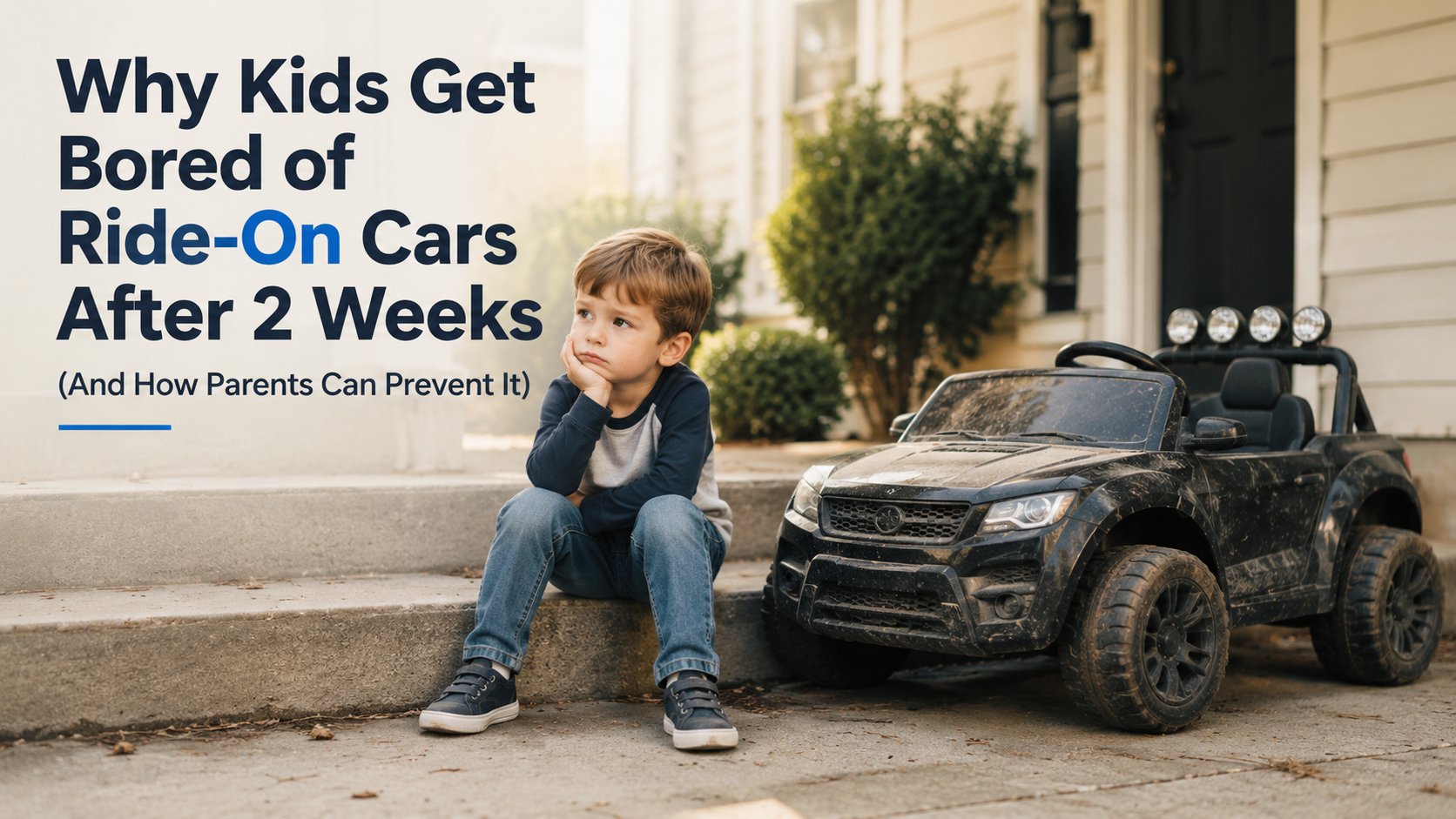
It happens in almost every household. A ride-on toy arrives, the unboxing is a celebration, the first ride is pure joy – and then, somewhere between week two and week four, it quietly migrates to the corner of the garage. Not broken, not disliked, just… ignored. The child has moved on.
For parents who spent real money on what they expected to be a lasting outdoor staple, this is genuinely frustrating. But the abandonment pattern isn’t a mystery – it follows predictable principles of child psychology and play behavior. Understanding those principles doesn’t just explain what went wrong in the past; it gives you a concrete framework for making the next outdoor toy one that actually holds attention across months and years.
This article covers the developmental science behind toy boredom, the specific design and environmental factors that accelerate or delay it, and practical strategies to transform a ride-on vehicle from a two-week novelty into a sustained part of your child’s outdoor routine.
The Psychology of Toy Boredom: Why It Happens So Fast
The Novelty Effect and Dopamine Cycles
When a child receives a new toy, the brain’s reward system responds to novelty itself – not to the toy’s inherent qualities. The activation of dopamine pathways creates the excitement you see at unboxing: the wide eyes, the immediate desire to touch and operate, the refusal to go to bed because they want to keep playing. This is a neurological response to newness, and it’s entirely predictable.
The problem is that the novelty effect has a shelf life. As the brain habituates to the toy’s predictable responses, the dopamine activation decreases. A ride-on car that drove forward, made sounds, and lit up on day one does the same things on day fifteen – but the brain no longer fires the same reward signal because the experience has become expected. Familiarity, which adults often associate with comfort, reads as boredom to the developing nervous system of a 3- or 4-year-old.
Open-Ended vs Closed-Ended Toys: The Depth Problem
Child development researchers broadly categorize toys as open-ended or closed-ended. Open-ended toys – blocks, sandboxes, playdough, dress-up clothes – don’t have a fixed ‘use.’ The child defines the play each session, which means the play changes every day and habituates slowly. Closed-ended toys have a fixed function. A ride-on car goes forward and backward. Press the horn and it honks. Turn the wheel and it steers. Once a child has discovered these functions – typically within the first 3–5 sessions – the toy’s discovery phase is complete.
This doesn’t mean closed-ended toys are bad purchases. It means parents need to understand that the design of a closed-ended ride-on creates an arc: discovery, peak engagement, habituation. The length of that arc depends on how richly the toy’s environment, social context, and parental involvement expand the experience beyond the toy’s fixed functions.
Developmental Stage Mismatch
A toy bought for a child’s current developmental stage can become mismatched surprisingly quickly. Children aged 2–5 develop at a rate that’s difficult to fully appreciate from within daily parenting life. A vehicle that was perfectly challenging at age 3 – requiring concentration to steer, requiring effort to manage the throttle – may feel trivially easy at 3.5 years old. When a toy no longer stretches the child developmentally, engagement collapses almost immediately.
This is why age ranges on ride-on toys matter more than most parents realize. A toy rated for ages 2–8 that genuinely serves that range – through adjustable speed settings, varied terrain capability, and genuine physical challenge across different environments – creates a much longer engagement arc than a toy rated 2–5 that maxes out its developmental ceiling by month three.
Environmental Factors That Accelerate Abandonment
Monotonous Riding Environment
One of the most common and easily preventable causes of ride-on toy abandonment is a fixed, unchanging riding environment. A child who always rides in the same section of the same driveway has exhausted the spatial discovery potential of that environment within a few sessions. The route is memorized, the obstacles are known, and nothing about the space creates surprise or challenge.
Compare this to a child who sometimes rides the driveway, sometimes a garden path, sometimes a paved park area with their parents walking alongside. Each environment changes the steering demands, the surface texture, the spatial navigation challenges, and the social context. The ride-on toy becomes a vehicle for environmental exploration rather than a fixed activity with a fixed context – and environmental exploration doesn’t habituate the same way a fixed routine does.
No Social Context
Solo play is inherently more susceptible to boredom than social play. When a child rides alone, the experience is entirely self-contained – and once the novelty of vehicle control habituates, there’s no social reward maintaining engagement. When two children ride together, or when a child rides alongside a parent on a walk, or when siblings take turns and compete, the social dimension adds a layer of engagement that the toy itself doesn’t generate.
Ride-on toys with 2-seater configurations naturally solve part of this problem by making shared riding the primary format. When two children are always on the vehicle together, the play is cooperative or competitive by default – which changes the experience dynamic every session based on what the children create together rather than what the toy provides.
Adult Disengagement After Initial Setup
Parents naturally front-load their involvement with a new toy – the assembly, the first rides, the enthusiastic encouragement. Then, once the toy is established as ‘working,’ adult involvement often drops to background supervision. For young children who are still learning to generate independent play, this withdrawal can trigger disengagement from an activity they’d happily continue with minimal adult interaction – just not zero.
This doesn’t mean parents need to supervise every second of every ride. It means that periodic re-engagement – riding alongside on a bicycle, creating a simple obstacle course, suggesting a new route, joining for the first few minutes of a session – reactivates the social reward layer and reminds the child that this toy is still part of the active family play repertoire.
How Ride-On Toy Design Affects Long-Term Engagement
Feature Depth vs Feature Width
Two ride-on toys can have the same number of features – lights, sounds, a horn, music – but one will hold attention longer than the other based on feature depth rather than feature width. Feature width is the number of things a toy can do. Feature depth is how much those things can vary or be combined to create different experiences.
A ride-on motorcycle with a horn, LED lights, and background music has feature width. A ride-on motorcycle with a Bluetooth speaker that plays whatever music the family chooses, LED lights that respond to riding speed, and engine sound effects that change with acceleration has feature depth. The second toy creates a different sensory experience each session depending on what music is playing and how the child rides – which slows habituation considerably.
Terrain Capability and Play Range
A ride-on vehicle that works only on smooth pavement confines the child’s play to a specific, limited environment. A vehicle with sufficient motor torque, appropriate tyres, and spring suspension to handle lawn, gravel paths, and mixed outdoor terrain gives the child access to different environments with the same toy – which multiplies the effective play variety without requiring any new purchase.
This is one of the concrete reasons why 24V motors, 4WD configurations, and spring suspension create longer toy lifespans: they expand the physical territory the child can explore rather than confining them to the same square footage of smooth driveway. Different terrain challenges require different riding skills, which maintains developmental stretch across a longer timeframe.
ToysPorter’s ride-on ATV and quad range specifically addresses terrain variety – models with four-wheel motor drive and independent spring suspension handle lawn, packed garden paths, and paved surfaces, expanding the effective play environment considerably beyond what standard ride-on cars manage on identical terrain.
Format Novelty: Different Vehicles for Different Play Modes
Children who own multiple different ride-on formats – a motorcycle, a train, an ATV – don’t divide their engagement across three toys. They switch between them based on mood, context, and the kind of play they want in a given session. The motorcycle format invites speed and solo adventure. The train format invites cooperative play and imaginative roleplay. The ATV invites off-road exploration. Each format activates a different play mode, which maintains overall outdoor play engagement at a much higher level than any single format could sustain alone.
The kids ride-on motorcycle range at ToysPorter and the
ride-on train collection represent these complementary formats – each one creates a genuinely different outdoor play experience that cross-pollinates engagement across the full set.
Seven Practical Strategies to Prevent Ride-On Toy Abandonment
1. Rotate Availability
Don’t make the ride-on toy constantly available. Toys that are always accessible lose their special quality faster than toys that appear periodically. Put the ride-on away for a few days, then bring it back out as an offered activity rather than a permanent fixture. Intermittent availability maintains the toy’s ‘event’ quality rather than letting it become background furniture.
2. Change the Environment
If the current riding environment is a driveway, take the vehicle to a local park, a paved path near a playground, or a family member’s garden. New spatial environments reset the exploration dynamic because the child encounters unfamiliar territory that requires genuine navigation and attention. The same toy in a new place effectively creates a new experience.
3. Create Simple Challenges
Set up a minimal obstacle course with chalk lines, cones, or garden furniture. Give the child a ‘mission’ – drive to the tree and back without leaving the path, or park in the chalk circle on the first try. Goal-directed play with a simple challenge reintroduces the developmental stretch that sustains engagement, and the goals can be progressively updated as the child masters each one.
4. Introduce Social Riding
Arrange rides alongside other children – a neighbourhood playdate centered on the ride-on, cousins visiting, or a sibling-racing format in a safe enclosed space. Social riding changes the dynamic from solo exploration to social performance and cooperation, reactivating the engagement layer that pure solo riding exhausts.
5. Tie Riding to a Routine
‘After dinner, we ride for 20 minutes before bath time’ creates a structured context that removes the decision friction of whether to play. Children who have established play routines engage more consistently with specific toys because the context cues the behavior. The ride-on becomes associated with a specific, anticipated time of day rather than competing for attention moment by moment.
6. Involve the Child in Maintenance
Charging the battery, wiping down the vehicle, checking the wheels – involving a child in simple ownership rituals creates a sense of proprietorship that deepens their relationship with the toy. A child who ‘maintains’ their vehicle has an ownership identity around it that pure passive play doesn’t generate. Even a 4-year-old can wipe down the body with a cloth or plug in the charger with guidance.
7. Match the Vehicle to the Child’s Current Stage
Periodically reassess whether the vehicle is still developmentally matched to the child. If they can navigate the current riding area without any concentration – steering automatically, throttle managed without thought – the toy has been mastered at the current difficulty level. Introduce new terrain, new challenges, or consider whether a more capable vehicle format would re-engage them at a more appropriate developmental level.
For families assessing whether to upgrade or supplement their current ride-on setup, ToysPorter’s full electric vehicles collection is a useful starting point for comparing formats, voltage levels, and terrain capability across the full age range from toddler to pre-teen.
Which Ride-On Toy Types Hold Attention Longest – and Why
Format Engagement Comparison
Not all ride-on formats create equal engagement longevity. Here’s an honest breakdown of what child development research and play behavior patterns suggest about each format:
- terrain. Longer arc when terrain capability supports outdoor exploration.
- Ride-on ATVs and quads: Longer engagement arc due to terrain capability and format novelty. The off-road identity creates sustained play motivation as children imagine themselves in adventure scenarios.
- Electric motorcycles: Strong engagement for children with a natural affinity for the motorcycle format. The solo-rider, upright-posture design rewards developing balance confidence and creates speed-identity play that sustains engagement across a wider age range.
- Ride-on trains: Uniquely strong social engagement, particularly for 2-seater formats. The cooperative play dynamic and imaginative (locomotive) format tap into very different play modes than vehicle formats, creating longer engagement for children who gravitate toward roleplay over pure vehicle operation.
The kids ride-on motorcycle buyer’s guide explores the motorcycle format in depth – including which features create longer-term engagement and what developmental stage benefits the format most, if you’re considering that direction specifically.
Browse ToysPorter’s current best-sellers to see which formats are generating the most sustained positive feedback from families – the ranking reflects real purchase and return data, which is a useful proxy for actual engagement longevity across different toy types.
Frequently Asked Questions
Why do children lose interest in toys so quickly?
The primary mechanism is habituation – the brain’s natural adaptation to repeated stimuli. When a toy’s responses are fully explored and become predictable, the dopamine-driven novelty reward that drove initial excitement no longer fires. For young children with developing nervous systems, this habituation happens faster than most parents expect, particularly with closed-ended toys that have a fixed and discoverable set of functions.
At what age do children have the longest attention spans for ride-on toys?
Generally, children aged 4–7 demonstrate the most sustained engagement with ride-on vehicles. They have sufficient motor coordination to genuinely operate the vehicle independently, enough cognitive development to engage in imaginative play scenarios around it, but haven’t yet developed the critical perspective that causes older children to dismiss ‘baby toys.’ This window is the peak ride-on engagement zone, and toys that remain developmentally appropriate through this range deliver the most play hours per dollar.
Does an expensive ride-on toy hold a child’s attention longer than a budget option?
Price alone doesn’t predict engagement longevity – feature depth, terrain capability, and developmental match are better predictors. A high-priced vehicle with no terrain capability and limited feature depth will be abandoned as fast as a budget alternative. A mid-range vehicle with 4WD, spring suspension, Bluetooth audio, and parental speed control can hold attention for years because it expands the play environment and creates genuinely varied experiences across sessions.
How can I tell if my child is developmentally ready for more challenge on their ride-on toy?
The clearest signal is effortless mastery: when the child navigates the current environment without noticeable concentration, controls the throttle without thinking, and steers automatically rather than deliberately, they’ve reached the ceiling of the current challenge level. At this point, introducing new terrain, creating structured challenges, or considering a more capable vehicle format will re-engage them at a more appropriate developmental level.
Do ride-on toys offer developmental benefits beyond entertainment?
Yes – and these benefits are part of why sustained engagement matters. Regular ride-on toy use develops spatial awareness, hand-eye coordination, cause-and-effect reasoning, risk calibration (judging how fast to go around a corner), and for shared formats, cooperative play and social negotiation. These developmental outputs are the real long-term value of outdoor vehicle play, and they require the sustained engagement that good play strategies support.
Is it worth buying more than one ride-on toy format?
For families with children in the 3–8 age range, yes – different formats genuinely activate different play modes. A motorcycle format and a train format, for example, don’t compete for the same engagement; they serve different moods and contexts. Children with access to multiple formats show higher overall outdoor play frequency than children with a single format, because the variety prevents any single format from fully habituating before the child has an alternative outdoor vehicle option.
The Long Game: Outdoor Toys That Last
The two-week abandonment pattern is real, but it isn’t inevitable. It’s the predictable result of novelty habituation colliding with a toy that was only ever going to deliver novelty value – no terrain depth, no developmental stretch, no environmental variety, no social context. When those elements are present and parents actively maintain them, ride-on toys don’t go to the garage corner. They become fixtures of daily outdoor life.
The most important thing parents can do isn’t choose a more expensive toy. It’s choose a vehicle with genuine feature depth and terrain capability, then invest a small amount of ongoing effort in varying the context and occasionally co-participating in play. Those two factors – good design plus minimal but consistent parental engagement – are what separates the toys children talk about years later from the ones they can’t remember owning.
Explore the full range of kids electric ride-on vehicles at ToysPorter – including ATVs, motorcycles, trains, and more – all built with the terrain capability and feature depth that supports sustained long-term engagement rather than two-week novelty.