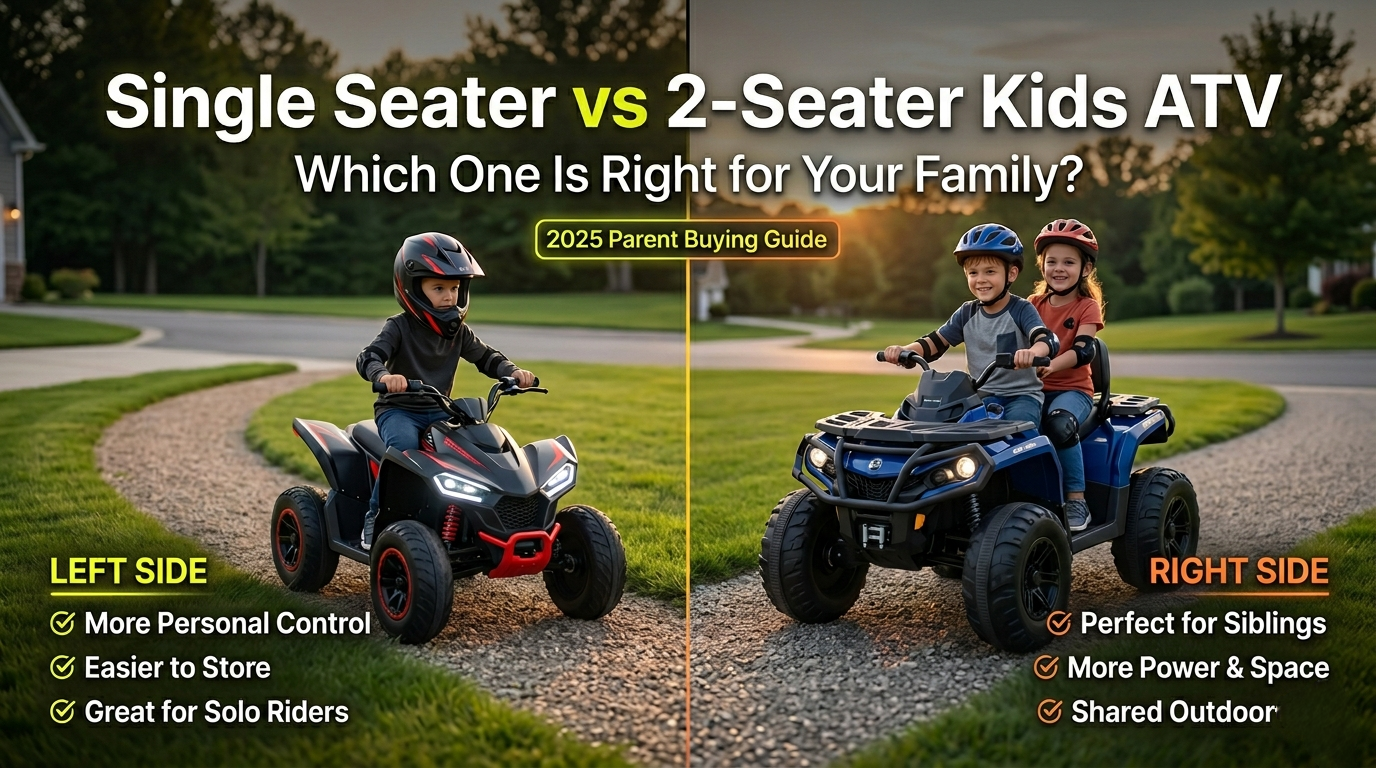
If you have two kids and you’re shopping for a ride-on ATV, the first question you’ll hit is whether to buy one 2-seater or two individual machines. It sounds like a simple math problem-two kids, one vehicle, half the cost-but the real answer involves motor power, battery chemistry, seat configuration, ride experience, and whether two kids arguing over steering is your idea of outdoor fun.
This guide breaks down the actual differences between single-seat and 2-seater kids electric ATVs, including what kind of motor you need to power two riders safely, how battery life is affected by dual occupancy, and which setup genuinely works better for different family situations.
The Core Difference: It’s About Motor Load, Not Just Seat Width
Many parents look at 2-seater ATVs and assume the main upgrade is just a wider body and an extra seat. In reality, the critical engineering difference is the motor system. A single rider on a 12V ATV might weigh 40 lbs. Two children together could easily total 80–120 lbs. That’s two to three times the load, and a motor system that isn’t designed for it will either bog down on any incline or burn out within a few months of regular use.
Quality 2-seater kids ATVs compensate for this with higher voltage-typically 24V-and either a higher-rated single motor or multiple motors working in tandem. The 24V system delivers more torque across a wider RPM range, which is what you need to move heavier combined weight without straining the drivetrain.
Why Voltage Matters More Than Horsepower Marketing
You’ll see ATVs marketed with wattage figures ranging from 100W to 500W. But wattage alone doesn’t tell the full story. Two 150W motors running in sync across four wheels will outperform a single 300W motor on real outdoor terrain, because the torque is distributed across more contact points. Four-wheel drive configurations-where all four wheels have independent motor drive-handle terrain variation much more gracefully than two-wheel configurations where the rear wheels do all the work.
The 24V Ride-On ATV with Remote Control and 4-Wheel Motor System from ToysPorter addresses this directly: it uses a 24V electrical system with a four-wheel motor configuration, delivering genuine 4WD traction that single-motor competitors in the same price range simply can’t match for two-rider loads.
When a 2-Seater Makes Perfect Sense
Siblings Close in Age
This is the clearest use case. When you have two children within 2–3 years of each other, both wanting outdoor ride time, a quality 2-seater eliminates the endless negotiation over whose turn it is. They both ride, they ride together, and outdoor play time becomes a shared experience rather than a managed rotation.
The social dimension of side-by-side riding also changes the experience in ways that most parents genuinely value. Instead of competing for screen time or chasing each other around, siblings on a 2-seater ATV are literally moving through the world together. That creates shared memories that single-player toys rarely generate.
One Child Who Always Wants a Passenger
Some kids want to be drivers. Others prefer to be passengers. If your child consistently invites friends or siblings to join them on everything-including ride-on vehicles-a 2-seater serves that personality trait in a way a single ATV never fully will.
Parents Who Want to Ride Along
Some 2-seater configurations comfortably accommodate one parent alongside a younger child, with the parent either operating the remote or taking over steering if the child is very young. It’s not the primary design intent, but for a cautious parent with a beginning rider, it can be a useful transitional setup.
When a Single Seater (or Two Single Seaters) Is the Better Choice
Children with Very Different Riding Styles
If one child is an aggressive throttle-pusher and the other is cautious, putting them on the same ATV creates constant conflict. The cautious child wants to go slow; the other wants full speed. A 2-seater handles both personalities physically, but managing the experience can be a constant battle. Two separate single-seaters with individual speed controls lets each child ride at their own comfort level.
Significant Age or Size Differences
A two-year age gap is manageable on a 2-seater. A five-year gap usually isn’t-not because the vehicle can’t physically accommodate the different sizes, but because the older child will be bored at the speed appropriate for the younger one. Individual vehicles with age-appropriate settings serve each child better in that situation.
Storage and Space Constraints
2-seater ATVs are substantially larger than single models-typically 30–40% wider and heavier. If your garage or storage area is already crowded, or if the vehicle needs to navigate through a gate or narrow path to reach the riding area, the dimensions matter. Measure before you commit.
Motor and Battery Specs: 2-Seater Requirements
Minimum Power for Two Riders
For two riders with a combined weight of up to 100 lbs, a 24V system with at least 140W total motor power is the minimum you should consider. Below this threshold, you’ll see performance degradation on grass and any incline above about 5 degrees. For heavier combined loads or hillier terrain, 200W+ is a safer target.
Battery Life Under Dual Occupancy
Running two riders at full weight draws more current than single-rider operation. Expect roughly 20–30% reduction in battery life compared to the manufacturer’s stated range when running at rated capacity with two riders. On flat terrain with light riders, this difference narrows considerably. On grass with two heavier children, the reduction can reach 40%.
This matters for planning: a vehicle with a rated 60-minute battery life may realistically deliver 40–45 minutes with two children on varied terrain. That’s still a solid outdoor session, but it’s worth setting expectations accurately.
Charge Time and Daily Use
Most 24V systems used in quality 2-seater ATVs require 8–12 hours to fully charge from a depleted state. For families who want daily riding sessions, charging overnight is the simplest approach. Avoid the habit of topping off a partially depleted battery rather than running it through full cycles-it doesn’t damage lead-acid batteries, but maintaining consistent charge habits extends battery life.
If you’re comparing options across the full 2-seater and single-rider range, the ride-on ATV category at ToysPorter lists all current models with full specifications, making it straightforward to filter by seating configuration and motor voltage.
Safety Considerations for 2-Seater Kids ATVs
Seat Belt and Restraint Systems
A properly designed 2-seater kids ATV includes safety restraints for both occupants-seat belts or a lap bar that prevents a passenger from sliding off during cornering. This is more important for the passenger position than the driver, as the passenger doesn’t have handlebar support to hold onto. Always verify restraint systems before purchase.
Stability and Center of Gravity
Adding a passenger shifts the vehicle’s center of gravity in ways that can affect cornering stability. Quality 2-seater designs account for this through wider wheelbases and lower seat positioning. Be cautious of designs that simply extend the body of a single-rider frame-they may not have been structurally re-engineered for dual-occupant use.
Speed Management for Two Riders
Parental remote control is even more important on a 2-seater, because now you have two children’s safety to manage rather than one. The ability to reduce speed or stop the vehicle remotely when needed is a critical safeguard that no 2-seater should lack.
For families who want to compare 2-seater ATV options alongside the full range of ride-on vehicles-including trucks, UTVs, and motorcycles-ToysPorter’s complete electric vehicles range provides a comprehensive view of every available configuration.
You can also visit the ToysPorter homepage to see current promotions and clearance pricing on 2-seater models-the site regularly features significant discounts on premium vehicles.
Frequently Asked Questions
Q: Can a 2-seater kids ATV handle two riders on grass?
Yes, if the motor system is appropriately rated. A 24V system with 4-wheel motor drive handles two riders on moderate grass well. The key variables are combined rider weight and grass thickness. Dense, wet grass creates significantly more motor load than short, dry turf. For mixed terrain, prioritize vehicles with higher combined wattage ratings.
Q: What’s the weight limit for a 2-seater kids ATV?
Weight limits vary by model, but most quality 2-seater ATVs are rated for a combined load of 110–130 lbs across both seats. Check individual product specifications rather than relying on general category figures, as there’s meaningful variation between models.
Q: Does a 2-seater ATV charge faster than a single?
No-charge time depends on the battery capacity and charger output, not the number of seats. A 24V 10Ah battery takes the same time to charge whether it powers a single-seat or dual-seat vehicle. What changes is how quickly that battery depletes under the additional load of two riders.
Q: Is a 2-seater kids ATV harder to steer than a single?
The additional width of a 2-seater increases the turning radius compared to a narrow single, which can make navigating tight spaces slightly more challenging. For open outdoor spaces-lawns, driveways, parks-this is rarely a problem. For narrow garden paths or tight gates, check the vehicle’s listed dimensions against your available space before purchasing.
Q: What’s the best age gap for sharing a 2-seater ATV?
A one-to-three year age gap works well for 2-seater sharing. Children with similar developmental stages are better matched in terms of appropriate speed and riding style, which reduces conflict. Very large age gaps-five years or more-tend to result in one child being bored or uncomfortable with the other’s pace preferences.
Making the Final Decision
The 2-seater vs single-seat decision ultimately comes down to how your children interact during play. Kids who consistently gravitate toward shared activities, who are close in age, and whose family has adequate storage and riding space will love a quality 2-seater ATV. Kids who prefer their own space, who have significantly different riding maturity levels, or whose ages are far apart are usually better served by individual vehicles.
Either way, the quality of the motor system, the battery specification, and the safety features matter enormously-regardless of how many seats you’re choosing between. Invest in the right specification before worrying about the seat configuration, and you’ll get years of value from the purchase.