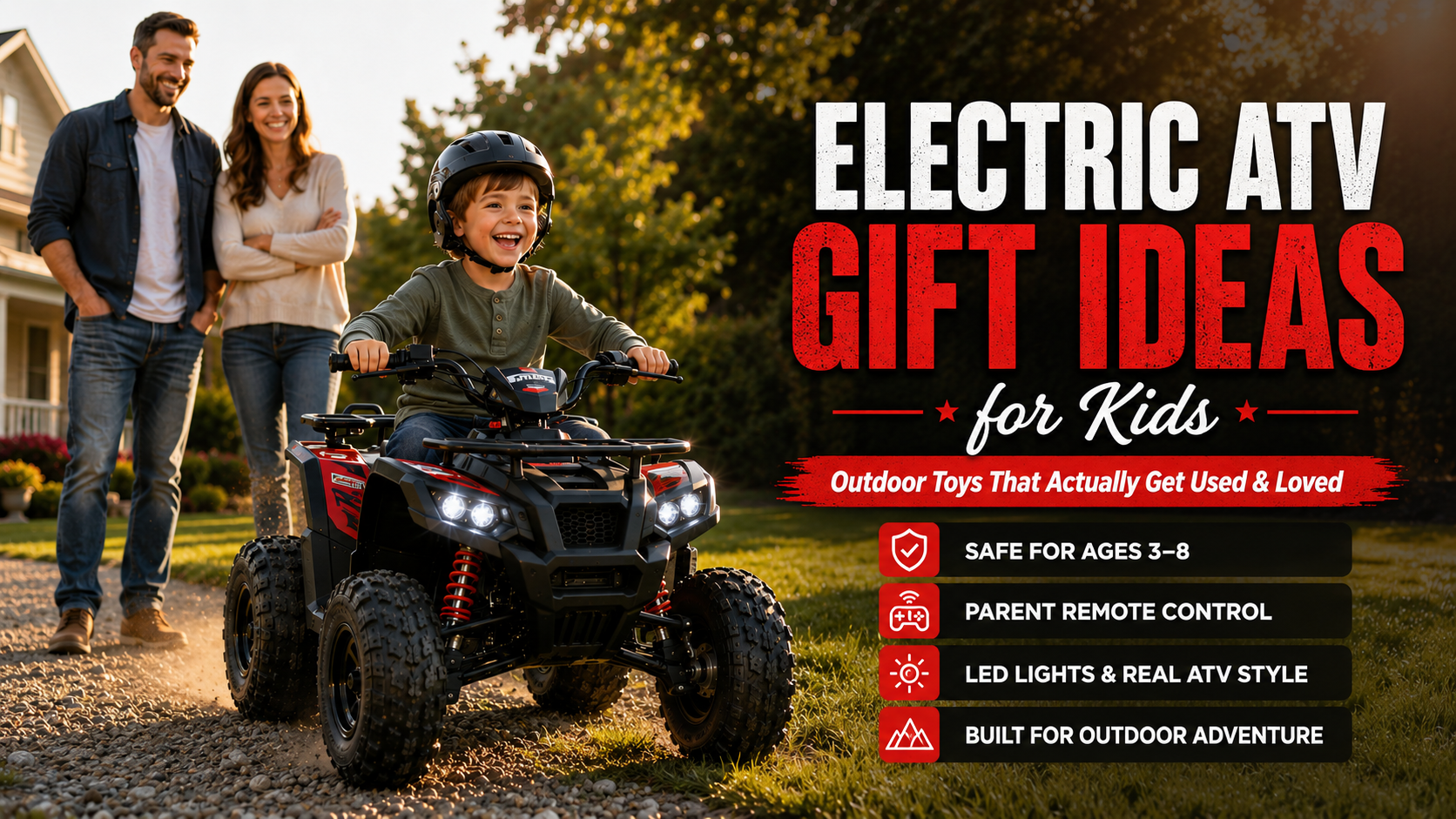
Every parent knows the feeling. You spend real money on a gift that looks incredible in photos, gets genuinely good reviews, and arrives looking exactly as promised-then ends up in the corner of the garage by February. The problem usually isn’t the toy itself. It’s a mismatch between what looked exciting and what actually holds a child’s attention outdoors, across weather, across seasons, and across the endless competition of screens and indoor entertainment.
Electric kids ATVs are one of the few outdoor toy categories that consistently beat that curve. When properly specced for the child’s age and the family’s outdoor space, they don’t get abandoned. They become a fixture of daily outside time. This guide explains why-and helps you pick the right one.
Why Electric Kids ATVs Make the Best Outdoor Gifts
They Create a Reason to Go Outside
The single most common complaint parents have about outdoor toys is that kids need to be pushed to use them. A sandbox gets abandoned when it rains. A trampoline loses its novelty by spring. A quality electric ATV doesn’t have that problem. It moves, it has sound effects and lights, it responds to the child’s inputs, and it goes places. That combination of interactivity and real-world consequence creates intrinsic motivation to go outside and ride.
They Grow With the Child
A well-chosen kids ATV-one with adjustable speed settings, a broad age range, and durable construction-can serve a child from age 3 to age 8 or beyond. That’s five-plus years of use from a single purchase, which changes the cost-per-use calculation entirely. Compare that to most toy categories, where a child’s interest evaporates in weeks.
They’re Genuinely Impressive
There’s a social dimension to outdoor toys that matters to kids-and honestly, to parents too. A child riding a proper 24V electric quad around the neighborhood or backyard naturally draws attention and creates shared outdoor play moments. That social reinforcement extends the toy’s active life considerably.
Matching the ATV to the Child: Age-by-Age Breakdown
Ages 3–4: Learning the Basics
At this age, the priority is safety, simplicity, and parental control. Look for an ATV with a maximum speed under 3 mph, strong parental remote override, a low profile with wide wheelbase for stability, and a simple forward/backward throttle that doesn’t require complex hand coordination. LED lights and sounds are a major hit at this age-the excitement of flashing lights makes even a slow ride feel thrilling.
The Kids ATV 4 Wheeler Electric Ride-On for Ages 3–8 from ToysPorter fits this bracket well. It includes spring suspension for a smooth ride on rough backyard surfaces, LED lighting, and parental remote control-everything a cautious parent needs for confident, supervised outdoor fun.
Ages 5–6: Building Confidence
This is the stage where children start wanting more control and more speed. They’ve mastered basic steering and throttle, and the 2 mph ceiling starts to feel restrictive. An ATV with multi-speed settings lets you step up the challenge gradually. At this age, the quad format becomes more compelling because children start exploring terrain-grass, gravel, garden paths-rather than just riding in a straight line.
Ages 7–8: Ready for Real Off-Road
Older children in this bracket can genuinely handle 4–5 mph on varied terrain. They benefit from a 24V motor system with enough torque to climb mild inclines, push through wet grass, and handle packed dirt without bogging down. Durability becomes the primary concern at this age-harder use demands sturdier construction.
What Makes a Kids ATV Actually Worth the Money
Motor Power and Torque vs. Top Speed
Most toy marketing focuses on top speed, but for genuine outdoor usefulness, torque matters more. A motor with high torque at low RPM handles grass, slight inclines, and varied terrain far better than a high-speed, low-torque motor that performs great on pavement but struggles everywhere else. Check motor wattage-anything under 100W combined will struggle on real outdoor terrain with a child of average weight.
Battery Chemistry and Charge Time
Most kids ATVs in this category use sealed lead-acid (SLA) batteries. They’re heavier than lithium options, but they’re robust, affordable to replace, and well-suited to the charge/discharge patterns of outdoor toy use. Charge time matters more than most parents realize-a 12-hour charge time isn’t a deal-breaker if you plug in overnight, but if you’re using it daily you’ll want to know whether the battery can sustain that cycle rate without degrading quickly.
Tires: Pneumatic vs. EVA Foam
Pneumatic (air-filled) tires offer the best outdoor ride quality-they absorb vibration, provide grip on varied surfaces, and handle edges and bumps gracefully. EVA foam tires are maintenance-free (no punctures) but transfer more vibration to the rider and typically offer less grip on wet surfaces. For primarily outdoor use on mixed terrain, pneumatic is the better choice when the rest of the build quality supports it.
Build Material: Checking for Long-Term Durability
The body shell of most kids ATVs is ABS plastic-which is fine, as long as it’s adequately thick. Thin plastic cracks under the kind of contact a young rider will subject it to. The frame and axle components are more critical. Metal axles and reinforced connection points between the frame and motor housing are signs of a toy designed for genuine outdoor durability rather than display-only aesthetics.
Browse the full range of kids ride-on ATVs at ToysPorter to compare specifications side by side-battery voltage, motor configuration, weight capacity, and age recommendations are all listed clearly for each model.
Setting Up for Success: Making the Gift Experience Great
Prepare the Riding Area
Before the first ride, walk the planned riding area and identify hazards-slopes steeper than about 15 degrees, hard obstacles at wheel height, gaps in fencing that a child could exit through. Mark or block off any areas that should be off-limits until the child has developed more skill.
First Ride Protocol
Don’t hand the controller to the child on day one. Start with the parental remote set to its lowest speed and let the child learn steering while you control pace. This prevents the overwhelming frustration of a child who drives straight into a fence at full speed in their first ten minutes. Within a few sessions, most children are ready to control their own speed progressively.
Safety Gear That Actually Gets Worn
A helmet is non-negotiable even at low speeds. At 3–4 mph, a fall from a moving ATV onto concrete or gravel causes real injury. Look for helmets designed for cycling or skateboarding-they’re designed for exactly this kind of lateral and frontal impact. Knee and elbow pads are worth adding for younger riders or harder surfaces.
Comparing the Top Gift-Worthy Kids ATVs
What to Look For at a Glance
When comparing electric kids ATVs for gift giving, the five features that matter most are: age appropriateness (don’t buy an 8+ model for a four-year-old), parental remote control, spring suspension, battery voltage, and safety certification. A model that checks all five boxes is genuinely gift-worthy. One that skips two or more will disappoint.
For families exploring all ride-on options-not just ATVs-ToysPorter’s full electric vehicles range includes trucks, UTVs, and motorcycles alongside ATVs, all with US shipping and easy returns within 40 days.
You can also explore the complete ToysPorter collection, which features current deals and clearance pricing on premium kids electric vehicles throughout the year.