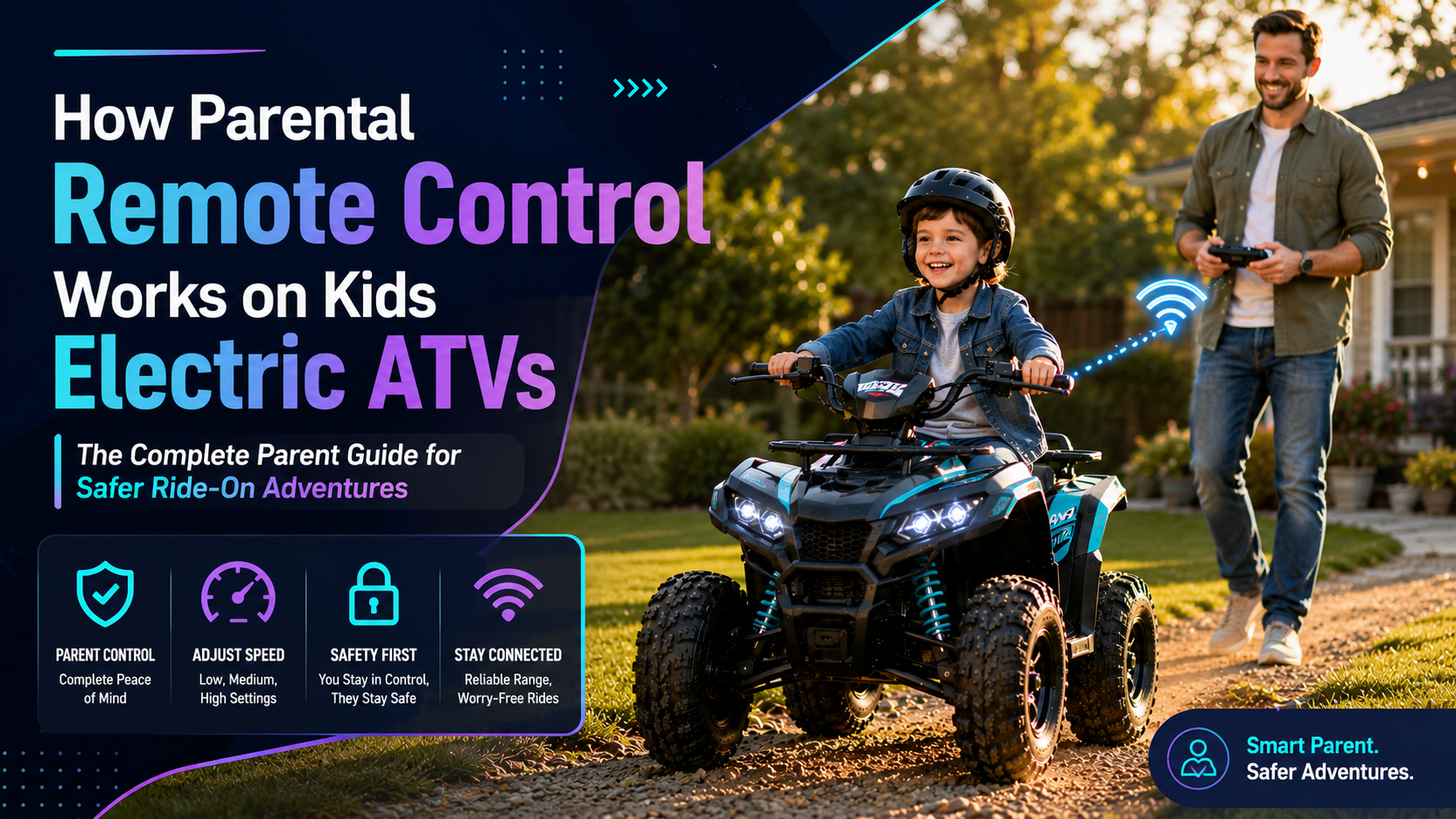
If you’ve been comparing kids electric ATVs online and noticed that ‘parental remote control’ appears as a selling point on virtually every product in the category, you might be wondering what it actually means in practice. Does it function like a video game controller? Can you steer the vehicle remotely? What happens if the signal drops? And is it genuinely useful, or mainly a marketing checkbox?
This guide answers all of those questions. We’ll cover how the technology works, what functions you can actually control, when it’s most useful during a child’s development, and what to look for in a remote system when choosing a vehicle. Understanding this feature properly will help you use it correctly-and choose the right ATV in the first place.
What Does Parental Remote Control Actually Do?
The Basic Function: Speed and Stop
The core function of most parental remote systems on kids electric ATVs is speed management and emergency stop. You can set a maximum speed from the remote-usually in two or three preset levels-and you can bring the vehicle to a complete stop instantly if needed. This addresses the most common parental concern: the child heading somewhere they shouldn’t, faster than you can intervene on foot.
Advanced Remote Functions
Higher-quality remote systems go beyond basic stop/start to include: directional control (you can steer the vehicle remotely), forward and reverse selection from the remote, horn activation, and sometimes LED light control. The practical value of directional remote control is high-it allows you to guide the vehicle back to you if the child is confused about how to reverse or turn around.
What Remote Control Doesn’t Do
Parental remote control doesn’t eliminate the child’s ability to operate the vehicle. In most configurations, the child retains primary control, and the remote functions as an override layer. When you push stop on the remote, the vehicle stops regardless of what the child’s throttle is doing. When you adjust speed via remote, the vehicle’s maximum speed changes while the child’s pedal control still functions within that new limit.
How the Technology Works: RF vs Bluetooth
RF (Radio Frequency) Remote Systems
Most parental remote controls on ride-on ATVs use 2.4GHz radio frequency technology-the same frequency band used by Wi-Fi and most wireless devices. RF signals penetrate through objects reliably and work at distances of 30–100 feet depending on the quality of the transmitter and receiver. For backyard use, RF range is rarely a limitation.
RF remote systems don’t require pairing in the Bluetooth sense-they use a fixed channel that the vehicle is tuned to receive. This makes them more reliable in environments with multiple wireless devices but also means there’s a small theoretical risk of interference from other RF sources.
Bluetooth Remote Systems
Some higher-end kids ATVs use Bluetooth for parental control. Bluetooth offers lower latency than RF in controlled conditions, and some systems integrate the remote control function into a smartphone app rather than requiring a dedicated remote handset. The practical downside is that Bluetooth range is more limited (typically 30 feet for reliable operation) and can be affected by obstacles between the phone and the vehicle.
What Matters Most: Latency and Reliability
In practice, what matters is how quickly the vehicle responds to your stop command when it matters. A system with high latency-where the stop signal takes a second or more to reach the vehicle-is significantly less useful in an emergency situation than one that responds in milliseconds. When evaluating remote systems, response time and signal reliability matter more than the underlying technology.
The 24V 4-Wheel Motor Kids ATV with Parental Remote Control from ToysPorter uses a 2.4GHz remote system with multi-function control including speed adjustment, direction override, and emergency stop-all from a single handset with ergonomic design that actually works in practice.
Using Parental Remote Control Effectively: Stage by Stage
Stage 1: Full Remote Control (Ages 3–4, First Rides)
When a young child first gets on a ride-on ATV, handing them full throttle control immediately is a mistake that creates a chaotic first experience. Use the first several sessions with the remote controlling the vehicle’s speed entirely, while the child focuses only on steering. This separates the learning of two different skills-directional control and throttle management-so neither one overwhelms the child.
At this stage, the remote’s value is essentially 100%: you’re operating the vehicle, the child is steering, and you’re building their confidence gradually in a controlled way. Set maximum speed to the lowest setting and keep the vehicle on flat, clear terrain.
Stage 2: Graduated Independence (Ages 4–5)
Once the child can reliably navigate a clear path and understands basic stopping, transition to letting them control the throttle with the remote set at low-speed maximum. Your role shifts from primary operator to safety override. Watch for situations where the child is heading toward a hazard and use the remote stop function as needed.
This stage typically lasts several weeks to months depending on the child’s pace of learning. Don’t rush it-the goal isn’t speed, it’s consistent, confident vehicle management.
Stage 3: Remote as Safety Net (Ages 5+)
By the time a child has 20–30 hours of ride time, the remote is primarily a safety net rather than an active control tool. You keep it in hand during rides in unfamiliar areas or when terrain changes, but you’re intervening less and less. The key value at this stage is the psychological safety it provides the parent-knowing you can stop the vehicle instantly even if you’re not right next to the child.
Parental Remote Maintenance: What Parents Don’t Think About
Battery Management
Remote controls run on AA or AAA batteries-obvious, but frequently overlooked. A remote with depleted batteries will behave intermittently before failing entirely, which is the worst possible scenario: you think you have control but you don’t. Replace remote batteries at the start of each riding season and check them monthly during heavy use periods.
Signal Pairing and Range Checks
Before each riding session in a new location, do a quick range test: walk to the farthest point of the intended riding area and verify that stop and speed commands work cleanly. If you’re at the edge of range, you’ll notice a slight delay before response. Know your reliable control distance before your child rides to the boundary of it.
Avoiding Signal Interference
In neighborhoods with heavy Wi-Fi density or near commercial wireless equipment, 2.4GHz interference can occasionally cause remote response issues. If you notice intermittent remote behavior in a specific location, try a different riding area or check whether nearby wireless equipment is operating on the same frequency. Switching to channel 2 or 3 on your router (if it’s the source) can also help.
Parents exploring the full range of ride-on options with parental remote control will find a comprehensive selection in ToysPorter’s ride-on ATV category-all models with remote control are clearly labeled, making it easy to filter by this feature.
Remote Control vs No Remote Control: Is It Really Necessary?
For children under 6, parental remote control is genuinely important-not optional. The developmental stage means children have limited hazard awareness, limited impulse control, and limited physical ability to stop a moving vehicle quickly if they panic. The remote fills all three gaps.
For children aged 6 and above with established riding experience, the remote becomes less operationally critical but still has value as a safety backup. Many parents of older children keep the remote available but rarely use it-which is exactly the right outcome of the graduated independence approach described above.
A vehicle without parental remote sold to parents of young children is a vehicle that requires more intensive physical supervision, faster parent response times, and more limited riding environments. For most families, the added cost of a good remote system is one of the better investments in the purchase.
For families comparing electric ride-on options beyond just ATVs-including trucks and UTVs with parental remote features-ToysPorter’s complete ride-on electric vehicles range provides a full view of available configurations with remote control support.
You can explore the full ToysPorter store to find current deals on remote-controlled kids electric vehicles, with free US shipping on all orders.
Frequently Asked Questions
Q: Can parental remote control override the child’s accelerator?
Yes-in properly designed systems, the remote override is absolute. When you press stop on the remote, the vehicle stops regardless of whether the child has the throttle fully depressed. The remote’s command takes priority over the child’s pedal input.
Q: What happens if the remote signal is lost?
Most quality systems default to maintaining the vehicle’s last commanded state rather than cutting power entirely (which could cause an abrupt stop on uneven terrain) or allowing the vehicle to accelerate without limit. In practice, brief signal interruptions are typically handled gracefully by the vehicle’s receiver logic.
Q: How far does the parental remote control work?
Range varies by system quality and environmental conditions. Most 2.4GHz RF systems provide reliable operation within 30–100 feet on open terrain. Walls, dense vegetation, and other obstacles reduce effective range. For typical backyard use, 30–50 feet is usually sufficient.
Q: Can my child’s friends also control my child’s ATV with their own vehicle’s remote?
On most consumer-grade systems, the vehicle and remote are paired at the factory or during setup. Interference between adjacent vehicles is generally not a problem in practice, as each remote and receiver combination operates on a specific frequency or channel. If you’re in a situation where multiple identical vehicles are being used simultaneously, check the pairing protocol for each model.
Final Word: Remote Control as a Confidence Builder-for Parents
The most underappreciated value of parental remote control isn’t the safety it provides to the child-it’s the confidence it gives the parent. When you know you can intervene instantly, you naturally allow more independence. You let the child explore more, go a bit faster, and ride in more interesting environments, because you know the failsafe is in your hand.
That relaxed parental confidence translates directly into a better riding experience for the child. Kids read parental anxiety clearly. When you’re relaxed because you have control, they ride with more freedom and develop more quickly. The remote isn’t just a safety tool-it’s an enabler of genuine outdoor independence, at exactly the pace that works for both parent and child.
If you’ve been comparing kids electric ATVs online and noticed that ‘parental remote control’ appears as a selling point on virtually every product in the category, you might be wondering what it actually means in practice. Does it function like a video game controller? Can you steer the vehicle remotely? What happens if the signal drops? And is it genuinely useful, or mainly a marketing checkbox?
This guide answers all of those questions. We’ll cover how the technology works, what functions you can actually control, when it’s most useful during a child’s development, and what to look for in a remote system when choosing a vehicle. Understanding this feature properly will help you use it correctly-and choose the right ATV in the first place.
What Does Parental Remote Control Actually Do?
The Basic Function: Speed and Stop
The core function of most parental remote systems on kids electric ATVs is speed management and emergency stop. You can set a maximum speed from the remote-usually in two or three preset levels-and you can bring the vehicle to a complete stop instantly if needed. This addresses the most common parental concern: the child heading somewhere they shouldn’t, faster than you can intervene on foot.
Advanced Remote Functions
Higher-quality remote systems go beyond basic stop/start to include: directional control (you can steer the vehicle remotely), forward and reverse selection from the remote, horn activation, and sometimes LED light control. The practical value of directional remote control is high-it allows you to guide the vehicle back to you if the child is confused about how to reverse or turn around.
What Remote Control Doesn’t Do
Parental remote control doesn’t eliminate the child’s ability to operate the vehicle. In most configurations, the child retains primary control, and the remote functions as an override layer. When you push stop on the remote, the vehicle stops regardless of what the child’s throttle is doing. When you adjust speed via remote, the vehicle’s maximum speed changes while the child’s pedal control still functions within that new limit.
How the Technology Works: RF vs Bluetooth
RF (Radio Frequency) Remote Systems
Most parental remote controls on ride-on ATVs use 2.4GHz radio frequency technology-the same frequency band used by Wi-Fi and most wireless devices. RF signals penetrate through objects reliably and work at distances of 30–100 feet depending on the quality of the transmitter and receiver. For backyard use, RF range is rarely a limitation.
RF remote systems don’t require pairing in the Bluetooth sense-they use a fixed channel that the vehicle is tuned to receive. This makes them more reliable in environments with multiple wireless devices but also means there’s a small theoretical risk of interference from other RF sources.
Bluetooth Remote Systems
Some higher-end kids ATVs use Bluetooth for parental control. Bluetooth offers lower latency than RF in controlled conditions, and some systems integrate the remote control function into a smartphone app rather than requiring a dedicated remote handset. The practical downside is that Bluetooth range is more limited (typically 30 feet for reliable operation) and can be affected by obstacles between the phone and the vehicle.
What Matters Most: Latency and Reliability
In practice, what matters is how quickly the vehicle responds to your stop command when it matters. A system with high latency-where the stop signal takes a second or more to reach the vehicle-is significantly less useful in an emergency situation than one that responds in milliseconds. When evaluating remote systems, response time and signal reliability matter more than the underlying technology.
The 24V 4-Wheel Motor Kids ATV with Parental Remote Control from ToysPorter uses a 2.4GHz remote system with multi-function control including speed adjustment, direction override, and emergency stop-all from a single handset with ergonomic design that actually works in practice.
Using Parental Remote Control Effectively: Stage by Stage
Stage 1: Full Remote Control (Ages 3–4, First Rides)
When a young child first gets on a ride-on ATV, handing them full throttle control immediately is a mistake that creates a chaotic first experience. Use the first several sessions with the remote controlling the vehicle’s speed entirely, while the child focuses only on steering. This separates the learning of two different skills-directional control and throttle management-so neither one overwhelms the child.
At this stage, the remote’s value is essentially 100%: you’re operating the vehicle, the child is steering, and you’re building their confidence gradually in a controlled way. Set maximum speed to the lowest setting and keep the vehicle on flat, clear terrain.
Stage 2: Graduated Independence (Ages 4–5)
Once the child can reliably navigate a clear path and understands basic stopping, transition to letting them control the throttle with the remote set at low-speed maximum. Your role shifts from primary operator to safety override. Watch for situations where the child is heading toward a hazard and use the remote stop function as needed.
This stage typically lasts several weeks to months depending on the child’s pace of learning. Don’t rush it-the goal isn’t speed, it’s consistent, confident vehicle management.
Stage 3: Remote as Safety Net (Ages 5+)
By the time a child has 20–30 hours of ride time, the remote is primarily a safety net rather than an active control tool. You keep it in hand during rides in unfamiliar areas or when terrain changes, but you’re intervening less and less. The key value at this stage is the psychological safety it provides the parent-knowing you can stop the vehicle instantly even if you’re not right next to the child.
Parental Remote Maintenance: What Parents Don’t Think About
Battery Management
Remote controls run on AA or AAA batteries-obvious, but frequently overlooked. A remote with depleted batteries will behave intermittently before failing entirely, which is the worst possible scenario: you think you have control but you don’t. Replace remote batteries at the start of each riding season and check them monthly during heavy use periods.
Signal Pairing and Range Checks
Before each riding session in a new location, do a quick range test: walk to the farthest point of the intended riding area and verify that stop and speed commands work cleanly. If you’re at the edge of range, you’ll notice a slight delay before response. Know your reliable control distance before your child rides to the boundary of it.
Avoiding Signal Interference
In neighborhoods with heavy Wi-Fi density or near commercial wireless equipment, 2.4GHz interference can occasionally cause remote response issues. If you notice intermittent remote behavior in a specific location, try a different riding area or check whether nearby wireless equipment is operating on the same frequency. Switching to channel 2 or 3 on your router (if it’s the source) can also help.
Parents exploring the full range of ride-on options with parental remote control will find a comprehensive selection in ToysPorter’s ride-on ATV category-all models with remote control are clearly labeled, making it easy to filter by this feature.
Remote Control vs No Remote Control: Is It Really Necessary?
For children under 6, parental remote control is genuinely important-not optional. The developmental stage means children have limited hazard awareness, limited impulse control, and limited physical ability to stop a moving vehicle quickly if they panic. The remote fills all three gaps.
For children aged 6 and above with established riding experience, the remote becomes less operationally critical but still has value as a safety backup. Many parents of older children keep the remote available but rarely use it-which is exactly the right outcome of the graduated independence approach described above.
A vehicle without parental remote sold to parents of young children is a vehicle that requires more intensive physical supervision, faster parent response times, and more limited riding environments. For most families, the added cost of a good remote system is one of the better investments in the purchase.
For families comparing electric ride-on options beyond just ATVs-including trucks and UTVs with parental remote features-ToysPorter’s complete ride-on electric vehicles range provides a full view of available configurations with remote control support.
You can explore the full ToysPorter store to find current deals on remote-controlled kids electric vehicles, with free US shipping on all orders.
Frequently Asked Questions
Q: Can parental remote control override the child’s accelerator?
Yes-in properly designed systems, the remote override is absolute. When you press stop on the remote, the vehicle stops regardless of whether the child has the throttle fully depressed. The remote’s command takes priority over the child’s pedal input.
Q: What happens if the remote signal is lost?
Most quality systems default to maintaining the vehicle’s last commanded state rather than cutting power entirely (which could cause an abrupt stop on uneven terrain) or allowing the vehicle to accelerate without limit. In practice, brief signal interruptions are typically handled gracefully by the vehicle’s receiver logic.
Q: How far does the parental remote control work?
Range varies by system quality and environmental conditions. Most 2.4GHz RF systems provide reliable operation within 30–100 feet on open terrain. Walls, dense vegetation, and other obstacles reduce effective range. For typical backyard use, 30–50 feet is usually sufficient.
Q: Can my child’s friends also control my child’s ATV with their own vehicle’s remote?
On most consumer-grade systems, the vehicle and remote are paired at the factory or during setup. Interference between adjacent vehicles is generally not a problem in practice, as each remote and receiver combination operates on a specific frequency or channel. If you’re in a situation where multiple identical vehicles are being used simultaneously, check the pairing protocol for each model.
Final Word: Remote Control as a Confidence Builder-for Parents
The most underappreciated value of parental remote control isn’t the safety it provides to the child-it’s the confidence it gives the parent. When you know you can intervene instantly, you naturally allow more independence. You let the child explore more, go a bit faster, and ride in more interesting environments, because you know the failsafe is in your hand.
That relaxed parental confidence translates directly into a better riding experience for the child. Kids read parental anxiety clearly. When you’re relaxed because you have control, they ride with more freedom and develop more quickly. The remote isn’t just a safety tool-it’s an enabler of genuine outdoor independence, at exactly the pace that works for both parent and child.If you’ve been comparing kids electric ATVs online and noticed that ‘parental remote control’ appears as a selling point on virtually every product in the category, you might be wondering what it actually means in practice. Does it function like a video game controller? Can you steer the vehicle remotely? What happens if the signal drops? And is it genuinely useful, or mainly a marketing checkbox?
This guide answers all of those questions. We’ll cover how the technology works, what functions you can actually control, when it’s most useful during a child’s development, and what to look for in a remote system when choosing a vehicle. Understanding this feature properly will help you use it correctly-and choose the right ATV in the first place.
What Does Parental Remote Control Actually Do?
The Basic Function: Speed and Stop
The core function of most parental remote systems on kids electric ATVs is speed management and emergency stop. You can set a maximum speed from the remote-usually in two or three preset levels-and you can bring the vehicle to a complete stop instantly if needed. This addresses the most common parental concern: the child heading somewhere they shouldn’t, faster than you can intervene on foot.
Advanced Remote Functions
Higher-quality remote systems go beyond basic stop/start to include: directional control (you can steer the vehicle remotely), forward and reverse selection from the remote, horn activation, and sometimes LED light control. The practical value of directional remote control is high-it allows you to guide the vehicle back to you if the child is confused about how to reverse or turn around.
What Remote Control Doesn’t Do
Parental remote control doesn’t eliminate the child’s ability to operate the vehicle. In most configurations, the child retains primary control, and the remote functions as an override layer. When you push stop on the remote, the vehicle stops regardless of what the child’s throttle is doing. When you adjust speed via remote, the vehicle’s maximum speed changes while the child’s pedal control still functions within that new limit.
How the Technology Works: RF vs Bluetooth
RF (Radio Frequency) Remote Systems
Most parental remote controls on ride-on ATVs use 2.4GHz radio frequency technology-the same frequency band used by Wi-Fi and most wireless devices. RF signals penetrate through objects reliably and work at distances of 30–100 feet depending on the quality of the transmitter and receiver. For backyard use, RF range is rarely a limitation.
RF remote systems don’t require pairing in the Bluetooth sense-they use a fixed channel that the vehicle is tuned to receive. This makes them more reliable in environments with multiple wireless devices but also means there’s a small theoretical risk of interference from other RF sources.
Bluetooth Remote Systems
Some higher-end kids ATVs use Bluetooth for parental control. Bluetooth offers lower latency than RF in controlled conditions, and some systems integrate the remote control function into a smartphone app rather than requiring a dedicated remote handset. The practical downside is that Bluetooth range is more limited (typically 30 feet for reliable operation) and can be affected by obstacles between the phone and the vehicle.
What Matters Most: Latency and Reliability
In practice, what matters is how quickly the vehicle responds to your stop command when it matters. A system with high latency-where the stop signal takes a second or more to reach the vehicle-is significantly less useful in an emergency situation than one that responds in milliseconds. When evaluating remote systems, response time and signal reliability matter more than the underlying technology.
The 24V 4-Wheel Motor Kids ATV with Parental Remote Control from ToysPorter uses a 2.4GHz remote system with multi-function control including speed adjustment, direction override, and emergency stop-all from a single handset with ergonomic design that actually works in practice.
Using Parental Remote Control Effectively: Stage by Stage
Stage 1: Full Remote Control (Ages 3–4, First Rides)
When a young child first gets on a ride-on ATV, handing them full throttle control immediately is a mistake that creates a chaotic first experience. Use the first several sessions with the remote controlling the vehicle’s speed entirely, while the child focuses only on steering. This separates the learning of two different skills-directional control and throttle management-so neither one overwhelms the child.
At this stage, the remote’s value is essentially 100%: you’re operating the vehicle, the child is steering, and you’re building their confidence gradually in a controlled way. Set maximum speed to the lowest setting and keep the vehicle on flat, clear terrain.
Stage 2: Graduated Independence (Ages 4–5)
Once the child can reliably navigate a clear path and understands basic stopping, transition to letting them control the throttle with the remote set at low-speed maximum. Your role shifts from primary operator to safety override. Watch for situations where the child is heading toward a hazard and use the remote stop function as needed.
This stage typically lasts several weeks to months depending on the child’s pace of learning. Don’t rush it-the goal isn’t speed, it’s consistent, confident vehicle management.
Stage 3: Remote as Safety Net (Ages 5+)
By the time a child has 20–30 hours of ride time, the remote is primarily a safety net rather than an active control tool. You keep it in hand during rides in unfamiliar areas or when terrain changes, but you’re intervening less and less. The key value at this stage is the psychological safety it provides the parent-knowing you can stop the vehicle instantly even if you’re not right next to the child.
Parental Remote Maintenance: What Parents Don’t Think About
Battery Management
Remote controls run on AA or AAA batteries-obvious, but frequently overlooked. A remote with depleted batteries will behave intermittently before failing entirely, which is the worst possible scenario: you think you have control but you don’t. Replace remote batteries at the start of each riding season and check them monthly during heavy use periods.
Signal Pairing and Range Checks
Before each riding session in a new location, do a quick range test: walk to the farthest point of the intended riding area and verify that stop and speed commands work cleanly. If you’re at the edge of range, you’ll notice a slight delay before response. Know your reliable control distance before your child rides to the boundary of it.
Avoiding Signal Interference
In neighborhoods with heavy Wi-Fi density or near commercial wireless equipment, 2.4GHz interference can occasionally cause remote response issues. If you notice intermittent remote behavior in a specific location, try a different riding area or check whether nearby wireless equipment is operating on the same frequency. Switching to channel 2 or 3 on your router (if it’s the source) can also help.
Parents exploring the full range of ride-on options with parental remote control will find a comprehensive selection in ToysPorter’s ride-on ATV category-all models with remote control are clearly labeled, making it easy to filter by this feature.
Remote Control vs No Remote Control: Is It Really Necessary?
For children under 6, parental remote control is genuinely important-not optional. The developmental stage means children have limited hazard awareness, limited impulse control, and limited physical ability to stop a moving vehicle quickly if they panic. The remote fills all three gaps.
For children aged 6 and above with established riding experience, the remote becomes less operationally critical but still has value as a safety backup. Many parents of older children keep the remote available but rarely use it-which is exactly the right outcome of the graduated independence approach described above.
A vehicle without parental remote sold to parents of young children is a vehicle that requires more intensive physical supervision, faster parent response times, and more limited riding environments. For most families, the added cost of a good remote system is one of the better investments in the purchase.
For families comparing electric ride-on options beyond just ATVs-including trucks and UTVs with parental remote features-ToysPorter’s complete ride-on electric vehicles range provides a full view of available configurations with remote control support.
You can explore the full ToysPorter store to find current deals on remote-controlled kids electric vehicles, with free US shipping on all orders.
Frequently Asked Questions
Q: Can parental remote control override the child’s accelerator?
Yes-in properly designed systems, the remote override is absolute. When you press stop on the remote, the vehicle stops regardless of whether the child has the throttle fully depressed. The remote’s command takes priority over the child’s pedal input.
Q: What happens if the remote signal is lost?
Most quality systems default to maintaining the vehicle’s last commanded state rather than cutting power entirely (which could cause an abrupt stop on uneven terrain) or allowing the vehicle to accelerate without limit. In practice, brief signal interruptions are typically handled gracefully by the vehicle’s receiver logic.
Q: How far does the parental remote control work?
Range varies by system quality and environmental conditions. Most 2.4GHz RF systems provide reliable operation within 30–100 feet on open terrain. Walls, dense vegetation, and other obstacles reduce effective range. For typical backyard use, 30–50 feet is usually sufficient.
Q: Can my child’s friends also control my child’s ATV with their own vehicle’s remote?
On most consumer-grade systems, the vehicle and remote are paired at the factory or during setup. Interference between adjacent vehicles is generally not a problem in practice, as each remote and receiver combination operates on a specific frequency or channel. If you’re in a situation where multiple identical vehicles are being used simultaneously, check the pairing protocol for each model.
Final Word: Remote Control as a Confidence Builder-for Parents
The most underappreciated value of parental remote control isn’t the safety it provides to the child-it’s the confidence it gives the parent. When you know you can intervene instantly, you naturally allow more independence. You let the child explore more, go a bit faster, and ride in more interesting environments, because you know the failsafe is in your hand.
That relaxed parental confidence translates directly into a better riding experience for the child. Kids read parental anxiety clearly. When you’re relaxed because you have control, they ride with more freedom and develop more quickly. The remote isn’t just a safety tool-it’s an enabler of genuine outdoor independence, at exactly the pace that works for both parent and child.