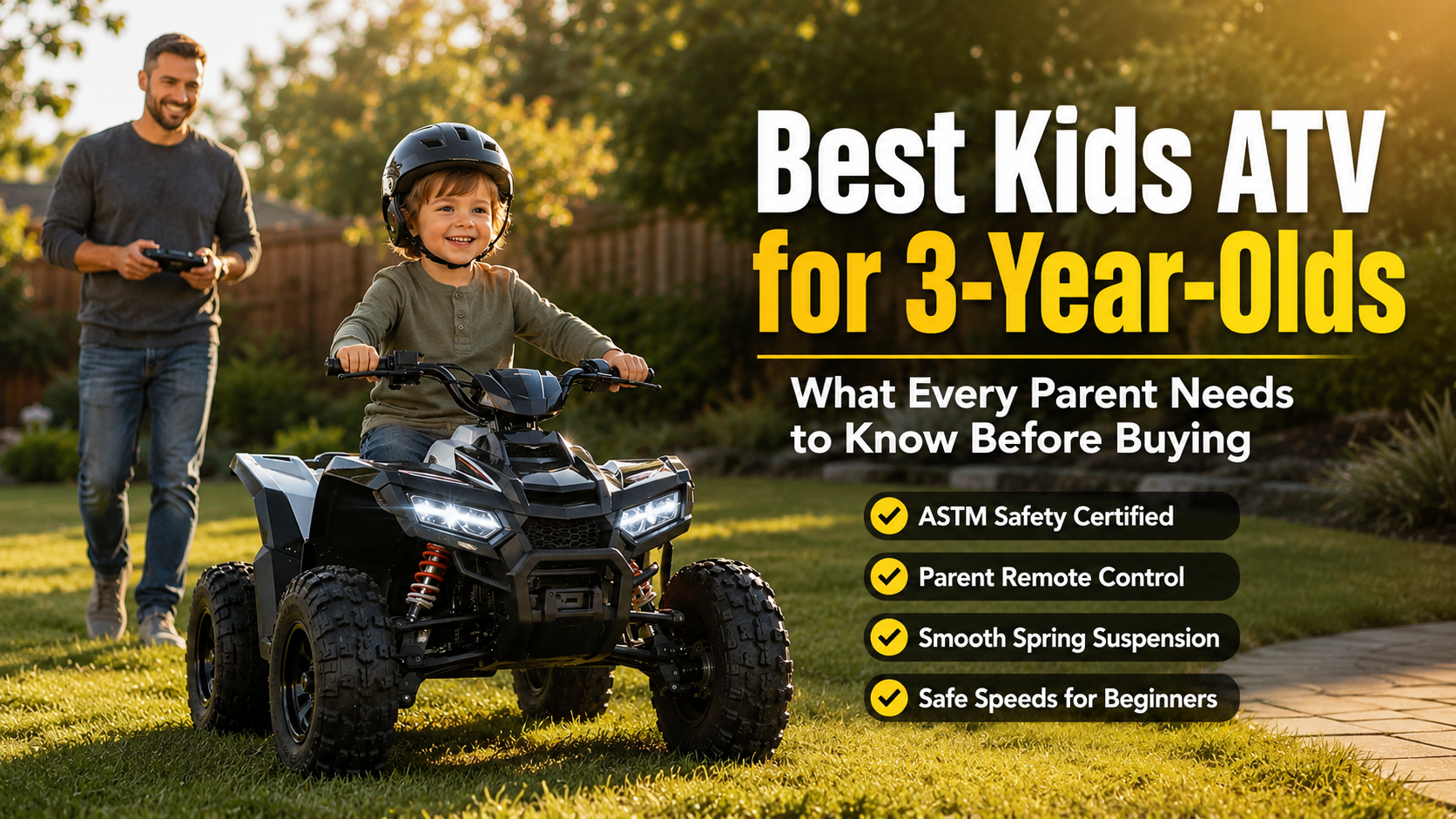
Your three-year-old has discovered the backyard. Now they want to ride something through it. You’ve seen the electric ATVs online-the ones with chunky tires, flashing LED lights, and that unmistakable quad shape-and you’re wondering if it’s too early, too dangerous, or just right. The truth? When you choose the right machine with the right safety features, a quality kids ATV at age three isn’t just possible. It’s one of the best outdoor gifts you can give a young child.
This guide walks through everything a parent needs to know before buying an electric ATV for a toddler or young child in the 3–8 age range. From voltage and motor size to safety certifications, spring suspension, and remote parental control, we’ll break down what actually matters versus what’s just marketing noise.
Why Age 3 Is the Right Time to Start Thinking About Ride-On ATVs
Child development experts broadly agree that by age three, most children have developed enough gross motor coordination to confidently operate simple ride-on vehicles. They understand basic cause and effect-push the pedal, it moves. Turn the wheel, it turns. That cognitive readiness, paired with the physical confidence most toddlers are building at this stage, makes three a natural entry point for electric ride-on toys.
The key difference between a toy that helps a child develop confidence and one that becomes a frustrating or dangerous experience comes down to design. Specifically: speed limits, battery size, seat stability, and whether a parent can intervene remotely when needed.
The Developmental Benefits Nobody Talks About
Beyond the pure fun factor, riding an electric ATV builds spatial awareness and hand-eye coordination in ways that indoor toys simply can’t replicate. A child navigating around garden furniture or along a path has to judge distances, react to terrain changes, and make real decisions about speed and direction. Those experiences compound quickly.
Many parents also notice a measurable boost in outdoor time when a ride-on vehicle enters the picture. Instead of pulling kids away from screens, the ATV pulls them outside on its own-which is something most parents will happily trade a few hundred dollars for.
Key Features to Look for in a Kids ATV for Ages 3–8
1. Spring Suspension for Young Riders
This is non-negotiable for outdoor use. A children’s electric ATV without spring suspension transfers every bump and root directly to the rider’s spine and seat. On a three-year-old, that can quickly turn a fun ride into an uncomfortable-or tearful-one. Suspension absorbs the impact from driveways, lawn edges, and gravel paths, keeping the ride smooth and keeping the child comfortable and confident.
Look for four-wheel independent spring suspension rather than rear-only systems. The difference in ride quality on uneven surfaces is substantial.
2. Parental Remote Control
For toddlers especially, the ability for a parent to take over the vehicle remotely is a critical safety feature. A young child approaching a fence, a slope, or the street can be stopped or redirected immediately, without the parent having to chase them down. This feature doubles as a teaching tool-you can slow the vehicle down as the child learns, gradually increasing the speed limit as their confidence grows.
3. Battery Voltage: What Does 12V vs 24V Actually Mean?
For children aged 3–5, a 12V motor system offers appropriate speed-typically 2–3 mph-which is fast enough to be fun but slow enough to be manageable. As children grow into the 5–8 range, they often outgrow the slower speed and benefit from a 24V system that can reach 4–5 mph in a controlled environment.
Some ATVs marketed to ages 3–8 use a 12V system with a single motor. Others in the same age range use a 24V dual-motor configuration. If you’re buying for a child who’s already on the older end of the age range, or you want the toy to last multiple years, a 24V setup offers better long-term value.
4. LED Lights and Sound Effects
Before you roll your eyes at flashing lights as a gimmick-hear us out. LED headlights and taillights on a children’s ATV aren’t purely decorative. They make the vehicle more visible in shaded garden areas and during early evening play. For a child who’s learning to take pride in their vehicle, the aesthetic details matter too. A toy that looks exciting gets used more.
5. Safety Certification: Why ASTM F963 Matters
Not all electric ride-on toys are manufactured to the same safety standards. In the US market, ASTM F963 is the benchmark for toy safety, covering everything from electrical component safety to structural integrity under load. When you see this certification listed, it means the product has been independently tested against those standards-not just self-certified by the manufacturer.
TheKids ATV 4 Wheeler Electric Ride-On for Ages 3–8 from ToysPorter is ASTM F963 certified, comes with spring suspension and LED lights, and features parental remote control for confident beginners. It’s built specifically for the 3–8 age bracket-not just a downsized adult toy.
Understanding Terrain: Where Can a Kids ATV Actually Go?
Grass and Lawn
Short, firm grass is where most kids ATVs will spend the majority of their time. This is the ideal surface for beginners-some grip, minimal obstacles, and a forgiving surface if a young rider slips off. A motor system with enough torque to push through wet grass without bogging down is important here. Motors rated too low for the vehicle’s weight will overheat on thick lawn.
Driveways and Paved Surfaces
Smooth paved surfaces are easier on motors but harder on little riders if there’s no suspension-every crack and expansion joint gets transmitted straight through the frame. They’re also faster than grass, which is why the parental remote becomes more important on open hardscape areas.
Gravel and Uneven Ground
This is where the ATV design separates from basic ride-on cars. Wide, knobby tires on a proper quad frame handle gravel, packed dirt, and light off-road terrain much better than wheeled cars. For families with outdoor areas that aren’t perfectly manicured, the ATV format is often the more practical choice over a traditional ride-on car.
If you’re also considering a broader range of ride-on formats for your child, the fullelectric vehicles collection at ToysPortercovers everything from ATVs and UTVs to trucks and motorcycles-all with US shipping and ASTM safety standards.
Common Parent Concerns Addressed
Is It Too Heavy for My Child to Operate?
Most quality kids ATVs in the 3–8 age range weigh between 30–50 lbs. The child doesn’t lift it-they simply sit on it and steer. Weight becomes a factor only when a parent needs to store or transport it. For in-yard use, the weight is largely irrelevant to the child’s experience.
What If My Child Drives Too Fast?
The parental remote control answers this question directly. You set the speed, you hold the override, and you can stop the vehicle at any moment. Most quality ATVs in this category also come with adjustable speed settings so you can graduate the child through lower speeds before allowing full throttle.
How Long Does the Battery Last?
Battery life varies by terrain, rider weight, and how aggressively the throttle is used. On flat ground with a light rider, most 12V or 24V systems will deliver 40–90 minutes of riding time. On heavy grass or with a heavier child, expect the lower end of that range. Factor in at least 8–12 hours of charging time between sessions.
Can More Than One Child Use It?
Single-seat ATVs are designed for one rider. If you have two kids who want to ride together, ToysPorter also carries2-seater ride-on ATVs that accommodate siblings side by side-a popular choice for families with children close in age.
Comparing Kids ATVs: What Separates the Best from the Budget Options
The electric kids ATV market has expanded dramatically. At the lower end of the price spectrum, you’ll find 6V single-motor machines with plastic suspension, thin tires, and no remote control. They work-for about six months-before the motor struggles with even moderate grass, the battery degrades, and the novelty wears off.
Mid-range options with 12V or 24V systems, proper spring suspension, and parental remote control tend to offer dramatically better longevity and a much better riding experience. The gap in build quality between a $99 clearance ATV and a properly spec’d machine is significant.
The table below summarizes what separates each tier:
Feature
Budget (Under $80)
Mid-Range ($80–$200)
Premium ($200+)
Battery
6V single
12V or 24V
24V dual-motor
Suspension
None / rigid
Rear spring only
4-wheel independent
Remote Control
No
Basic on/off
Full speed + direction
Safety Cert.
Self-certified
ASTM tested
ASTM + UL
Longevity
6–12 months
1–2 years
2–4 years
Frequently Asked Questions
Q: What is the safest kids ATV for a 3-year-old?
The safest option is an ASTM F963-certified electric ATV with parental remote control, a top speed limited to 2–3 mph at its lowest setting, spring suspension, and a low center of gravity. Avoid any model with a motor system that lacks speed adjustment, as young riders can’t reliably self-regulate on their own.
Q: What age is appropriate for an electric ATV ride-on?
Most quality manufacturers and safety guidelines point to age 3 as the starting point for ride-on electric ATVs-provided the model is rated for that age group. The child should be able to follow basic instructions, understand ‘stop’ and ‘go,’ and sit comfortably in the seat with both feet able to reach the platform.
Q: How fast do kids ATVs go?
Speed depends on the voltage and motor configuration. For ages 3–5, a properly designed vehicle will max out around 2–3 mph on its slowest setting. Older children (6–8) can handle 3–5 mph. Some models allow you to lock the speed electronically via remote control, which is the safest approach for beginners.
Q: Do I need to supervise my child the entire time?
For children under 5, close supervision is recommended regardless of safety features. The parental remote control adds a layer of safety but is not a substitute for parental presence. Children aged 6 and above with established riding experience can typically operate within a defined, enclosed area with periodic check-ins.
Q: How do I maintain an electric kids ATV?
Key maintenance tasks include: keeping the battery charged according to manufacturer guidelines (never store it fully discharged for extended periods), checking tire air pressure if pneumatic tires are fitted, tightening any bolts after the first few rides (vibration can loosen connections), and keeping the vehicle dry and stored away from direct sunlight when not in use.
Final Thoughts: Is a Kids ATV Worth the Investment at Age 3?
For parents who prioritize outdoor play, development, and longevity of a toy purchase, yes-a quality electric kids ATV is absolutely worth it. The key is choosing a model that’s genuinely designed for the age range, not simply a scaled-down machine without appropriate safety features. If you’re ready to explore the options,ToysPorter’s ride-on ATV selectionincludes models certified to US safety standards, built for real-world outdoor use, and designed to grow with your child through the early school years.
For the broader category of kids outdoor electric vehicles-including trucks, UTVs, and motorcycles-the fullelectric ride-on collection at ToysPorter is a strong starting point for any parent navigating the options for the first time.