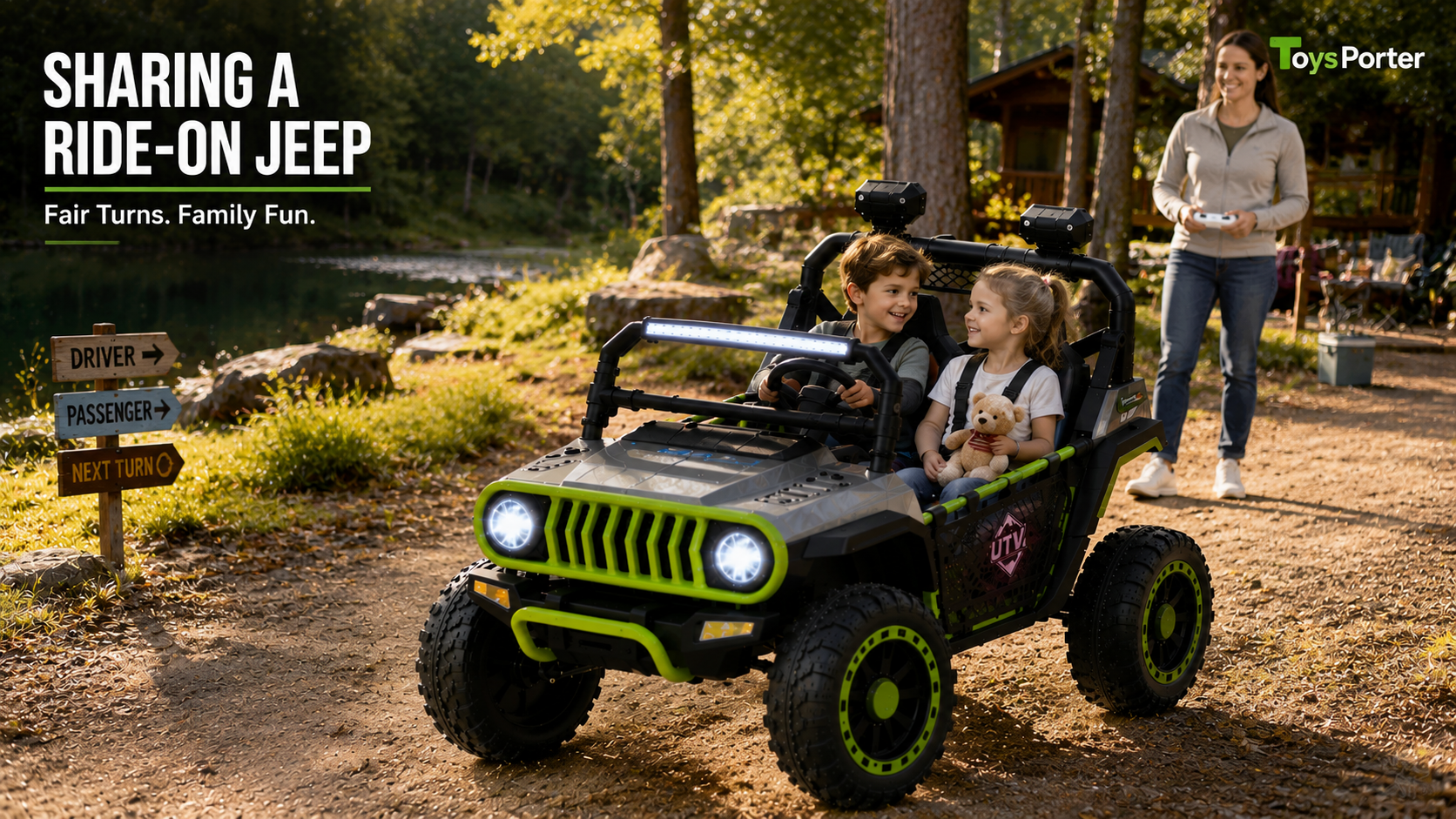
A 2-seater ride-on Jeep is designed with two kids in mind. The wide cab, the extra seat width, the second seat belt, it all signals “built to share.” What that design doesn’t solve on its own is that only one child can actually drive at a time. The other rides along. And that single, unavoidable fact is where most of the backyard arguments start.
This isn’t a buying guide, and it isn’t a lesson on how to teach a child to drive, Toysporter already covers that ground in its step-by-step driving guide. This article is about what happens once the Jeep is already parked in the driveway and two kids, sometimes years apart in age, both want the wheel right now.
Quick Answer: Making One Ride-On Jeep Work for Multiple Kids
If you only read one section, read this:
- Agree on a turn-taking method before the first ride, not in the middle of an argument.
- Use a visible timer or simple turn chart so “how much longer” has an obvious answer nobody has to negotiate.
- Give the passenger a job, such as the horn, lights, music, or navigation, so riding along still feels like part of the ride rather than a consolation prize.
- Match driving responsibility to a child’s actual skill and age, not strictly to whose turn it is, especially when siblings are years apart.
- Set a handful of non-negotiable safety rules that apply to every rider, every time, with no exceptions for the easier-going child.
- Watch for the signs that point toward a second ride-on rather than another round of new rules.
The rest of this guide walks through each of these in more detail.
Why a 2-Seater Jeep Doesn’t Automatically Solve Sharing
It helps to be clear about what the 2-seater design actually gives you. Toysporter’s 24V 2-seater off-road Jeep has one steering wheel, one accelerator, and one parent remote override, positioned for a single driver. The second seat is a genuine passenger seat: same seat belt, same cabin, same ride, but no steering input. That’s a meaningful upgrade over a single-seat ride-on for family play, but it doesn’t turn one vehicle into two independent driving experiences.
In practice, that means every ride still has a driver and a rider, and most sibling conflict over a shared Jeep isn’t really about the toy. It’s about whose turn it is to be the one in control. Solving that is a parenting and scheduling problem more than a product problem, and it responds well to a simple, consistent system.
Setting Up a Fair Turn-Taking System
The single biggest predictor of whether sharing goes smoothly is whether a system exists before the disagreement starts. Waiting until two kids are already arguing over the wheel to invent a rule rarely goes well for anyone.
Timed Turns
A kitchen timer or a phone timer works better than a parent’s sense of “that’s long enough.” Pick a length that suits your family, somewhere in the five-to-ten-minute range for younger kids and slightly longer for older ones, and keep it the same every time. Consistency matters more than the exact number. When the timer goes off, the driver’s seat changes hands, no debate required, because the timer made the decision instead of a parent.
Turn Charts and Visual Reminders
For younger children especially, a simple chart taped near the back door, a checklist with names or photos, does a lot of the work a verbal reminder can’t. Seeing “it’s my turn next” in writing, or in a picture for a child who can’t read yet, cuts down on how often a child asks whether it’s their turn yet.
Task-Based Turns for Older Kids
With school-age children, tying ride time to a small responsibility, like putting away shoes or finishing a homework page, can work, but it’s worth using sparingly. If the Jeep becomes the reward for every single household task, it stops feeling like play and starts feeling like a transaction. Save task-based turns for the moments they genuinely help, not as a default system.
When Siblings Have a Big Age Gap
A 2-seater outdoor Jeep is generally recommended for a specific age and combined weight range, detailed in full in the parent’s buying guide to outdoor ride-on Jeeps. A household with a preschooler and a school-age child sharing one vehicle is, in effect, managing two very different riders on the same equipment.
A few practical adjustments help:
- Let skill, not just age, decide who drives first. A confident younger child who has already progressed past remote-assisted driving may be a more capable solo driver than an anxious older sibling who still wants a parent nearby. The step-by-step guide to teaching a child to drive a ride-on Jeep walks through that remote-to-solo progression in detail.
- Use the parent remote as the equalizer, not the punishment. When a younger or newer driver is at the wheel, keeping the remote in an adult’s hand isn’t about distrust of the older sibling. It’s a safety layer that lets a beginner drive with a safety net, regardless of birth order.
- Give the older child a role that isn’t just waiting. An older sibling who is old enough to help watch for hazards, call out a stop signal, or manage the horn and lights while a younger sibling drives often finds that role more engaging than simply standing by.
- Check the sizing guide for bigger kids if one child is near the upper end of the age or weight range. A child who has outgrown the shared Jeep’s comfortable fit changes the sharing equation entirely, and it’s worth knowing before conflict tells you.
House Rules That Prevent Most Backyard Arguments
A short, consistent list of rules, applied the same way to every child, prevents more disputes than any amount of after-the-fact refereeing. Toysporter’s ride-on UTV and Jeep safety guide for parents covers the broader safety fundamentals; these rules are specifically about keeping sharing fair.
- Decide who drives before both kids get in the vehicle, not after the motor starts.
- No grabbing the wheel, remote, or door handle from another child, ever, even in fun.
- Every rider buckles in every time, regardless of whether they’re driving or riding along.
- The parent, not either child, holds the remote control and has final say on speed and stopping.
- Agree on one clear stop signal or word that both children already understand before the ride begins.
- Keep track of turns somewhere visible, such as a chart, a sticky note, or a phone timer, so nobody has to rely on memory during a disagreement.
Making the Passenger Seat Feel Like a Real Turn
A lot of sibling friction comes down to one thing: riding as a passenger can feel like losing. A few small adjustments change that:
- Let the passenger control the horn, the LED lights, or the Bluetooth music, so they have an active job rather than just sitting.
- Alternate who calls the destination or the “mission” for that ride, such as a trip to the mailbox or a lap around the yard, even if the driver is doing the actual steering.
- Swap seats at the timer, not just the driver and passenger role, so the child who went second this round is guaranteed the front seat next round.
- Build in games that work for both riders, not just the driver. Toysporter’s play ideas for ride-on Jeep adventures has suggestions that give a passenger something meaningful to do.
Signs It Might Be Time for a Second Ride-On
Rules and routines solve most sharing problems. Some households eventually reach a point where a second vehicle makes more sense than more structure. Consider it if:
- The age or skill gap between siblings is wide enough that shared driving genuinely isn’t comfortable or safe for one of them, even with adjustments.
- Arguments continue at roughly the same rate even after a consistent turn-taking system has been in place for several weeks.
- Both children consistently want independent riding time rather than shared time, and your household can support two vehicles logistically.
- Your outdoor space and budget can reasonably accommodate a second ride-on without crowding your storage plan.
A Second Ride-On Doesn’t Have to Match the First
If you do decide a second vehicle makes sense, it doesn’t need to be an identical Jeeps. A single-seat ride-on ATV or a ride-on truck can give an older, more independent child their own vehicle to drive solo, while a younger sibling keeps the shared 2-seater Jeep for supervised rides with a parent or older sibling as co-pilot. Families who want to stay within the same outdoor off-road category sometimes choose the Jeep built for big kids, which uses the same 24V 4WD platform but is positioned for an older or larger child who has outgrown the standard fit.
Either way, browsing Toysporter’s best sellers or the site’s kids ride-on UTV buyer’s guide is a reasonable starting point for comparing options once you’ve decided a second vehicle is the right move.
FAQ
Can two kids really share one ride-on Jeep fairly?
Yes, in most households, with a consistent turn-taking system in place. The 2-seater design lets both children ride together, but only one drives at a time, so a simple structure, such as a timer, a visible chart, and agreed-on rules, does most of the work of keeping things fair.
What age gap works best for siblings sharing a ride-on Jeep?
There’s no fixed cutoff, but the wider the age and skill gap, the more the driving role should be based on ability rather than birth order. A young beginner and a confident older sibling can often share successfully if the parent remote stays active for the less experienced driver.
How do I stop my kids from fighting over who drives?
Decide who drives before either child gets in the vehicle, use a timer instead of a verbal estimate, and give the passenger an active role, such as the lights, horn, or music, so riding along doesn’t feel like losing.
Should the older or younger child drive first?
There’s no rule requiring either order. Alternating who goes first from ride to ride, or week to week, tends to feel fairer over time than always giving the same child priority.
Is it better to buy two ride-on toys instead of one 2-seater Jeep?
It depends on the household. Many families do fine sharing one Jeep with a clear system. A second vehicle, whether a matching Jeep, a single-seat ATV, or a ride-on truck, makes more sense once shared driving consistently isn’t working for one child’s age, skill level, or temperament.
What if my child refuses to give up a turn when the timer goes off?
Consistency is what makes a timer system work. If the rule holds every time, without exceptions, most children adjust within a few uses. A visible, agreed-upon rule is easier for a child to accept than a decision that seems to come from a parent in the moment.
Can the parent remote help settle turn-taking arguments?
Yes. Because the parent remote gives an adult full override of speed and stopping regardless of who’s in the driver’s seat, it can double as a built-in safety net during a less experienced or younger child’s turn, which often reduces safety-driven objections from an older sibling.