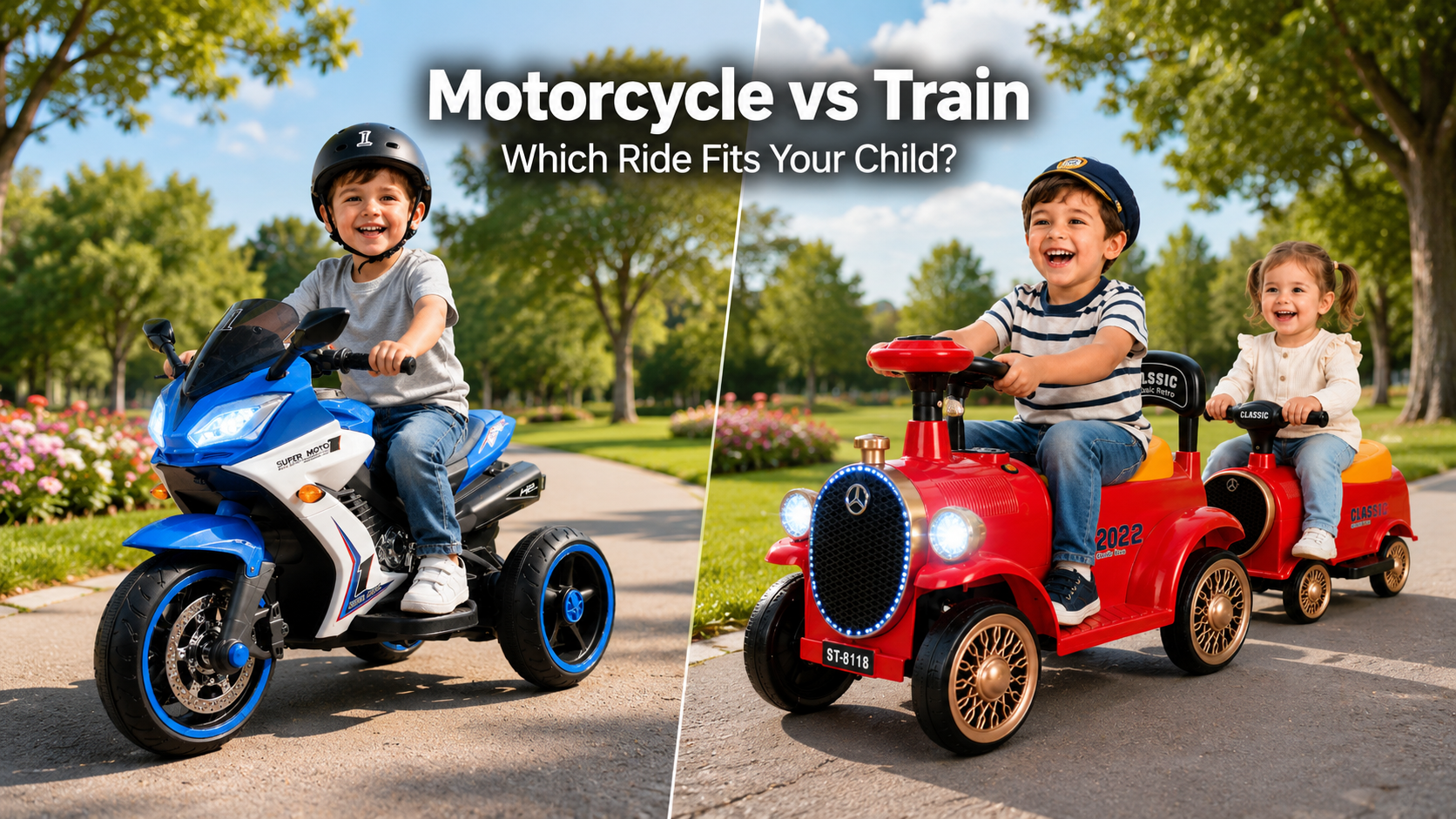
“Should we get the motorcycle or the train?” is one of the most common questions we hear from parents shopping Toysporter for the first time – and it’s a genuinely harder decision than it looks. Both are electric, both are built for ages roughly 3 to 8, and both promise the same thing: hours of outdoor play without a screen in sight. But they deliver that promise in very different ways, and the wrong pick for your specific kid and household can mean a ride-on toy that gets used twice and then forgotten.
This guide comparesRide-On Motorcycles andRide-On Trains head-to-head across the factors that actually predict whether a ride-on toy becomes a favorite or a driveway decoration.
The Core Difference: Balance vs. Passenger Experience
A ride-on motorcycle is fundamentally a skill toy. The appeal is learning to balance, steer, and control speed – it rewards a child who wants to feel like they’re driving something real. A ride-on train is fundamentally a passenger and social toy. The appeal is the ride itself, the storage compartment, the extra carriage for a sibling or friend, and the sense of an adventure with company. Neither is “better” – they’re built around different kinds of play.
Side-by-Side Comparison
Factor
Ride-On Motorcycle
Ride-On Train
Core skill built
Balance, steering, independent control
Cooperative/imaginative play, following directions
Typical seating
1 rider
1–2 riders, expandable with extra carriages
Learning curve
Moderate – most kids need several sessions to feel confident
Minimal – ready to ride from the first try
Best personality fit
Kids drawn to speed, motorbikes, “driving like a grown-up”
Kids who like company, storytelling, and shared play
Sibling/friend play
One rider at a time, unless a second motorcycle is added
Naturally built for two riders at once
Typical footprint
Slightly more compact when parked
Longer with carriages attached; needs more storage width
Terrain flexibility
Can access uneven ground and short off-road patches better
Best on smooth, flat surfaces – patios, driveways, sidewalks
Storage while riding
Minimal to none
Hidden compartment under the second seat on most models
Which One Fits Your Child’s Personality?
Choose a Motorcycle If…
Your child gravitates toward bikes, motorcycles, or anything with two wheels in everyday play.
They enjoy a challenge and don’t get easily frustrated while learning a new physical skill.
You want a ride-on toy that keeps growing in appeal as their control and confidence improve over months, not just weeks.
Choose a Train If…
You have two children close in age who will both want to ride at the same time.
Your child prefers cooperative or imaginative play – pretend train conductor, delivering “cargo,” bringing a stuffed animal along.
You want something a younger child (toward the lower end of the 3–8 range) can enjoy immediately without a learning curve.
What About Households With More Than One Child?
This is where the decision gets more nuanced. A 2-seater ride-on train solves the “whose turn is it” problem directly – both kids ride together instead of taking turns. A motorcycle doesn’t offer that built-in solution, but plenty of families with two children still choose one, either because their kids are far enough apart in age that a shared ride doesn’t matter, or because the plan is for the older child to eventually “graduate” to their own motorcycle later. If shared, simultaneous riding is a top priority, the train has a structural advantage here that’s worth weighing heavily. We cover the logistics of that shared-riding setup in detail in our2-Seater Ride-On Train Sibling Sharing Guide.
Real-World Scenario: Two Households, Two Different Picks
A family in Texas with a single five-year-old who’d been asking for “a motorcycle like the neighbor’s big kid has” went with a ride-on motorcycle. The learning curve took about a week of short driveway sessions before their son could start, stop, and turn confidently – and a year later, it’s still his most-requested outdoor activity.
A family in Georgia with three-year-old twins went with a 2-seater ride-on train instead. A motorcycle would have meant constant turn-taking and, almost certainly, a second purchase down the line. The train let both kids ride together from day one, with the added storage compartment doubling as a spot for sidewalk chalk and snacks on longer driveway “road trips.”
Durability and Long-Term Ownership
Both product lines are built for years of use with reasonable care, but the ownership experience differs slightly. A motorcycle’s moving parts are more exposed to tip-over stress, so front-end alignment and tire wear are the components to watch over time. A train’s coupling mechanisms and second-seat hinge see the most repeated use, particularly in households where carriages are added and removed often. Neither requires more maintenance than the other overall – they simply wear differently based on how they’re used.
Budget and Gift Considerations
Price points across both lines are broadly comparable within Toysporter’s catalog, so budget is rarely the deciding factor – fit for your child and household usually is. If you’re shopping for a holiday or birthday gift and want to see what’s currently trending across both lines, ourBest Sellers collection is a useful starting point before narrowing down to a specific model.
Still Not Sure? A Simple Decision Framework
If your main goal is skill-building and independence, lean motorcycle.
If your main goal is shared play between siblings or friends, lean train.
If your child is younger (3–4) or new to ride-on toys generally, the train’s shorter learning curve is usually the easier starting point.
If your child already shows strong interest in bikes or motorcycles specifically, that existing enthusiasm is often the strongest signal of all.
Is a ride-on motorcycle or ride-on train better for a 3-year-old?
A ride-on train is generally the easier starting point at age 3, since it requires no balance skills and is ready to enjoy immediately. A motorcycle can still work at 3, but expect a longer learning curve before your child rides confidently.
Can two kids ride a motorcycle together?
Most ride-on motorcycles are single-rider by design. Households with two children who want to ride at the same time are usually better served by a 2-seater ride-on train, or by a second motorcycle if age and interest support it.
Which is more durable, a ride-on motorcycle or a ride-on train?
Both are built for similar lifespans with normal use. Motorcycles see more wear at the front end and tires from tip-overs during learning; trains see more wear at the carriage couplings and second-seat hinge from repeated attach/detach use.
Do ride-on trains need a smooth, flat surface to work well?
Yes, trains perform best on driveways, patios, sidewalks, and similar flat surfaces. Motorcycles handle mild terrain variation and short grass or gravel patches noticeably better.
Is a motorcycle harder for kids to learn than a train?
Yes, by design. A motorcycle requires learning balance and steering, which typically takes several short sessions. A train requires no balance skill at all, so most children are comfortable on their very first ride.
Which is the better first ride-on toy if we’ve never owned one before?
For a true first ride-on toy, especially for a younger or more cautious child, a train’s zero learning curve makes it the lower-friction choice. Families confident their child will enjoy the challenge often go straight for a motorcycle instead.