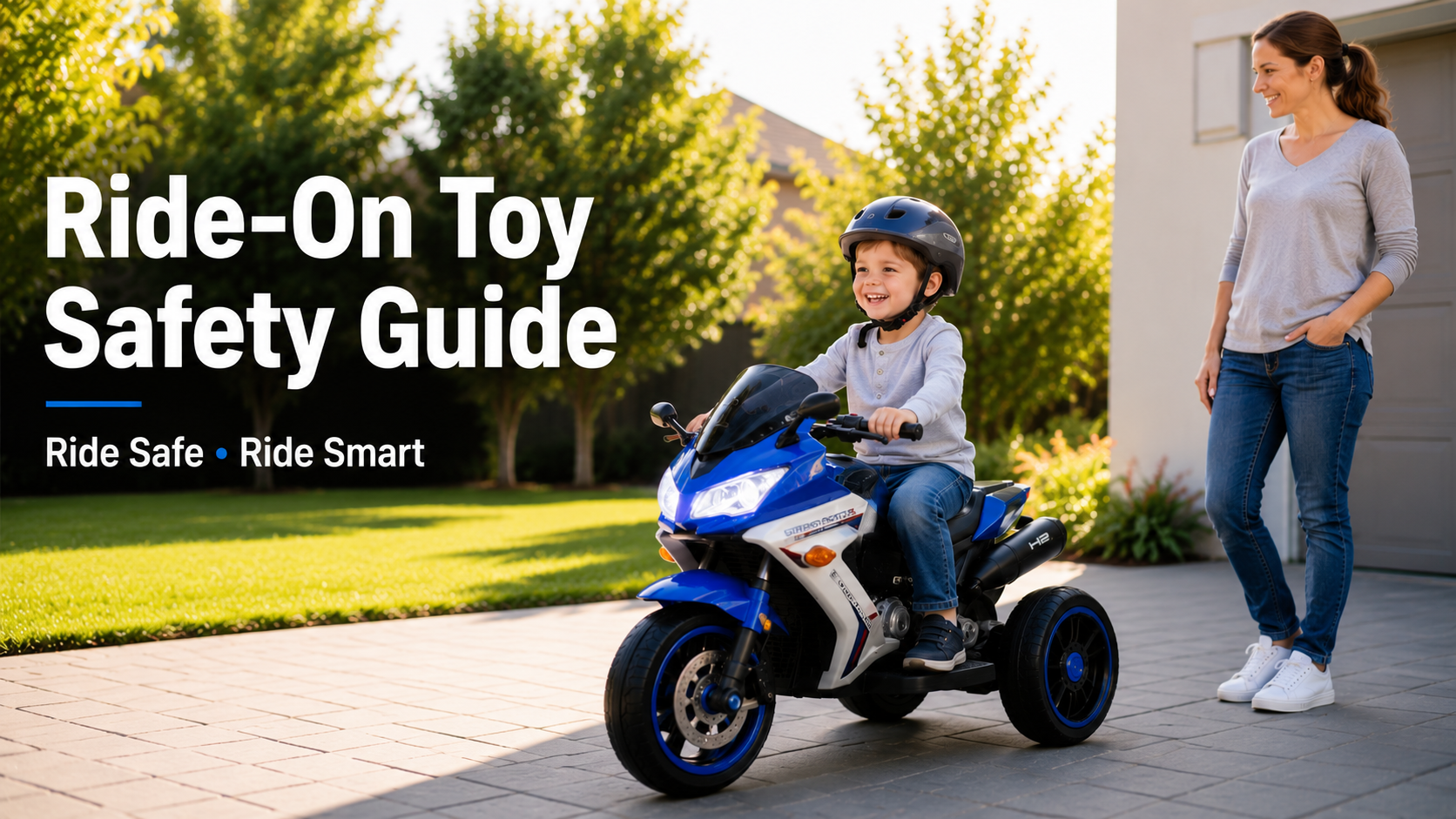
Your child unwraps a ride-on motorcycle or hops onto a new ride-on train for the first time, and within about thirty seconds you realize you have no actual rules in place yet. How fast is too fast? Does a four-year-old need a helmet for something that tops out at 3 mph? Can they ride it around the block, or does it stay in the driveway? These aren’t trivial questions – they’re the difference between a ride-on toy that becomes a trusted part of your family’s outdoor routine and one that ends up back in the garage after a scare.
This guide walks through exactly what safety looks like for both product types Toysporter sells –Ride-On Motorcycles andRide-On Trains – so you can set rules once, confidently, instead of improvising every time your child asks to ride.
Why Motorcycles and Trains Have Different Risk Profiles
A ride-on motorcycle balances on two wheels (or two wheels plus training-wheel-style stabilizers on entry models), which means falls and tip-overs are the primary risk to plan for. A ride-on train sits low, wide, and stable on three or four wheels – its main risks are collisions, pinch points between carriages, and a child standing up or leaning out while it’s moving. Good safety planning starts with knowing which risks actually apply to the vehicle you own, rather than applying generic “ride-on toy” advice to both.
Motorcycle-Specific Risks
Tipping on turns taken too fast or on a side slope.
Loss of balance when a young or new rider first learns to keep both feet up while moving.
Riding on the wrong surface – gravel and wet grass reduce tire grip more than pavement.
Train-Specific Risks
A child standing up, leaning out, or riding between carriages instead of seated.
Fingers near carriage couplings during hook-up or when carriages are added or removed.
Collisions with furniture, walls, or siblings when riding indoors or in tight spaces.
Protective Gear: What’s Actually Necessary
Not every ride-on toy requires a full motocross setup, but gear expectations should match the vehicle and the riding environment.
Gear
Ride-On Motorcycle
Ride-On Train
Helmet
Recommended for all riders, especially outdoors or on pavement
Optional indoors; recommended outdoors or if standing is a habit
Closed-toe shoes
Required – feet near moving parts and the ground for balance
Recommended – protects feet if a child hops on/off while moving
Knee/elbow pads
Nice-to-have for new riders still learning balance
Not typically necessary
Gloves
Optional, useful for grip and minor scrapes
Not necessary
A simple rule of thumb we recommend to Toysporter families: if the vehicle can tip over, a helmet earns its place. If it can’t tip but can collide with things, closed-toe shoes and clear house rules do most of the safety work.
Setting Age-Appropriate Speed Limits
Most ride-on motorcycles and trains include a parental speed-limiting feature – either a physical low/high switch or a capped setting accessible through a remote. This is the single most effective safety tool you have, and it’s worth using intentionally rather than defaulting to the highest setting because your child asks for it.
First two weeks: lowest available speed setting, regardless of your child’s age or confidence. Balance and steering habits need to form before speed is added.
After the first two weeks: increase one setting at a time, only once your child reliably stops, turns, and stays on the intended riding surface.
Full speed: reserve for children who have shown consistent control over at least a month of regular riding, and only in open, obstacle-free spaces.
OurElectric Motorcycle Ownership Guide goes deeper on the first-ride teaching process itself; this section is specifically about how to pair that teaching process with speed limits so the two build confidence together instead of outrunning it.
House Rules Worth Setting on Day One
Families who avoid most ride-on toy injuries tend to share a few habits in common – not because they’re strict, but because they set expectations before the excitement of a new ride-on toy makes it harder to introduce rules later.
Riding happens only where an adult can see the child the entire time – no riding around a corner of the house or out of the yard alone.
The vehicle stays off streets and driveways with vehicle traffic, regardless of how slow the speed setting is.
No riding after dark, even in a driveway, unless the vehicle has working lights and the area is well lit.
On a ride-on train, riders stay seated at all times while it’s moving – this is worth stating explicitly, since trains feel more like furniture than motorcycles and kids are more likely to treat them casually.
On a ride-on motorcycle, both feet stay on the footpegs while moving, and the kickstand (if included) is used every time the vehicle is parked, even briefly.
Supervision: How Much Is Actually Needed
Supervision needs change with age, experience, and the vehicle type, but a few general guardrails apply across the board.
Ages 3–4: direct, within-arm’s-reach supervision at all times, regardless of vehicle.
Ages 5–6: supervision from a consistent vantage point (porch, driveway chair) is usually enough once basic control is demonstrated, but stay close enough to intervene.
Ages 7 and up: supervision can relax to periodic check-ins in a contained, familiar space, provided house rules have been consistently followed.
Parental remote control – standard on most Toysporter motorcycles and trains – is a supervision tool, not a replacement for supervision itself. It lets you intervene instantly, but it doesn’t substitute for being present, especially in the first few weeks of ownership.
A Quick Pre-Ride Safety Checklist
Battery charged and connections secure (a vehicle that cuts out mid-ride is its own hazard).
Tires and wheels free of debris, and – for trains – carriage couplings fully engaged before riding.
Riding area checked for obstacles, other children, pets, or uneven ground.
Speed setting confirmed appropriate for the rider’s current skill level, not just their age.
Helmet and closed-toe shoes on, if applicable to your vehicle and setting.
An adult present and watching before the child gets on.
What to Do If Your Child Has a Minor Fall or Bump
Most falls from a ride-on motorcycle happen at low speed during the learning phase and result in nothing more than a startled child and a skinned knee. Stay calm, check for pain when the child bears weight or moves the affected area, and treat it like any other backyard tumble. The more useful response is usually adjusting the setup that led to the fall – a slippery surface, a speed setting that was too high, or a turn that was too tight – rather than treating it as a reason to stop riding altogether.
Frequently Overlooked Safety Details
Charging safety matters as much as riding safety – always charge on a hard, ventilated surface and never let a child plug in or unplug the charger unsupervised.
Weight limits are safety limits, not just performance specs – check the listing on theRide-On Motorcycle orRide-On Train product page before assuming an older sibling can ride along.
ASTM F963 certification – the U.S. safety standard for toys – covers construction, materials, and mechanical safety, but it doesn’t replace the supervision and house-rule habits covered in this guide.
Where to Go From Here
Once your house rules and gear are sorted, the day-to-day questions tend to shift toward setup and features – ourKids Ride-On Motorcycle Buyer’s Guide andRide-On Train Buyer’s Guide cover those in depth, and ourFAQs page answers common shipping, warranty, and product questions that come up after purchase.
FAQ Section
Do kids need a helmet for a ride-on toy motorcycle?
It’s strongly recommended, especially outdoors or on pavement where a tip-over is possible. Indoor, low-speed use on carpet is lower-risk, but a helmet habit formed early tends to carry over naturally as riders move to faster vehicles later in childhood.
What age is safe for a ride-on motorcycle or train?
Most models are designed for ages 3 to 8, with speed and complexity scaled to different age ranges within that window. The right age depends more on whether a child can follow basic safety instructions consistently than on a specific birthday.
How much supervision does a ride-on toy actually need?
Direct, within-reach supervision for younger or newer riders, tapering to closer-but-not-hovering supervision as a child demonstrates consistent control. Parental remote control features support supervision but don’t replace an adult being present.
Is a ride-on train safer than a ride-on motorcycle?
Trains carry a lower fall risk since they don’t tip over, but they introduce different hazards – pinch points at carriage couplings and the temptation to stand up while riding. Both require age-appropriate rules; neither is risk-free without supervision.
What’s the most common mistake parents make with ride-on toy safety?
Setting the speed to the highest level too early, based on age rather than demonstrated skill. Speed should increase gradually as control improves, not all at once on day one.
Do ride-on toys need to be ridden only in the yard?
For newer riders, yes – a contained, obstacle-free space like a driveway or yard is safest while control is still developing. As confidence grows, supervised riding in wider, still-traffic-free areas can be considered.