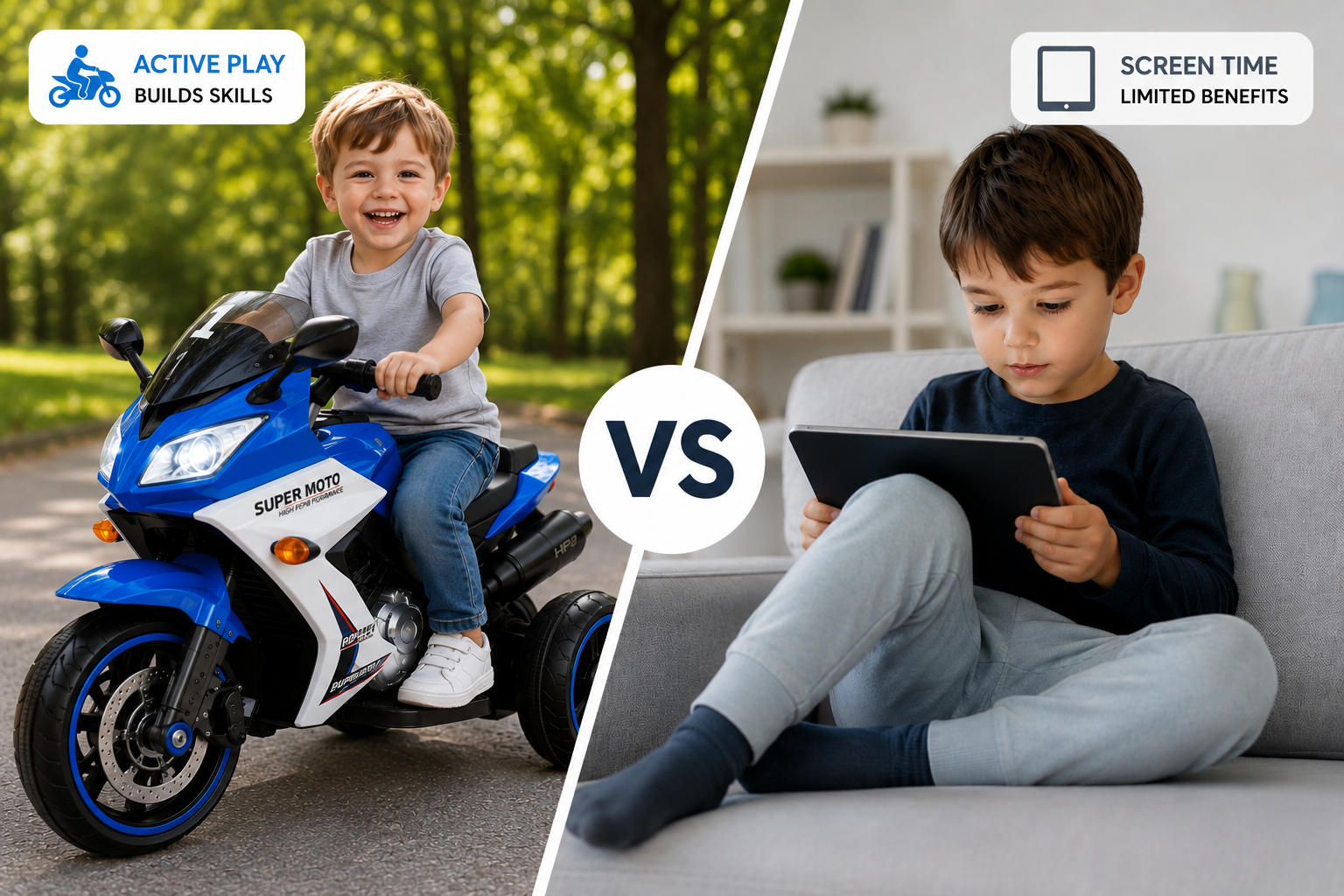
It’s one of the defining tensions of modern parenting: the tablet that keeps a child occupied, calm, and apparently engaged versus the outdoor toy that requires space, supervision, weather cooperation, and a child who’s willing to put down the screen in the first place. Most parents aren’t asking which one is good and which is bad. They’re asking a more nuanced question: what does each one actually do for my child’s development, and how do I strike the right balance?
This article takes that question seriously. It doesn’t demonize screens or romanticize outdoor play. Instead, it examines the specific developmental domains that each activity engages, the evidence for what both contribute, and how active outdoor play – including ride-on vehicle experiences – develops capabilities that digital environments genuinely cannot replicate. The goal isn’t to make you feel guilty about screen time. It’s to help you make deliberate choices about how your child’s play hours are distributed.
Setting Up a Fair Comparison
‘Tablets’ and ‘ride-on cars’ are both umbrella categories containing enormous variety. A tablet running a phonics learning app is doing something very different from one streaming cartoon videos. A simple ride-on push toy does something very different from a 24V electric ATV with four-wheel drive and terrain capability. For this comparison to be useful, we need to be specific about what each category does at its most developmentally engaged.
The tablet at its best – structured educational apps, age-appropriate creative tools, supervised video communication with family – is a legitimate learning environment. Research supports digital play as a meaningful context for early literacy, numeracy, pattern recognition, and even early coding concepts. We’re not dismissing that.
The ride-on toy at its best – a vehicle that challenges motor coordination, requires spatial navigation, creates physical feedback from real-world terrain, and exists in a social outdoor context – is doing something categorically different. Not better in every dimension. Different in ways that matter across the arc of childhood development.
The right framing: This isn’t which activity your child should do instead of the other. It’s understanding what each uniquely contributes so you can make intentional decisions about balance rather than defaulting to whatever requires least resistance in the moment.
Motor Skills: Where the Gap Is Clearest
Fine Motor vs Gross Motor Development
Tablets primarily engage fine motor skills – the small muscle movements of fingers and hands. Tapping, swiping, pinching, and dragging develop finger dexterity and hand-eye coordination at a fine scale. These are genuinely valuable skills, and the precision demands of touchscreen interaction aren’t trivial for a 3-year-old learning to control their hand movements accurately.
Ride-on vehicles engage gross motor skills – the large muscle systems of the legs, core, arms, and full body. Steering a vehicle requires integrated arm and shoulder coordination. Maintaining balance on a motorcycle-format ride-on engages the core stabilizers. Navigating around obstacles requires the full-body coordination of visual input, postural adjustment, and limb control working simultaneously. These are fundamentally different movement systems, and both need regular engagement during the 2–8 developmental window to develop properly.
Proprioception: The Skill Tablets Cannot Touch
Proprioception – the body’s sense of its own position and movement in space – develops through physical activity that creates real sensory feedback. When a child steers a ride-on vehicle around a corner, their vestibular system processes the turn, their proprioceptors register the postural adjustment, and their motor system calibrates the correction. This feedback loop doesn’t exist in digital environments, where all interactions occur on a flat surface at zero physical consequence.
Proprioceptive development in early childhood is linked to later coordination, athletic ability, and the physical confidence that allows children to accurately judge their own physical capabilities in novel situations. It’s one of the most important developmental domains that only physical play can reliably build – and it’s one of the areas where the ride-on toy category creates consistent, repeatable developmental input across thousands of micro-adjustments per session.
Spatial Reasoning: Two Different Kinds
Digital Spatial Skills
Research genuinely supports tablets as builders of certain spatial reasoning skills. Puzzle apps, pattern recognition games, and even some action games develop the ability to mentally rotate objects, recognize spatial relationships on a two-dimensional plane, and navigate virtual environments. These are legitimate cognitive skills with real-world application in subjects like mathematics and engineering.
Real-World Spatial Navigation
Navigating a physical environment in a moving vehicle develops a different, and arguably deeper, form of spatial reasoning. When a child pilots a ride-on vehicle through a garden, they’re learning to predict the turning radius of a physical object, judge distances to real obstacles, calibrate speed to available stopping distance, and maintain a mental map of a three-dimensional space while moving through it. This is Euclidean spatial reasoning – the kind that underlies driving, architecture, athletics, and physical problem-solving – and it can only be built through navigation of real physical environments.
A child who has spent 200 hours navigating a ride-on vehicle through varied outdoor terrain has developed an intuitive physical spatial model that no amount of tablet-based spatial games can replicate, because the input – real physics, real consequences, real sensory feedback – is categorically different from what a touchscreen can simulate.
Confidence and Independence: The Outdoor Advantage
Risk Calibration in the Real World
Confidence in children is not built through praise – it’s built through repeated experiences of successfully managing real challenges at the edge of their current capability. A child who navigates a ride-on vehicle through a new terrain, recovers from a near-stall on thick grass, or successfully parks in a chalk circle they drew themselves has accumulated real evidence of their own capability. That evidence is what builds genuine confidence.
Digital environments can simulate challenge, but the stakes are different. A failed level in a game is restarted without consequence. A misjudged corner on a ride-on vehicle that scuffs a wheel hub or requires a physical recovery – within a safe, supervised context – creates a real-consequence learning moment that registers differently in the brain’s confidence architecture. The child learns that they can handle real challenges, not just virtual ones.
Independent Decision-Making
Active outdoor play with a ride-on vehicle requires the child to make a continuous stream of real decisions: how fast to go, where to turn, whether to try the grassy slope or stick to the path, whether to keep riding or take a break. These micro-decisions occur in a context with real physical outcomes, and the child learns to trust their own judgment through their accumulated track record of decisions and their consequences.
Tablet environments structure decision-making differently – options are curated by the app, consequences are bounded by design, and the physical self is absent from the experience. Both environments create decision-making practice, but the physical-world version creates a wider transfer of confidence into non-digital real-world contexts.
Theelectric motorcycle for kids ownership guide documents this progression specifically – how children move from full parental remote control at age 2 to genuinely independent riding by age 5, and how that arc of graduated independence builds both skill and confidence in measurable stages.
Creativity and Imagination: Different Modes, Different Value
How Tablets Support Creativity
The best creative apps – drawing tools, music makers, simple animation tools, storytelling apps – give children a genuinely powerful creative medium. A 6-year-old who creates their own illustrated story in a tablet app has engaged creative, narrative, and fine motor skills simultaneously. Digital creative tools lower the technical barrier to creation in ways that physical media sometimes can’t – a child can produce a compelling piece of digital art before they have the fine motor precision to hold a pencil correctly.
How Active Play Supports Imagination
Outdoor physical play, particularly with vehicles, activates a different mode of imagination – the embodied, roleplay imagination that developmental psychologists call ‘dramatic play.’ A child on a ride-on motorcycle isn’t just operating a vehicle; they’re a rider on a mission, navigating hostile terrain, racing against an invisible opponent, or delivering an important cargo to the back garden. This embodied imaginative scenario-building creates richer, more integrated imaginative experience than the structured scenarios of most apps because the child is the physical protagonist, not a controller of a digital avatar.
The sensory richness of outdoor embodied play – real wind, real terrain feedback, real sound of the motor and their own movement through space – creates a more vivid imaginative canvas than a screen can replicate. Children who regularly engage in this kind of physical dramatic play show stronger narrative ability, more elaborate imaginative scenarios in all play contexts, and higher creative flexibility than children whose imaginative play is primarily digital.
Vehicles that support this imaginative dimension most strongly tend to have strong format identity – a ride-on that looks like a motorcycle, a train, or an ATV creates a specific imaginative context that generic ride-on cars don’t. Thekids ride-on train range is particularly strong here: the locomotive format instantly invokes conductor/passenger roleplay scenarios that children extend into complex multi-session imaginative narratives.
Social Development: The Most Important Comparison
Digital Social Interaction
Tablets create social opportunities through cooperative gaming, video calling with family, and shared content experiences. These are real social interactions – a child video-calling grandparents or playing a tablet game alongside a sibling is having genuine social experience with a digital medium. We shouldn’t dismiss this.
Physical Co-Play and Embodied Social Skills
Outdoor physical play with another child, however, develops a specific category of social skill that digital interaction cannot – the embodied negotiation of shared physical space. Two children sharing a 2-seater ride-on, deciding who drives, managing the speed between them, negotiating routes, and physically cooperating to turn the vehicle around are practicing social skills that require bodies, space, and real-time physical consequence. Eye contact, physical coordination with another person, reading non-verbal cues in a moving-body context, resolving disagreement about a shared physical resource – these are the foundational social competencies that underlie adult social function, and they develop in physical social play contexts more richly than in digital ones.
The social dimension is one of the clearest arguments for 2-seater ride-on formats specifically. The2-seater ride-on train and other multi-rider formats at ToysPorter create structured physical co-play that single-seat vehicles and solo tablet use both miss.
Head-to-Head: Developmental Skills at a Glance
Developmental Domain
Tablet (Best Use)
Ride-On Vehicle (Active Play)
Fine Motor Skills
Strong – precision touch input
Moderate – handlebar/throttle control
Gross Motor Skills
Minimal
Strong – full-body coordination
Proprioception
Not developed
Strong – continuous physical feedback
Real-World Spatial Nav.
Limited (2D simulation)
Strong – 3D real-environment navigation
Confidence Building
Moderate (virtual stakes)
Strong – real-consequence experiences
Independent Decisions
Structured by app design
Open-ended, real physical outcomes
Creative Imagination
Strong (digital creation tools)
Strong (embodied dramatic play)
Digital Literacy
Strong
Not applicable
Embodied Social Skills
Limited
Strong – especially 2-seater formats
Physical Health/Activity
Minimal
Strong – outdoor movement
What the Research Actually Says About Screen Time and Active Play
The American Academy of Pediatrics (AAP) recommends that children aged 2–5 have no more than one hour of high-quality screen time per day, with co-viewing and discussion preferred over solo screen time. For children aged 6 and above, the recommendation shifts to consistent limits rather than fixed hours, with emphasis on ensuring screens don’t replace sleep, physical activity, or face-to-face social time.
The World Health Organization’s physical activity guidelines for children aged 3–4 recommend at least 180 minutes of physical activity daily, including at least 60 minutes of moderate-to-vigorous intensity movement. For children aged 5–17, the recommendation is at least 60 minutes of moderate-to-vigorous activity every day.
These guidelines aren’t anti-technology – they reflect what the evidence shows about the irreplaceable developmental value of physical activity in childhood. A child who gets 180 minutes of mixed physical activity (which active outdoor ride-on play meaningfully contributes to) and one hour of quality screen time is having a developmentally well-rounded day. A child who gets three hours of screen time and 20 minutes of incidental movement is not.
Key research finding: A 2019 study in JAMA Pediatrics found that every additional hour of screen time at ages 2-3 was associated with lower developmental scores in communication, motor skills, problem-solving, and social competence at ages 3-5. The association wasn’t with any screen content in particular – it was with displacement of active, physical, and social play time.
Building a Balanced Play Routine: Practical Guidance
The Replacement vs Complement Framework
The most useful parental mental model isn’t ‘which is better’ – it’s ‘what does each replace or complement?’ Tablets that replace passive TV watching are a net positive. Tablets that replace outdoor physical play are a net developmental loss. Ride-on outdoor play that replaces aimless screen time adds physical, spatial, and confidence development. Ride-on play that replaces structured creative digital work loses some of the legitimate benefits of the digital context.
The goal is a schedule where active outdoor play – including vehicle-based outdoor play – is a reliable daily component, not a weather-dependent afterthought. Children who have consistent access to outdoor vehicle play as part of a predictable routine maintain higher physical activity levels, stronger outdoor play preferences, and better regulation of their own screen time requests.
Age-Specific Balance Guidance
Ages 2–3: Prioritize physical and sensory play heavily. Digital time should be minimal and always co-viewed. This is the critical window for gross motor and proprioceptive development that only physical activity builds.
Ages 4–6: Begin introducing structured digital creativity tools alongside consistent daily outdoor physical play. The balance should remain tilted toward physical activity, but quality digital creative time adds genuine value.
Ages 7–10: Children can handle more independent digital time, but physical activity requirements (WHO: 60 min+ daily) should be non-negotiable. Ride-on vehicle play at this age should be terrain-capable and sufficiently challenging to continue building spatial and motor skills.
For families building an outdoor play routine, the starting point is choosing a vehicle format that matches the child’s age and outdoor environment.ToysPorter’s full range of electric ride-on vehiclescovers all formats from toddler-appropriate to pre-teen capable, with clear age ratings and terrain specifications for each model.
If you’re exploring which ride-on format creates the strongest active play engagement for your child’s developmental stage,ToysPorter’s best-sellersprovides a useful reference – real purchase data from parents across the full age range.
ride-on ATV collectionfor formats that offer particularly strong terrain capability and developmental challenge for children aged 4 and above.
VisitToysPorter.com to explore the complete kids electric ride-on collection with free US shipping and 40-day returns across all models.
Frequently Asked Questions
Are tablets or ride-on toys better for child development?
Neither is universally better – they develop different skills. Tablets build digital literacy, fine motor skills, and (with quality apps) early literacy and numeracy. Ride-on vehicles build gross motor skills, real-world spatial navigation, proprioception, physical confidence, and embodied social skills. A balanced childhood includes meaningful time in both categories. If forced to prioritize one for the 2–6 age window, child development research broadly supports active physical play as the higher developmental priority in those years.
How much screen time is appropriate for a child who also plays outdoors regularly?
The AAP recommends no more than one hour of quality screen time per day for children aged 2–5. For children 6 and above, the guidance is consistent limits that don’t displace physical activity, sleep, or face-to-face social time. A child who gets 60+ minutes of active outdoor play daily (including ride-on vehicle time) and then engages with quality digital content within reasonable limits is meeting the core developmental recommendations of both physical activity and appropriate digital engagement guidelines.
What skills do ride-on vehicles specifically build that tablets cannot?
The clearest unique contributions of ride-on vehicle play are: proprioceptive development (body position sense from real physical movement), real-world spatial navigation (learning to move a physical object through 3D space with real consequences), gross motor coordination across full-body systems, embodied social skills in co-play contexts, physical confidence from real-consequence challenge, and outdoor environmental engagement that develops nature connection and attention restoration. None of these can be meaningfully replicated in a digital environment because they require the physical body to be the instrument of experience.
Do educational apps on tablets replace the need for active play?
No. Educational apps can supplement cognitive learning and fine motor development, but they cannot replace the gross motor, proprioceptive, spatial navigation, and physical confidence development that active outdoor play provides. The research is clear that active physical play in the 2–8 developmental window is not optional and cannot be substituted by any form of digital engagement, however high quality. The two categories are complementary, not interchangeable.
At what age can a child benefit from a ride-on vehicle for development?
Most quality electric ride-on vehicles are appropriate from age 2 with parental remote control support. The developmental benefits begin from the first rides – even a 2-year-old navigating a slow, remote-controlled vehicle is building spatial awareness, vestibular processing, and the cause-and-effect understanding of vehicle control. By ages 3–4, independent steering and throttle management create genuine gross motor and coordination development. The developmental relevance continues through age 10 as vehicles become more challenging and terrain-capable.
How can parents create a healthy balance between screen time and outdoor play?
The most effective approach is routine rather than restriction. Establishing outdoor play as a predictable daily anchor – ‘after school we ride for 30 minutes before any screen time’ – removes the daily negotiation and frames physical play as a given rather than a reward or exception. Making outdoor vehicles easily accessible (charged, available, not stored in a difficult location) reduces the friction that causes parents to default to tablets as the path of least resistance. Periodic parental co-participation in outdoor riding – even briefly – significantly increases how often children choose active play independently.
The Honest Verdict: Different Tools, Different Jobs
The question ‘ride-on cars vs tablets’ has a more accurate framing: ‘physical embodied play vs digital interactive engagement.’ Both have genuine developmental value. Both have real limitations. The evidence is clear that physical active play builds a category of skills – proprioception, real-world spatial reasoning, physical confidence, embodied social competence, gross motor coordination – that digital environments cannot replicate, regardless of how well-designed the app.
For parents navigating this daily balance, the practical takeaway isn’t to feel guilty about tablets or to restrict them categorically. It’s to ensure that outdoor physical play – including vehicle-based play that genuinely challenges developing coordination and spatial skills – is a consistent, non-negotiable part of every day. Not as a reward for screen time. Not as a weekend activity. As a daily developmental investment that the research shows cannot be deferred or replaced.
The child who spends an hour a day navigating a real vehicle through real outdoor terrain, alongside regular but bounded quality digital engagement, is getting the best of what both categories can offer. That balance is the goal – and it’s entirely achievable when outdoor play has the equipment, space, and parental support to compete with the frictionless availability of the screen.
Explore the full range of kids electric ride-on vehicles atToysPorter– from first ride-ons for toddlers to terrain-capable electric ATVs and motorcycles for older children, all certified to US safety standards and shipped free within the US.