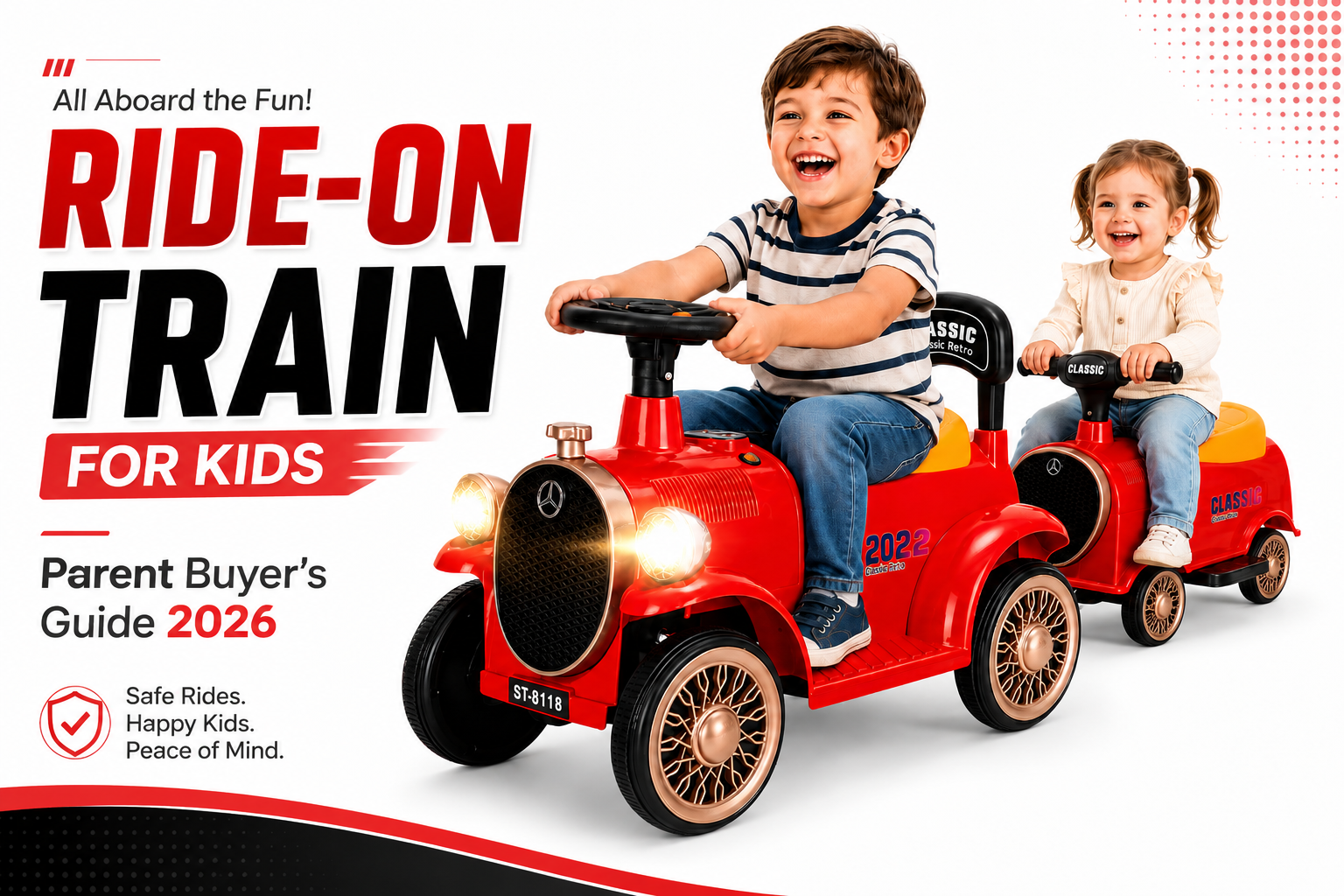
Few outdoor toys spark a child’s imagination quite like a ride-on train. Unlike a basic push toy or a simple ride-on car, a battery-powered train carries the added magic of being something the child actively drives — steering across the backyard, pressing the horn, hearing the chug of a locomotive, and feeling completely in control of their own little adventure.
If you’re researching ride-on trains for a toddler, a young child, or as a gift, this guide covers every factor that matters: battery and motor specs, age suitability, safety standards, terrain handling, and what features are worth paying for. You can also browse the fullride-on train collection at ToysPorterto see current models alongside this guide.
What Is a Ride-On Train Toy?
A ride-on train is an electric battery-powered vehicle shaped like a locomotive that a child sits on and drives — no tracks required. Modern versions are entirely trackless, meaning the child steers freely across driveways, garden paths, patios, and indoor playrooms without any fixed route.
This distinguishes them from toy train sets (where a small locomotive runs on a fixed plastic track). A ride-on train is a vehicle, not a model — the child is the engineer, and wherever they steer is where the train goes.
Trackless Design: Why It Matters
Track-based ride-on trains were common a decade ago, but they created obvious limitations — the child could only follow a fixed loop, setup took significant space and time, and the experience became repetitive quickly. Trackless electric trains eliminate all of that. The child has full directional control, the toy works on virtually any flat surface, and setup is simply charging the battery and switching on.
For families without large, dedicated play areas, the trackless format is also far more practical. A trackless ride-on train works just as well in a hallway or living room as it does on a wide patio.
Age Recommendations: Who Is a Ride-On Train For?
Most quality ride-on trains are designed for children between 18 months and 6 years old. The realistic entry point depends on the child’s physical development rather than age alone — specifically, whether they can sit upright unsupported, reach the controls comfortably, and follow simple directional instructions.
18 Months to 3 Years
At this age, a child can enjoy a ride-on train with close parental supervision. Most quality models include a parental remote override, which allows a caregiver to control the vehicle’s speed and direction while the child focuses on enjoying the experience. Foot pedal control alone is typically not reliable until age 2.5–3.
Ages 3 to 5: The Sweet Spot
This is the primary age range for ride-on trains. Children at this stage have the coordination to steer independently, understand basic stop-and-go controls, and engage fully with the sound effects and lighting features. The imaginative play value is at its peak — a 4-year-old driving a train with music playing and LED lights glowing is having a genuinely immersive experience.
Ages 5 to 6+
Older children can still enjoy ride-on trains, though the weight and size limits of specific models should be checked carefully. Many ride-on trains are rated to around 66 lbs. Children approaching this limit will experience reduced motor performance, particularly on grass or inclines.
Key Features to Look for in a Ride-On Train
Battery Voltage: 6V vs 12V
Entry-level ride-on trains typically use 6V batteries. They work adequately on smooth indoor or paved surfaces but often struggle on grass, packed dirt, or slight gradients. A 12V battery system provides meaningfully more torque, better sustained speed, and longer battery life under real outdoor conditions. For outdoor use on anything other than smooth concrete, 12V is the appropriate choice.
The2-Seater Trackless Ride-On Train from ToysPorter uses a 12V battery system, which delivers the power needed for genuine outdoor performance without overcomplicating the controls for young riders.
Single Seat vs 2-Seater
Single-seat trains are appropriate for one rider — typically suited to families with one child in the target age range. 2-seater configurations allow two children to ride together, which dramatically changes the social dynamic. Sibling pairs, cousins, or playground friends can share the experience simultaneously, and the added shared engagement tends to extend how long the toy holds their interest.
2-seater models require a higher motor rating to maintain performance with two riders. Always check whether the motor is specifically rated for dual occupancy rather than simply physically wide enough to fit two children.
Storage Seat
A storage compartment built into the seat is a surprisingly useful feature for parents, not just children. It keeps small accessories, snacks, or a spare battery charger close at hand without cluttering the ride-on itself. It also adds structural rigidity to the seat platform, which improves the overall build quality feel of the vehicle.
LED Lights and Sound Effects
LED headlights and ambient lighting are not purely decorative. They improve visibility during evening outdoor play and add the kind of visual feedback that keeps young children engaged. Sound effects — train horns, locomotive chugging, and music options — contribute significantly to the imaginative play value at the 2–5 age range. Children at this stage are highly motivated by sensory richness, and a train that sounds and looks like a real locomotive gets used far more than a silent one.
Ride-On Train Feature Comparison at a Glance
Feature
6V Single Seat
12V Single Seat
12V 2-Seater
Battery Life
30–45 min
50–75 min
45–65 min
Outdoor Terrain
Pavement only
Pavement + grass
Pavement + grass
Rider Capacity
1 child
1 child
2 children
Max Weight
44–55 lbs
55–66 lbs
66–88 lbs
LED Lights
Basic or none
Yes
Yes
Music / Sounds
Limited
Yes
Yes
Remote Control
Often absent
On quality models
Recommended
Safety: What Parents Need to Know
ASTM F963 Certification
This is the US standard for toy safety, covering structural integrity, electrical safety, flammability, and chemical composition. Products certified to ASTM F963 have been independently tested to these standards — not simply self-declared compliant. When buying any battery-powered ride-on toy in the US market, ASTM F963 certification should be a baseline requirement, not a bonus feature.
ToysPorter’s ride-on vehicles, including their train range, carry ASTM F963 certification. This is worth noting because lower-priced alternatives on large marketplace platforms frequently lack independent certification.
Speed and Parental Control
Most quality ride-on trains for toddlers cap at 2–3 mph at maximum speed. This is appropriate for the age group — fast enough to be exciting, slow enough to be manageable. Parental remote control allows caregivers to override the child’s throttle input, which is particularly important during the learning phase and in environments with limited space.
Riding Surface Recommendations
For any ride-on vehicle, the safest surfaces are flat, firm, and enclosed. Smooth driveways, patios, and indoor floors are ideal. Avoid surfaces near pools, steep gradients (more than about 10 degrees), or areas with loose gravel that can cause wheels to lose traction suddenly. Even at 2 mph, a sudden stop or tip on a hard surface can cause injury without protective gear.
Terrain and Outdoor Performance
Many ride-on train purchases disappoint parents because they assumed the vehicle would work on the family’s lawn — and it didn’t. Terrain performance depends directly on motor power and tire design. Here’s what to expect realistically:
Smooth Indoor Surfaces
All electric ride-on trains handle indoor hard floors well. This is the least demanding terrain type and relevant for families who plan to use the toy primarily inside during colder months.
Paved Outdoor Surfaces
Driveways, patios, and smooth concrete paths are appropriate for any 12V model. Performance is reliable, battery life is at its maximum, and speed is consistent.
Lawn and Garden Paths
Short, dry grass is manageable for 12V models with adequate torque. Thick, wet, or long grass creates significantly more rolling resistance and may cause the motor to bog down. Compact garden paths are generally fine. Avoid surfaces with loose soil, deep mulch, or uneven paving gaps that can catch small wheels.
Maintenance and Ownership: What to Expect
Battery Care
Lead-acid batteries — the standard type in most kids ride-on toys — should be charged after every use, even for short sessions. Storing the battery in a discharged state degrades it significantly within weeks. Always charge before storing for extended periods (more than 2 weeks), and never leave the charger connected indefinitely after the battery is full.
Cleaning and Storage
Wipe down the body with a damp cloth after outdoor use — grass stains and damp soil can accelerate UV degradation on plastic if left. Store the vehicle out of direct sunlight when not in use. Most ride-on toys are not designed for outdoor storage and will fade and deteriorate faster when left exposed to weather year-round.
Tire and Wheel Check
Periodically check that all wheels are securely attached and that any EVA foam tires haven’t split at the join line (common with lower-quality foam tires under regular stress). Wheels should rotate freely without wobble. Tighten any visible fasteners on the wheel hubs after the first few weeks of use, as initial vibration can loosen assembly hardware.
When to Replace the Battery
A noticeably shortened run time — less than 60% of the original duration — typically indicates battery degradation. Most sealed lead-acid batteries in ride-on toys last 1–3 years depending on usage frequency and how well they’re maintained. Replacement batteries are widely available and are a cost-effective way to extend a vehicle’s life rather than replacing the whole unit.
Is a Ride-On Train Right for Your Child?
Ride-on trains tend to be the right choice for children who are drawn to trains specifically (a significant subset of toddlers), families who want something slightly more distinctive than a standard ride-on car, and situations where two children will share the vehicle simultaneously.
They work best in enclosed outdoor spaces or large indoor areas with smooth floors. They’re not the right choice for children who primarily want high-speed outdoor riding on varied terrain — for that use case, a ride-on ATV or electric car with more ground clearance and motor power is better suited.
If you’re exploring the full spectrum of kids electric ride-on options beyond trains, ToysPorter’scomplete electric vehicles collectioncovers ATVs, UTVs, trucks, motorcycles, and trains — all ASTM-certified and shipped free within the US.
You can also checkToysPorter’s current best-sellers to see which models are most popular with other parents right now, updated regularly.
For families interested in two-wheel ride-on options alongside a train,the ride-on motorcycle range offers another distinctive format that appeals to children who want the experience of balancing on a powered vehicle.
Frequently Asked Questions
What age is appropriate for a ride-on train?
Most ride-on trains are suitable from around 18 months to 6 years. The realistic starting point is when a child can sit upright independently and respond to basic directional instructions — typically around age 2. For children under 3, parental remote control is strongly recommended.
Do ride-on trains work on grass?
12V models with adequate torque handle short, dry grass reasonably well. They are not designed for thick, wet, or overgrown lawn surfaces. For primarily outdoor grass use, look specifically for 12V models with higher-rated motor wattage and wide, low-profile tires that distribute weight more evenly.
How long does the battery last on a ride-on train?
On a 12V model with a single rider on smooth terrain, expect 50–75 minutes per full charge. Battery life is reduced by heavier riders, outdoor terrain, inclines, and continuous high-speed operation. Charge times are typically 8–12 hours for a fully depleted battery.
Can two children ride a 2-seater train at the same time?
Yes, if the model is specifically rated for dual occupancy. Always verify the combined weight limit — most 2-seater ride-on trains support up to 66–88 lbs total. Running a vehicle over its rated weight degrades motor performance and shortens battery life.
Are ride-on trains safe for toddlers?
Yes, when used correctly. Look for ASTM F963 certification, a parental remote control override, and a maximum speed appropriate for the age (2–3 mph for toddlers). Always use on safe, flat terrain with supervision, and always fit the child with a properly sized helmet for outdoor use.
What’s the difference between a ride-on train and a toy train set?
A toy train set is a small locomotive that runs on a fixed plastic track — the child controls it remotely but doesn’t ride in it. A ride-on train is a battery-powered vehicle the child sits on and drives. Modern ride-on trains are trackless, meaning the child steers freely rather than following a fixed loop.
Final Thoughts: Choosing the Right Ride-On Train
The best ride-on train for a child is one matched to their age, their typical riding environment, and whether they’ll be riding solo or with a sibling. For most families with children aged 2–5, a 12V trackless model with LED lights, music, and parental remote control delivers the most complete experience — sufficient outdoor performance, appropriate safety controls, and enough sensory engagement to hold a young child’s attention across repeated sessions.
The2-Seater Trackless 12V Ride-On Train at ToysPorter combines all of these features — storage seat, LED lighting, music, 12V battery, and dual seating — in a single ASTM-certified vehicle with free US shipping and a 40-day return window.
Browse the fullride-on train range or explore the broader collection of kids electric vehicles at ToysPorter to find the right outdoor ride-on for your child’s age, interests, and environment.
VisitToysPorter.com to see current promotions, clearance pricing, and the latest additions to the kids electric ride-on lineup.