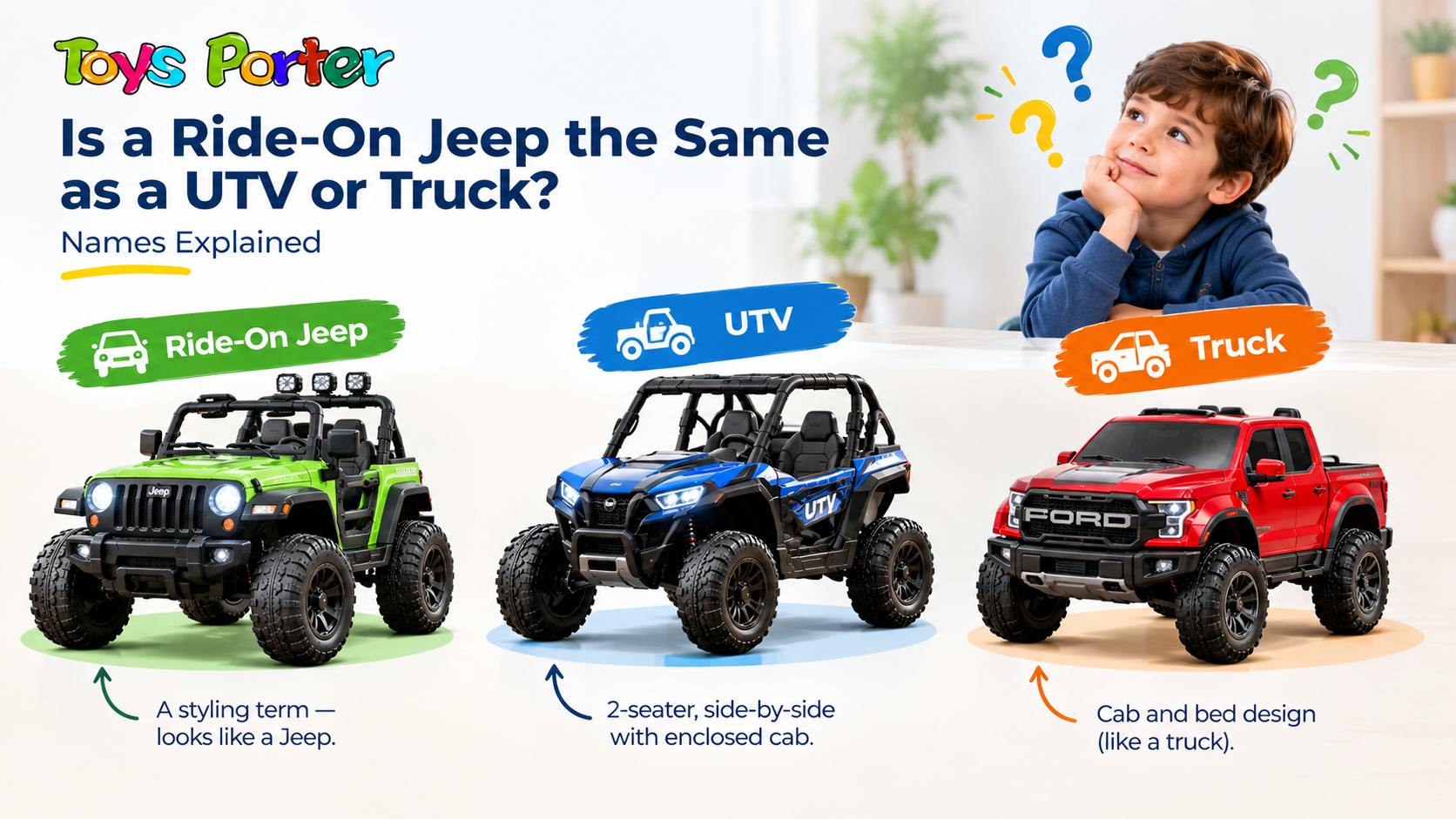
If you’ve spent any time shopping for a kids’ ride-on vehicle, you’ve probably noticed something odd: the same-looking product gets called a “Jeep” on one listing, a “UTV” on another, and a “truck” somewhere else. It’s not a mistake, and it’s not three different products pretending to be the same thing – it’s a naming habit worth understanding before you compare anything else.
Short answer: “Jeep” isn’t a separate vehicle category in the ride-on toy world. It’s a styling term – boxy body, round headlights, an off-road look – that gets layered on top of whichever actual vehicle type the product is built on. A “ride-on Jeep” might be a 2-seater UTV-style side-by-side, a single-cab truck-style vehicle, or even a quad-style ATV. The word “Jeep” tells you about the look. The underlying type – UTV, truck, or ATV – tells you how it actually functions, and that’s the part worth paying attention to.
Why the Names Get Mixed Up
“Jeep” Describes a Look, Not a Vehicle Category
Real Jeep vehicles have a recognizable design language – boxy body panels, round headlights, visible door hinges, an upright windshield. When a ride-on toy borrows that look, it often gets called a “Jeep” regardless of what’s actually underneath it. That’s different from “UTV” or “ATV,” which describe a vehicle’s actual structure and function: how many seats it has, whether the cab is enclosed, and how it’s built to handle terrain. “Jeep” is cosmetic. “UTV” and “ATV” are structural.
A Real Example of the Overlap
This isn’t a hypothetical mix-up. One listing on Toysporter is literally titled a “Ride On Truck Car for Kids 24V UTV Electric Vehicle” – truck, UTV, and electric vehicle all in the same title – and a customer review on that same product reads, “I got this 24V ride-on jeep truck for my 4-year-old.” Another listing, titled a “Ride On Truck Car for Kids Electric UTV,” has a reviewer referring to it simply as “this jeep.” Three different words, one product. That’s not a labeling error on anyone’s part – it’s just how loosely these terms get used across the category, by sellers and shoppers alike.
The Three Real Vehicle Types Behind the “Jeep” Name
Once you set the word “Jeep” aside, most products wearing that label actually fall into one of three underlying types.
UTV-Style “Jeep” – the 2-Seater Side-by-Side
A UTV (Utility Terrain Vehicle) is a 2-seater, side-by-side ride-on with an enclosed cab, built to resemble a real off-road buggy. This is probably the most common vehicle type dressed up with Jeep-style body panels, since the boxy look and the side-by-side seating layout pair naturally. If a “ride-on Jeep” listing mentions two seats, side-by-side seating, or an enclosed cab, it’s a UTV-style vehicle wearing a Jeep look.
Truck-Style “Jeep” – Cab-and-Bed Design
Some products described as a “Jeep” are actually built on a truck-style frame, with a cab up front and a separate bed or cargo area behind it, rather than a fully enclosed side-by-side cab. These tend to be styled for road and driveway use rather than heavier off-road terrain. If a listing mentions a bed, cargo area, or truck-shaped body alongside the word “Jeep,” it’s this type underneath.
ATV-Style “Jeep” – Single-Seat Quad Design
Less commonly, a boxier, Jeep-styled body gets applied to a single-seat, quad-bike-style frame – what’s typically sold as an ATV. These are built for one rider, with an open design rather than an enclosed cab, and are generally the most compact option of the three.
Why the Underlying Type Matters More Than the Label
Once you know which of the three types you’re actually looking at, several practical questions answer themselves:
How many kids can ride at once? A UTV-style vehicle seats two; a truck-style or ATV-style vehicle typically seats one.
Is the cab enclosed? UTV-style vehicles tend to offer more cab protection; truck- and ATV-style vehicles are generally more open.
How does it handle rougher terrain? This depends far more on the vehicle’s wheels, suspension, and motor configuration than on whether it’s labeled a “Jeep.”
None of these questions get answered by the word “Jeep” itself – they get answered by the vehicle type underneath it, which is exactly why it’s worth looking past the styling name when you’re actually comparing options.
How to Tell Which Type You’re Actually Looking at When Shopping
A few quick checks clear up the confusion fast:
Check the seat count. “2-seater” or “side-by-side” almost always means a UTV-style vehicle, Jeep-styled or not.
Look for “bed” or “cargo area” in the description. That typically signals a truck-style frame.
Check whether the cab is described as enclosed or open. Enclosed generally points to UTV styling; open generally points to ATV styling.
Look at the category the product is actually filed under, not just the product name. A listing titled with “Jeep” in it is often filed under Ride On UTV or Ride On Truck in the site’s actual category structure, which is a more reliable signal than the title alone.
Read a few reviews. As the examples above show, customers often describe the same product using different terms, which can actually help confirm what body style and seating it really has.
A Quick Reference
If the listing mentions…
It’s likely this underlying type
2 seats, side-by-side, enclosed cab
UTV-style
Cargo bed, truck shape, single cab
Truck-style
Single seat, quad design, open frame
ATV-style
Where This Fits Into Your Search
Understanding this naming overlap makes the rest of your research easier, since you can now compare listings by actual vehicle type instead of by whichever word happens to be in the title. Toysporter’sKids ATV vs. UTV comparison is a useful next step for weighing those two structural types directly, and itsRide on UTV category is where most Jeep-styled, 2-seater products actually live, regardless of what word appears in the individual product title. If a single-rider option fits your family better, theRide on ATV category is the equivalent destination for that structural type, and theRide on Truck category covers the cab-and-bed style. For families who’ve already decided a Jeep-styled, off-road-capable vehicle is the right fit and want help narrowing down a specific model, Toysporter’sbuying guide to outdoor ride-on Jeeps is a reasonable next read.
Frequently Asked Questions
Is a ride-on Jeep technically a UTV?
Often, yes – many ride-on vehicles styled to look like a Jeep are built on a UTV-style, 2-seater side-by-side frame. But “Jeep” itself isn’t a defined vehicle category, so it’s worth checking the seat count and cab style directly rather than assuming based on the name alone.
Why do sellers call the same product a Jeep, a UTV, and a truck?
Because “Jeep” describes a styling look, not a structural vehicle type, while “UTV” and “truck” describe the actual body and seating layout. A single product can accurately be described by its style (Jeep) and its structure (UTV or truck) at the same time.
Does it matter which word is used in the listing title?
Not as much as the actual specifications do. Seat count, cab enclosure, and terrain capability tell you far more about how a vehicle will actually perform than whether the title says “Jeep,” “UTV,” or “truck.”
How many kids can ride a Jeep-style ride-on at once?
It depends on the underlying type. A UTV-style Jeep typically seats two children side by side; a truck-style or ATV-style Jeep typically seats one.
Is a Jeep-style UTV better than a Jeep-style ATV?
Neither is universally better – it depends on what you need. A UTV-style vehicle suits two riders and offers more cab protection; an ATV-style vehicle suits a single rider and tends to be more compact.
Conclusion
“Ride-on Jeep” is a style description that gets layered onto several genuinely different vehicle types, which is exactly why two products both called “Jeeps” can look and function quite differently from each other. Once you know to check the seat count, cab style, and actual product category rather than relying on the name alone, comparing options becomes much more straightforward. You can exploreToysporter’s full range of electric ride-on vehicles to see how these styles and structural types line up across the current lineup.