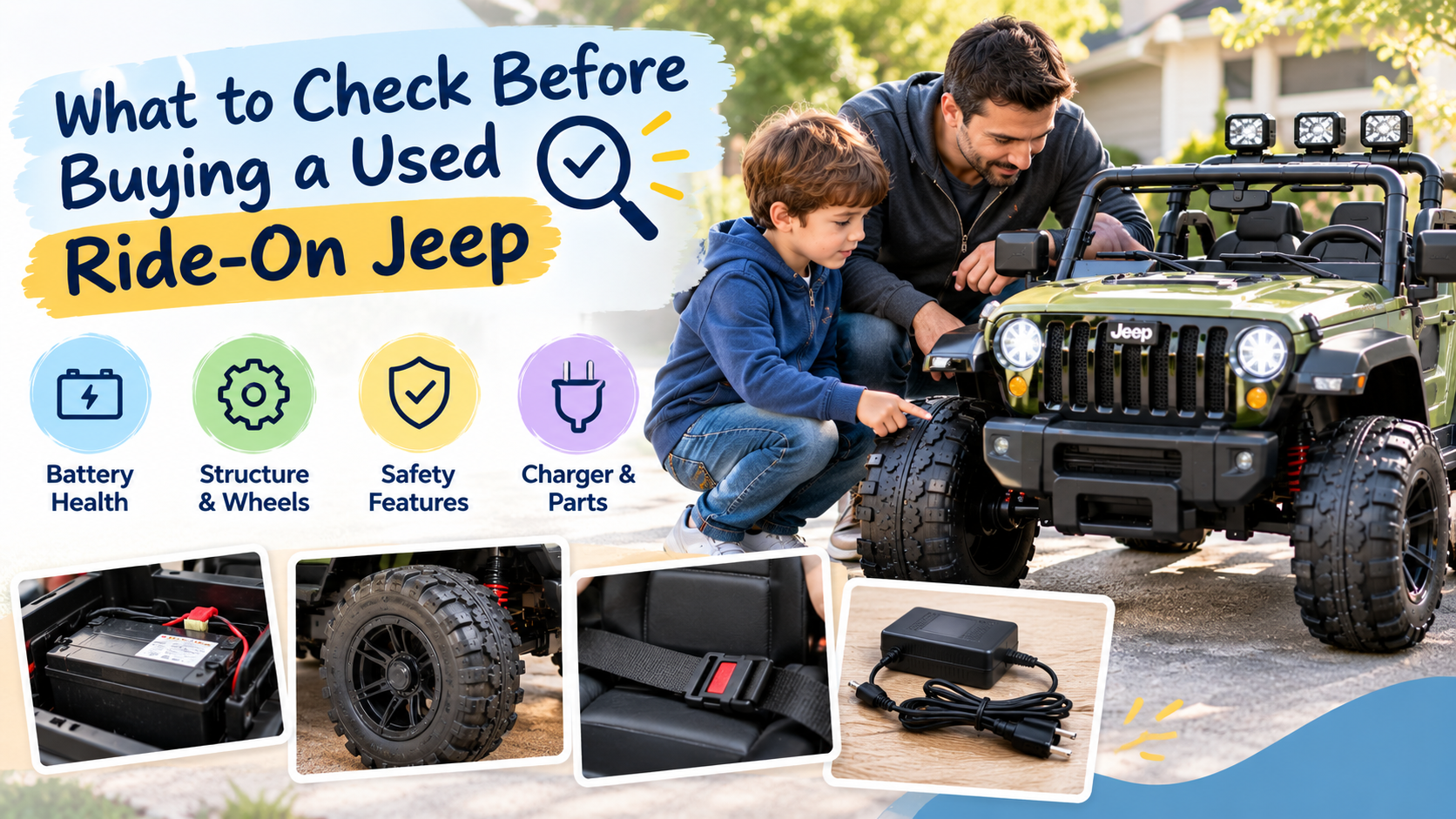
A used ride-on Jeep on Facebook Marketplace or at a neighborhood yard sale can be a genuinely good deal – kids often outgrow these vehicles long before they’re worn out. But a secondhand ride-on comes with risks a brand-new one doesn’t, and a few minutes of inspection before you buy can be the difference between a great find and a vehicle that dies, or becomes unsafe, within weeks.
Short answer: Before buying a used ride-on Jeep, check the battery’s age, type, and charge behavior; inspect the frame, wheels, and panels for cracks or excessive wear; confirm the seatbelt, doors, and brakes still function correctly; and make sure the charger and any other original parts are actually included. A battery that won’t hold a charge is the single most common reason a secondhand ride-on becomes a disappointment, so it deserves the closest attention of anything on this list.
Why Buying a Used Ride-On Jeep Can Make Sense
Kids frequently outgrow a ride-on Jeep well before it’s mechanically worn out, which means the secondhand market is full of vehicles in genuinely good condition at a fraction of the original price. For a short ownership window – a toy a child might use heavily for a year or two before moving on to something bigger – buying used can be a perfectly reasonable way to get a quality vehicle without paying full price for something that will eventually be handed down or resold again. The savings only hold up, though, if the vehicle you’re buying is actually in the condition the listing claims.
Battery: The Single Biggest Risk With a Used Ride-On Jeep
Ask About Battery Age and Type
A ride-on Jeep’s battery is a wear item, not a permanent part, and it’s the component most likely to be the reason a vehicle is being sold in the first place. Ask the seller directly how old the battery is, whether it’s the original one that came with the vehicle, and whether it’s a sealed lead-acid (SLA) or lithium-ion battery, since the two have different lifespans and replacement costs.
Signs a Battery Is Already Failing
Ask the seller to demonstrate the vehicle running, ideally for more than just a minute or two. A battery that powers the vehicle briefly and then noticeably slows down, or one the seller admits “needs a longer charge than it used to,” is likely nearing the end of its useful life. If you can test it yourself before buying, do a short test ride rather than just watching the wheels spin while the vehicle is stationary.
Can You Even Replace the Battery?
Before buying, it’s worth checking whether a replacement battery is realistically available for the specific model and voltage class. Toysporter’s guide to Power Wheels weight limits is a useful reference for understanding how voltage class relates to the battery itself, which can help you figure out what you’d be looking for if a replacement ever becomes necessary.
Checking the Vehicle’s Structure and Safety Features
Frame, Wheels, and Panels
Look closely for cracked plastic body panels, especially around mounting points and the frame underneath the seat, since these are the areas that take the most stress during normal use. Check that all wheels spin freely without wobbling and that tire tread isn’t worn smooth, which affects traction on grass or uneven ground.
Seatbelt and Doors
Test the seatbelt buckle and webbing directly – a belt that doesn’t latch securely or has frayed material isn’t something to plan on “fixing later.” If the model has doors, as many UTV-style Jeeps do, confirm they open, close, and latch properly rather than hanging loosely on worn hinges.
Brakes and Soft-Start Function
If the model includes a distinct braking function or a soft-start acceleration feature, test both directly rather than taking the listing’s word for it. A motor that lurches forward abruptly instead of ramping up smoothly, or a vehicle that doesn’t stop promptly when the pedal is released, is a meaningfully different riding experience – and a safety concern – compared to one that behaves as designed.
Confirming What’s Actually Included
The Charger Matters as Much as the Vehicle
A ride-on Jeep without its original charger is a real problem, since chargers are often model-specific and not something you can easily substitute. Confirm before you buy, not after, that the charger is included and that you’ve seen it actually charge the vehicle.
Missing Parts and Where to Find Them
Steering wheels, seat cushions, mirrors, and other smaller components sometimes go missing by the time a ride-on reaches the secondhand market. None of these are necessarily dealbreakers, but knowing what’s missing before you buy – rather than discovering it once you get the vehicle home – lets you factor replacement cost or availability into your decision.
Questions to Ask the Seller Before You Buy
A short, direct set of questions tends to surface the information that matters most:
- How old is the vehicle, and is this the original battery?
- Can you turn it on and let it run for a few minutes while I watch?
- Is the charger included, and does it work?
- Are there any cracks, loose panels, or non-functioning parts you’re aware of?
- Why are you selling it?
That last question is simple, but sellers are often more candid than a listing description, and “my kid outgrew it” is a very different answer than “it stopped holding a charge a while back.”
When a Used Ride-On Jeep Isn’t Worth the Risk
Some situations are reasonable to walk away from entirely:
- The seller can’t or won’t demonstrate the vehicle running
- The battery is clearly failing and a replacement isn’t readily available for that model
- Structural cracks are visible near load-bearing points like the seat mount or axle
- The seatbelt doesn’t latch securely and can’t be easily repaired
- The asking price is close to what a comparable new model would cost anyway
If a used listing raises more questions than it answers, comparing it against current pricing on a new model is worth doing before committing. Toysporter’s buying guide to outdoor ride-on Jeeps and its ride-on UTV category are useful points of comparison if a secondhand option starts to look like more trouble than it’s worth. New models also come with a working battery, a complete set of parts, and manufacturer safety certifications that a used vehicle’s condition can no longer guarantee.
Frequently Asked Questions
How do I know if a used ride-on Jeep’s battery is still good?
Watch it run for more than a minute or two rather than just confirming it powers on. A battery that starts strong and quickly loses power, or one the seller says needs an unusually long charge, is likely near the end of its lifespan.
Is it safe to buy a used ride-on Jeep without the original charger?
It’s risky. Chargers for ride-on vehicles are often model-specific, and finding a compatible replacement isn’t always straightforward. Confirm the charger is included and working before buying.
What structural damage should I look for on a used ride-on Jeep?
Check closely for cracks near the seat mount, axle, and other load-bearing points, along with wheel wobble and worn tire tread. Cosmetic scratches are generally not a concern; cracks near structural points are.
Should I test the seatbelt and brakes before buying a used ride-on Jeep?
Yes. Test the seatbelt buckle and webbing directly, and take a short test ride if possible to confirm the brakes and acceleration behave as they should, rather than relying on the listing description alone.
Is buying a used ride-on Jeep actually cheaper than buying new?
It often is, but not always by as much as expected once you factor in a potential battery replacement or missing parts. Comparing the used asking price against current new-model pricing is worth doing before deciding.
Conclusion
A used ride-on Jeep can be a genuinely smart purchase, but only when the battery, structure, and safety features hold up to a direct inspection rather than a listing’s word alone. A few focused questions and a short test run before you buy are usually enough to tell a good find from a future headache. If a secondhand option doesn’t check out, Toysporter’s full Jeep and UTV-style lineup offers a reliable new alternative with a working battery and intact safety features from day one.