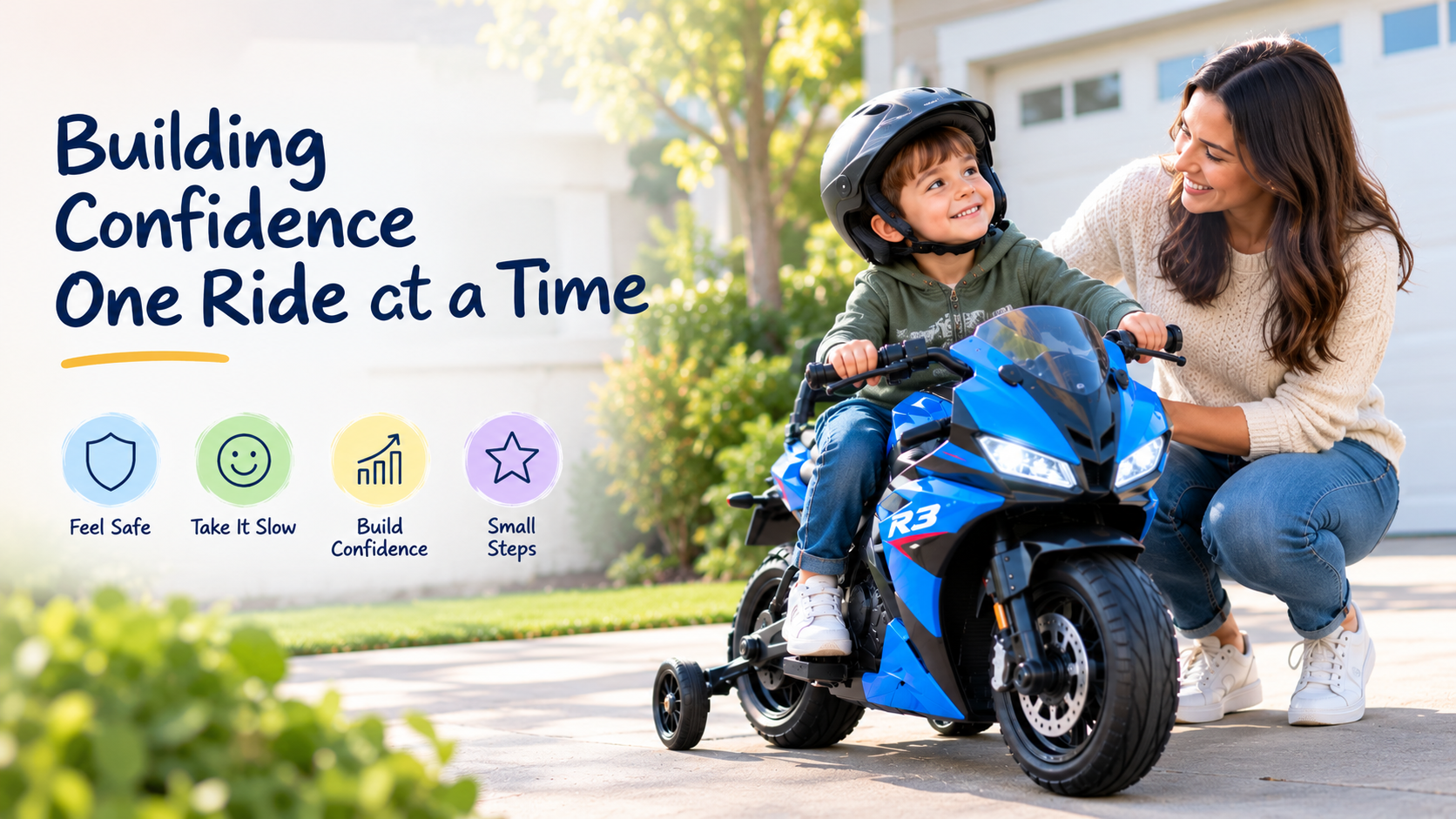
You picked out the motorcycle, assembled it, charged the battery, and your child took one look at it and backed away. This happens more often than most parents expect, and it doesn’t mean anything is wrong with your child or the toy.
Short answer: A child who hesitates to try a new ride-on motorcycle is usually responding to how different it looks and feels from a car-style ride-on, not to anything actually unsafe about it. The fastest way through it is almost never more encouragement or a bigger push – it’s smaller, lower-pressure exposure: letting them sit on it with the motor off, starting at the lowest possible speed, keeping early sessions short, and letting interest build on its own timeline.
Why a New Ride-On Motorcycle Can Feel Intimidating to a Child
Understanding what’s actually going on makes it easier to respond well.
It Looks Different From a Car or UTV
A four-wheeled ride-on car or UTV sits low and wide, and a child can see all four wheels touching the ground. A motorcycle-style ride-on, even one built with training wheels for stability, doesn’t read the same way visually. To a young child, “two wheels” can look like “this might tip over,” regardless of how stable it actually is.
The Motor Sound and Sudden Movement
The moment a battery-powered motor engages, there’s a sound and a small jolt of movement that a child hasn’t experienced before. For a first-time rider, that unexpected sensation – even a mild one – can be enough to make them want off immediately.
Height and the Feeling of Being on Two Wheels
Sitting up higher and straddling a seat, rather than sitting down low inside a car-style body, changes how secure a child feels, even when the actual center of gravity is well controlled by the design.
What Not to Do When a Child Is Reluctant
A few common parent instincts tend to make hesitation worse rather than better:
- Don’t force a ride “to get it over with.” A bad first experience is far more likely to create lasting avoidance than a slow, comfortable introduction.
- Don’t compare them to a sibling or friend who rode confidently right away. Kids pick up on comparison quickly, and it tends to add pressure rather than confidence.
- Don’t turn it into a big audience moment. A crowd of relatives watching and cheering can raise the stakes for a nervous child instead of easing them.
- Don’t assume reluctance means the toy was a bad choice. Interest and readiness often develop over days or weeks, not in the first five minutes.
A Step-by-Step Approach to Building Confidence
Let Them Explore It Off First
Before the motor is ever turned on, let your child sit on the motorcycle, hold the handlebars, and get familiar with how it feels with no movement involved at all. This removes the unknown of “what happens when it moves” from the equation entirely.
Start With the Lowest Speed Setting
If your model has multiple speed settings, use the lowest one for every early session, regardless of how capable your child seems. A slow, predictable first movement does far more for confidence than a faster ride ever will.
Keep the First Sessions Short
Five or ten minutes is plenty for a first attempt. Ending on a positive note, even a very small one, matters more than logging a long ride.
Let a Sibling or Friend Go First, if That Helps
For some kids, watching someone else ride first – especially someone close in age – genuinely helps. For others, it adds pressure. You’ll generally know which type your child is after the first attempt or two.
Celebrate Small Wins, Not Speed or Distance
Sitting on it without asking to get off, turning the handlebars, or riding a few feet are all genuine wins worth acknowledging, independent of how far or fast your child actually goes.
Using the Motorcycle’s Built-In Features to Ease the Transition
Training Wheels and Stability
Toysporter’s 24V Kid’s Electric Motorcycle with Training Wheels includes detachable training wheels specifically designed to keep the vehicle upright, which is worth pointing out to a nervous child directly – showing them the training wheels and explaining that they keep the motorcycle from tipping over can address the exact fear driving the hesitation.
Soft-Start Acceleration
A gradual start, rather than an abrupt jolt forward, is a common design feature on ride-on motorcycles, and it’s worth confirming on your specific model’s product page. A smoother, more predictable start reduces the surprise factor that often triggers a child’s initial fear in the first place.
Choosing a Low-Pressure Practice Space
Where a first attempt happens matters almost as much as how it happens. A quiet, flat, familiar space – your own driveway or a corner of the backyard rather than a busy park – gives a nervous child one less variable to worry about. Toysporter’s guide to space and terrain for ride-on motorcycles is useful for figuring out what a good first practice area actually looks like.
When to Just Let It Be a Someday Toy
Sometimes the most effective approach is simply stepping back. If your child isn’t interested after a couple of low-pressure attempts, it’s completely reasonable to let the motorcycle sit for a few weeks and bring it back out later without any fanfare. Interest in riding toys often develops on its own schedule, tied to a child’s general confidence and coordination at that particular stage, and a toy that gets ignored in October is often embraced enthusiastically in the spring. There’s rarely anything to fix here – just time.
Frequently Asked Questions
Is it normal for a young child to be scared of a new ride-on motorcycle?
Yes, it’s a common reaction, especially for a first two-wheeled ride-on toy. It usually has more to do with how different it looks and feels from a car-style ride-on than with anything actually unstable about the vehicle.
Should I push my child to try it if they’re refusing?
Gentle, low-pressure encouragement is generally more effective than pushing. Letting a child explore the motorcycle with the motor off, at their own pace, tends to work better than insisting on a full ride right away.
Will training wheels actually stop the motorcycle from tipping over?
Training wheels are specifically designed to keep the vehicle upright and stable. Pointing this out directly to a nervous child, and showing them how the training wheels work, can help address the specific fear of tipping.
How long does it usually take for a hesitant child to warm up to a ride-on motorcycle?
It varies significantly by child. Some kids come around within a single session; others take days or weeks of occasional, low-pressure exposure. There’s no fixed timeline, and taking a break entirely is a completely reasonable option.
Should I use the lowest speed setting even if my child seems ready for more?
Yes, especially for the first several sessions. Starting slow builds a foundation of comfort and control that makes it easier for a child to handle higher speeds confidently later on.
Conclusion
A child’s hesitation toward a new ride-on motorcycle is rarely about the toy itself – it’s about an unfamiliar sensation that eases with small, low-pressure exposure over time. Letting your child explore at their own pace, starting slow, and pointing out the specific features designed to keep them stable usually does more than any amount of encouragement. If you’re still deciding whether a ride-on motorcycle is the right fit for your child, Toysporter’s ride-on motorcycle collection is worth a look, and for families exploring the full range of ride-on vehicle types, Toysporter’s homepage is a good starting point for comparing options that might feel like a more comfortable first step.