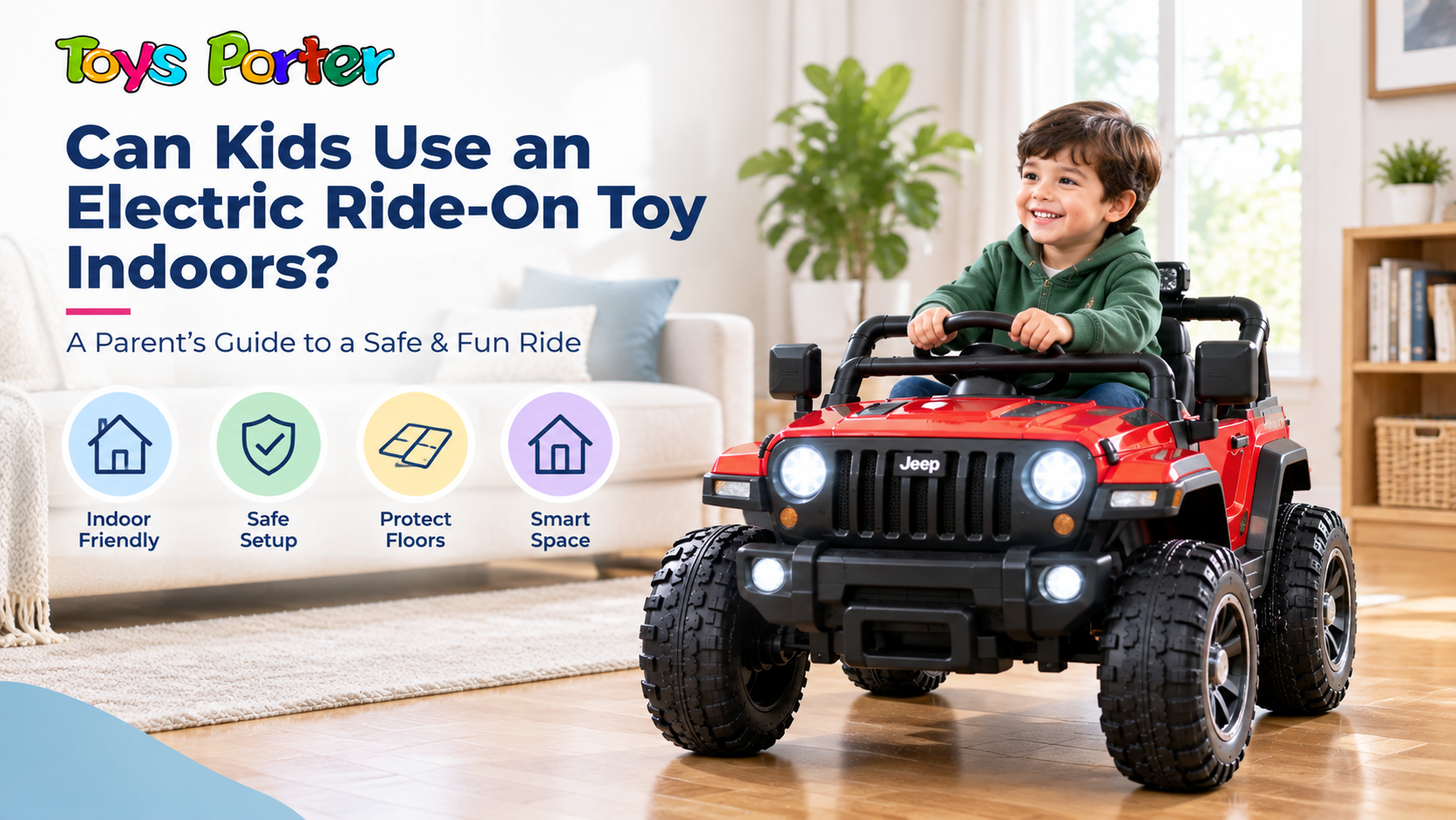
When rain, cold, or a tiny yard keeps kids off the driveway, it’s tempting to roll the ride-on into the garage or living room. Sometimes that works well. Other times it ends with scuffed floors, bumped furniture, or a child aimed at the stairs. Knowing which situation you’re in makes all the difference.
Short answer: Some compact ride-on vehicles can be used indoors on hard floors, but most are designed for driveways, patios, and yards. Whether it works depends on the vehicle’s size, its wheels, your floor type, the space available, and the speed setting. Toysporter’s own guidance is that some compact models can be used indoors on hard floors, while most are best outdoors. Always follow the manual that comes with your specific model, and supervise every indoor ride.
Which Ride-On Toys Make Sense Indoors
Not every ride-on is a good candidate. Three factors matter most.
Size and Turning Space
A vehicle needs room to turn without hitting walls or furniture. A compact one-seater is far easier to maneuver in a garage or open playroom than a larger two-seater. If indoor riding is a priority, it is worth choosing with that in mind, as Toysporter’syear-end buying guide suggests for families with limited indoor space.
Vehicle Type
Some vehicle types suit indoor use better than others. Toysporter’s electric vehicle listings describe its trackless ride-on train as gliding over wooden floors and patios, and describe the wheels as wear-resistant and quiet. Those are listing claims, so check the current product page and manual for your model. Larger off-road styles such as ATVs and UTVs are built for outdoor terrain and typically have more power and bulk than a room can comfortably handle.
Voltage and Speed
Toysporter’s24V vs. 12V ATV comparison notes that a 12V model is acceptable for a child under 3 on smooth, flat surfaces like driveways or hardwood floors, and that a 24V model still works in low-speed mode. In general, slower vehicles and lower speed settings are far better suited to enclosed spaces.
Floors: Wheels and Surfaces
The floor is often the first thing to worry about.
Hardwood, Tile, and Laminate
Hard, smooth floors are usually the most workable indoor surface. Rubber or EVA tires tend to be quieter and grip better than hard plastic, as Toysporter’sholiday gift guidepoints out. That said, no wheel is guaranteed to leave a floor untouched. Test in a small, out-of-the-way spot first and check for marks before committing to a full room.
Carpet and Rugs
Thick carpet and loose rugs can make it harder for a ride-on to move and may bunch up under the wheels. A vehicle that struggles on soft surfaces can also strain its motor, so a flat, firm surface is the safer choice.
Wheels Coming In From Outside
Grit, sand, and small stones stuck in the tread can scratch a hard floor. If the same vehicle goes outdoors, wipe the wheels before driving inside.
Setting Up the Room Safely
An indoor space has hazards a driveway doesn’t.
Hazards to Clear Out
Before a ride, walk the route and remove anything that could become a problem:
Stairs and open stairwells (block them completely)
Glass doors, fireplaces, and heaters
Cords, cables, and low tables with sharp corners
Pets and toddlers who could wander into the path
Speed and Remote Control
Start on the lowest speed setting. Toysporter’s gift guide recommends models with a 2.4G parental remote so a parent can take over steering or stop the vehicle, which is especially useful in a tight space. Confirm that your specific model includes one.
Supervision
Indoor spaces are smaller and full of obstacles, so stay in the room and within reach. Toysporter’sride-on UTV and off-road Jeep safety guide covers supervision habits that apply here too.
Charging and Battery Basics When It Lives Indoors
Bringing a ride-on inside often means charging it inside as well. Charge according to the manual, in a dry area, and keep the charger and cord out of your child’s play path. If the vehicle normally sits in a cold garage, letting it come to room temperature before use is sensible, but check your manual for specific battery guidance.
Indoor vs. Outdoor: Quick Reference
Factor
Indoor use
Outdoor use
Best vehicle size
Compact, easy to turn
Any size the space allows
Best surface
Smooth, hard floors
Driveways, patios, yards
Speed
Lowest setting
Any setting the child can handle
Main risks
Furniture, stairs, floor marks
Traffic, uneven ground
Supervision
Constant
Constant
When to Skip Indoor Riding
Indoor riding probably isn’t a good idea when:
The vehicle is a larger two-seater or off-road model
The room is small or crowded with furniture
Your home has open stairs the child could reach
Your floors are delicate or hard to repair
The manual advises against indoor use
Frequently Asked Questions
Can a kid ride a Power Wheels-style toy inside the house?
Some compact models can be used on hard floors, but most are designed for outdoor use. Check your manual, use the lowest speed, and supervise closely.
Will a ride-on toy scratch my hardwood floor?
It can. Rubber or EVA wheels are generally gentler than hard plastic, but there’s no guarantee, so test a small area first and keep the wheels clean.
Is it safe to ride an electric ride-on in a garage?
A garage can work if the floor is smooth and the space is cleared of hazards. Keep cars, tools, and cords out of the path and watch for garage-door hazards.
Is a ride-on train better for indoor use than a car?
Some train listings describe wheels suited to wood floors, but it depends on the specific model. Always check the product page and manual.
What speed setting should I use indoors?
The lowest one. Slower speeds give a child more time to react and reduce the force of any bump.
Conclusion
Indoor riding can be a great cold-weather option when the vehicle is compact, the floor is smooth, the room is clear, and an adult is watching. If you’re still deciding which vehicle fits your space, you can browseToysporter’s full ride-on lineup to compare sizes and features.