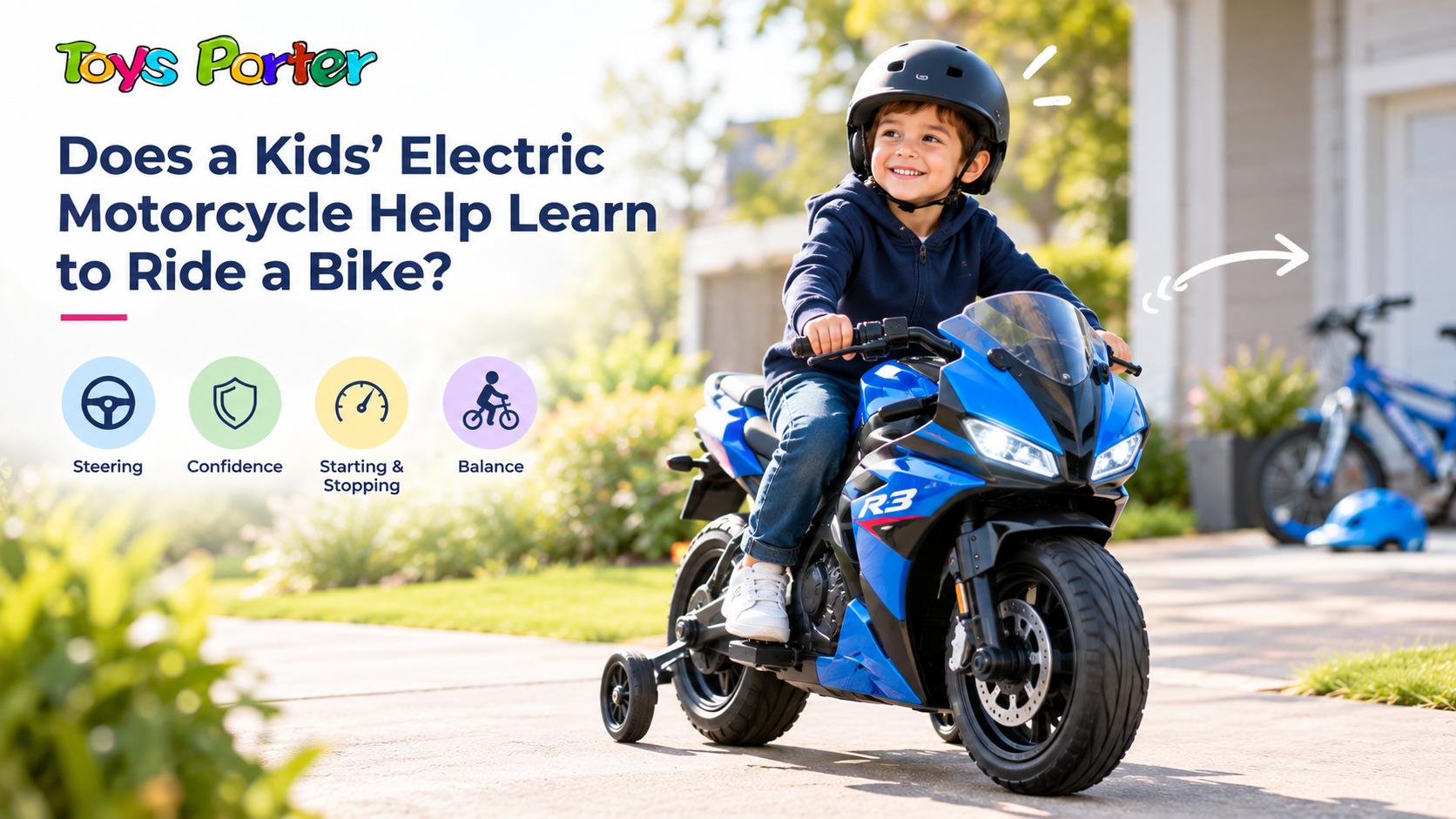
Many product pages suggest that a ride-on motorcycle prepares a child for a real bike. The truth is more mixed, and knowing where it lines up and where it doesn’t will help you decide whether the purchase fits your goals.
Short answer: A battery-powered ride-on motorcycle with training wheels can build familiarity with steering, starting, stopping, and following riding rules. It does not teach balance, because the training wheels keep the vehicle upright, and it does not teach pedaling. Treat it as a fun, confidence-building toy, not as bicycle training. This article doesn’t rely on studies, because I’m not aware of rigorous research showing that ride-on toys speed up bike learning, so the points below are practical reasoning rather than proven outcomes.
What Learning to Ride a Bike Actually Requires
Riding a pedal bike combines several skills at once. Understanding them shows where a ride-on motorcycle overlaps and where it doesn’t.
Balance
Staying upright on two wheels is usually the hardest part. It comes from making constant small corrections while moving.
Steering and Looking Ahead
Children learn to point the bike where they want to go and to keep their eyes up instead of on the front wheel.
Pedaling and Braking
Pedaling adds leg coordination, and stopping means learning a brake system, which differs from bike to bike.
Where a Ride-On Motorcycle Can Help
A ride-on motorcycle isn’t a bicycle, but it can give a child some useful early experience.
Steering and Directional Control
Handlebars that turn the front wheel, and a vehicle that goes where you point it, are concepts that carry over to any wheeled ride.
Comfort With Starting, Stopping, and Speed
Kids get used to a start-stop routine, to slowing down before turns, and to the idea that a vehicle has to be controlled. For families new to these vehicles, ourspace and terrain guide for ride-on motorcycles and trains helps you plan a suitable riding area.
Outdoor Confidence and Riding Habits
A child who is comfortable sitting on a “motorcycle,” wearing a helmet, and riding only where a parent says is building habits that make any first bike easier. This is the most realistic benefit, and it is behavioral, not physical.
Where It Doesn’t Transfer
Balance
Toysporter’s24V kids’ electric motorcycle is listed with training wheels. Training wheels do their job by holding the vehicle upright, so the child isn’t practicing balance while riding. The listing describes them as detachable, so check the product page and manual for what the manufacturer says about removal, since riding without them changes how the vehicle behaves.
Pedaling
A battery does the work, so the leg coordination that pedaling requires isn’t practiced at all.
Braking Feel
Ride-on motorcycles typically use a simple stop-on-release or foot-pedal system, which feels different from hand brakes or coaster brakes on a bike.
Comparing Common First-Ride Options
This is a general comparison of what each option tends to emphasize, not a ranking.
Skill
Ride-on motorcycle with training wheels
Balance bike
Pedal bike with training wheels
Balance
Not practiced
Central focus
Limited
Steering
Yes
Yes
Yes
Pedaling
No
No
Yes
Powered by
Battery
Child’s feet
Child’s legs
Best described as
Play and independence
Balance practice
Pedaling practice
How to Get the Most Out of It
If your goal includes eventually riding a bike, you can pair the ride-on with simple activities:
Let your child try a scooter, balance bike, or pedal bike in a safe space alongside their ride-on time.
Practice stopping on cue, such as “stop at the cone,” so it becomes a habit.
Keep the helmet routine consistent across every ride-on vehicle.
Supervise closely and keep rides on flat, appropriate surfaces.
Who a Ride-On Motorcycle Is Good For
It suits families who want an outdoor toy that captures a child’s interest in motorcycles, gives them a sense of independence, and fits their yard or driveway. It is a poor choice if the only goal is teaching balance quickly. You can browse Toysporter’sride-on motorcycle collection with that expectation in mind.
Frequently Asked Questions
Does riding a ride-on motorcycle teach a child balance?
Not while training wheels are attached, since they keep the vehicle upright. Balance is better practiced on a balance bike or scooter.
Can my child go straight from a ride-on motorcycle to a pedal bike?
Some kids do, but the ride-on doesn’t cover balance or pedaling, so expect to teach those separately.
Are the training wheels on a ride-on motorcycle removable?
Toysporter’s 24V kids’ motorcycle listing describes detachable training wheels. Check the product page and manual for the manufacturer’s guidance before removing them.
Is a ride-on motorcycle a good first vehicle?
It can be, especially for play and building riding habits. The right choice depends on your child’s size, comfort, and your riding space.
Do ride-on motorcycles have any developmental benefits?
Many parents feel their kids gain confidence and coordination, but I’m not aware of solid research proving specific outcomes, so it’s best to treat those as possible extras.
Conclusion
A ride-on motorcycle is best understood as a fun, confidence-building outdoor toy, not a shortcut to riding a bike. If you want to explore options for your child,Toysporter’s full ride-on lineup is a good place to start.