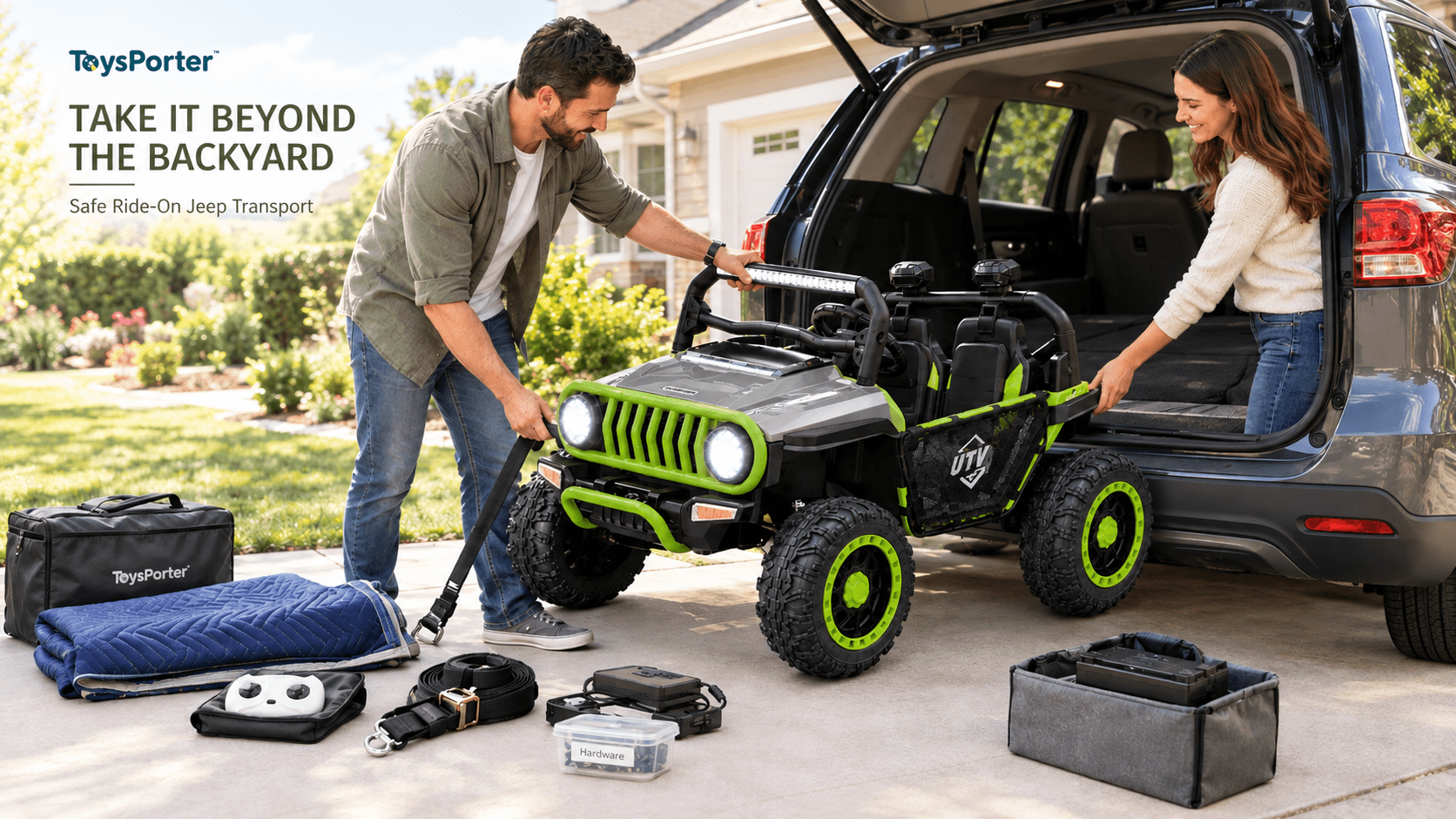
The first time a family tries to bring their kid’s ride-on Jeep to a birthday party, a cookout, or grandma’s driveway, they usually run into the same problem: nobody designed these vehicles with “fits in the trunk” in mind.
Quick answer: Most assembled kids’ ride-on Jeeps and UTVs are too large to fit in a standard sedan trunk. They generally travel best in an SUV, minivan, or pickup truck bed, or with partial disassembly – removing the seat, steering wheel, or doors on models where those pieces detach – to fit into a smaller vehicle. The battery can usually be removed separately, which both reduces weight and lets you charge it at your destination if needed. The rest of this guide walks through what actually needs to happen to move a ride-on Jeep safely, without damaging it or arriving somewhere with a vehicle that won’t turn back on.
Will It Actually Fit in Your Car?
This is the question that trips up most families, because a ride-on Jeep looks compact in a driveway but takes up more room than expected once you’re trying to angle it into a trunk.
Sedans. Fully assembled, most 2-seater ride-on Jeeps and UTVs will not fit in a standard sedan trunk. The cab width and overall length are simply too large for most trunk openings, even with rear seats folded down.
SUVs and minivans. This is where most families land. With the rear seats folded flat, a ride-on Jeep typically fits without needing to remove major components – though it’s worth measuring your specific cargo area against the vehicle’s footprint before assuming it’ll slide in easily, since cargo dimensions vary a lot between compact and midsize SUVs.
Pickup trucks. A truck bed is usually the most forgiving option, especially for models with a taller roll bar or windshield that would otherwise need to come off to clear a lower vehicle roofline. Securing the vehicle so it can’t slide or tip during transport is still essential.
Trailers. For families who move a ride-on Jeep frequently – regular trips to a relative’s house, a family lake property, or recurring outdoor events – a small utility trailer removes the guesswork entirely and avoids repeated loading and unloading through a vehicle’s interior.
Do You Need to Take It Apart?
Sometimes, but not always – and how much depends on both your vehicle and the specific model.
Many ride-on Jeeps have a handful of components that detach without tools: the steering wheel, the seat (on some models), and on Jeep-style UTVs with real doors, the doors themselves often lift off their hinges the same way they’d come off during a repair, which is covered in Toysporter’smaintenance guide for ride-on UTVs and off-road Jeeps. Removing these pieces can shave off just enough width or height to make the difference between “doesn’t fit” and “fits with room to spare.”
What generally should not be removed for a routine trip: the main body shell, the axles, or anything that isn’t designed to be disassembled without tools. If a ride-on Jeep needs more than the quick-release parts removed to fit your vehicle, it’s usually a sign you need a different vehicle for the trip rather than a more aggressive disassembly attempt. Anyone who assembled the Jeep originally already has a good sense of which parts came together easily – the same logic that applied duringinitial assembly applies in reverse here.
A Practical Pre-Trip Checklist
Before loading up, a few minutes of prep prevents most of the common transport headaches:
Check the battery charge level. A full charge before you leave means the Jeep is ready to drive the moment you arrive, without waiting around for a charge at your destination.
Remove the battery if your trip is long or hot. A battery left connected and exposed to a hot trunk or truck bed for hours isn’t doing itself any favors – disconnecting it for transport is a simple extra step that protects battery health.
Fold in or remove the side mirrors and antenna, if present. These are usually the first things to snap off during loading if they’re left extended.
Secure it so it can’t shift. Cargo straps or tie-downs anchored to solid points on the frame keep the vehicle from sliding around during braking or turns – loose ride-on toys in a trunk or truck bed can scratch, crack plastic body panels, or tip.
Bring the charger. It’s an easy thing to leave behind, and without it, a dead battery at your destination means a Jeep that just sits there.
Note which parts you removed and where the hardware is. A small labeled bag or container for any bolts or clips prevents the classic “which screw goes where” moment during reassembly.
Charging Away From Home
If you’re staying somewhere for more than a day, charging capability matters as much as getting the Jeep there in the first place. A standard household outlet is all most ride-on Jeep chargers need, so as long as your destination has regular household power, charging works the same way it does at home. What’s worth planning for is charge time – most kids’ ride-on vehicles take several hours for a full charge, so plugging it in as soon as you arrive, rather than waiting until the next time your child wants to ride, avoids a disappointed kid staring at a Jeep that isn’t ready to go.
Riding Somewhere New
Part of the appeal of bringing a ride-on Jeep somewhere else is that it opens up a different driving environment than the same backyard loop. Before assuming a new location will work the same way home does, it’s worth a quick read of Toysporter’sterrain guide for ride-on UTVs, since gravel driveways, uneven yards, or a relative’s sloped lawn can behave differently than the surface your child usually drives on. The same house rules and supervision habits that apply at home – outlined in Toysporter’sUTV and off-road Jeep safety guide – are worth carrying over to a new environment too, since an unfamiliar yard means a child is less likely to already know where the uneven patches or hazards are.
Common Situations Families Run Into
A grandparent’s house. Often the most frequent destination, and usually the easiest – most driveways and yards work fine, and leaving a Jeep there between visits (if there’s storage space) can save you from transporting it every single trip.
A family gathering or cookout. Bringing a ride-on Jeep to a location with multiple kids present is worth pairing with a quick read of Toysporter’s guide onsharing a ride-on Jeep between siblings, since the same turn-taking and fairness considerations apply just as much with cousins or friends as they do at home.
A vacation or extended stay. For trips longer than a weekend, factor in charging schedules realistically – a Jeep that only gets used for short bursts each day may only need a charge every couple of days, but daily heavy use will need daily charging time built into the schedule.
A one-time event. For something like a single birthday party, it’s often simpler to skip disassembly altogether and use whichever vehicle in the family fits it fully assembled, even if that means asking to borrow an SUV or minivan for the day rather than wrestling with sedan trunk logistics.
Vehicle Type Comparison for Transport
Vehicle Type
Fits Fully Assembled?
Disassembly Usually Needed?
Best For
Sedan
Rarely
Often significant
Not recommended without borrowing a larger vehicle
SUV / Minivan
Usually, with seats folded
Rarely
Most families’ regular trips
Pickup truck bed
Yes, with secure tie-down
Rarely
Larger models, frequent trips
Utility trailer
Yes
No
Families transporting regularly
What to Avoid
Don’t leave the battery connected in a hot, enclosed trunk for hours. Heat is hard on battery health regardless of the season, and a sealed trunk on a warm day gets hotter than the outside air.
Don’t stack anything heavy on top of the Jeep during transport. Plastic body panels aren’t designed to bear weight from above.
Don’t skip the tie-down straps because “it’s a short trip.” Sudden braking can shift an unsecured vehicle even over a few miles.
Don’t force a fit. If a Jeep genuinely won’t fit your vehicle even with the removable parts taken off, that’s a sign to borrow a bigger vehicle or use a trailer rather than attempting a disassembly the manufacturer never intended.
The Bottom Line
A ride-on Jeep wasn’t built with road trips in mind, but with a little planning most families can get one wherever they need it to go – an SUV or minivan with the seats folded handles the majority of trips without any disassembly at all, and the parts that do come off tend to be the same ones designed for easy removal during assembly or repair in the first place. Whether it’s a weekly trip to grandma’s or a once-a-year family reunion, a few minutes of prep is usually the difference between a smooth trip and a frustrating one. For families weighing whether their current setup –Toysporter’s ride-on UTV and Jeep lineupamong them – is the right size for how much traveling they actually do, it’s worth factoring transport frequency into future buying decisions the same way terrain and backyard space already get considered.
FAQ
Can a kids’ ride-on Jeep fit in a normal car trunk?
Usually not fully assembled. Most 2-seater ride-on Jeeps and UTVs are too large for a standard sedan trunk. An SUV, minivan, or truck bed typically works without needing to remove major parts.
Do I need tools to disassemble a ride-on Jeep for transport?
Often not, for the parts designed to be quick-release – a detachable steering wheel, seat, or doors on models that have them. Anything requiring tools to remove usually isn’t meant to come off for a routine trip.
Should I remove the battery before a car trip?
For shorter trips, it’s optional. For longer trips or hot weather, removing the battery reduces weight and avoids leaving it exposed to heat buildup in an enclosed trunk or truck bed.
Can I charge a ride-on Jeep’s battery at someone else’s house?
Yes, as long as there’s access to a standard household outlet. The charger works the same way it does at home; just bring it along, since it’s an easy item to forget.
Is it safe to transport a ride-on Jeep in a truck bed?
Yes, as long as it’s secured with tie-down straps so it can’t shift or tip during driving. An unsecured vehicle in a truck bed can slide during braking or turns.
How long does a ride-on Jeep battery take to fully charge after a trip?
It varies by model and battery type, but several hours is typical for most kids’ ride-on vehicles. Planning to charge immediately upon arrival, rather than waiting until playtime, avoids delays.