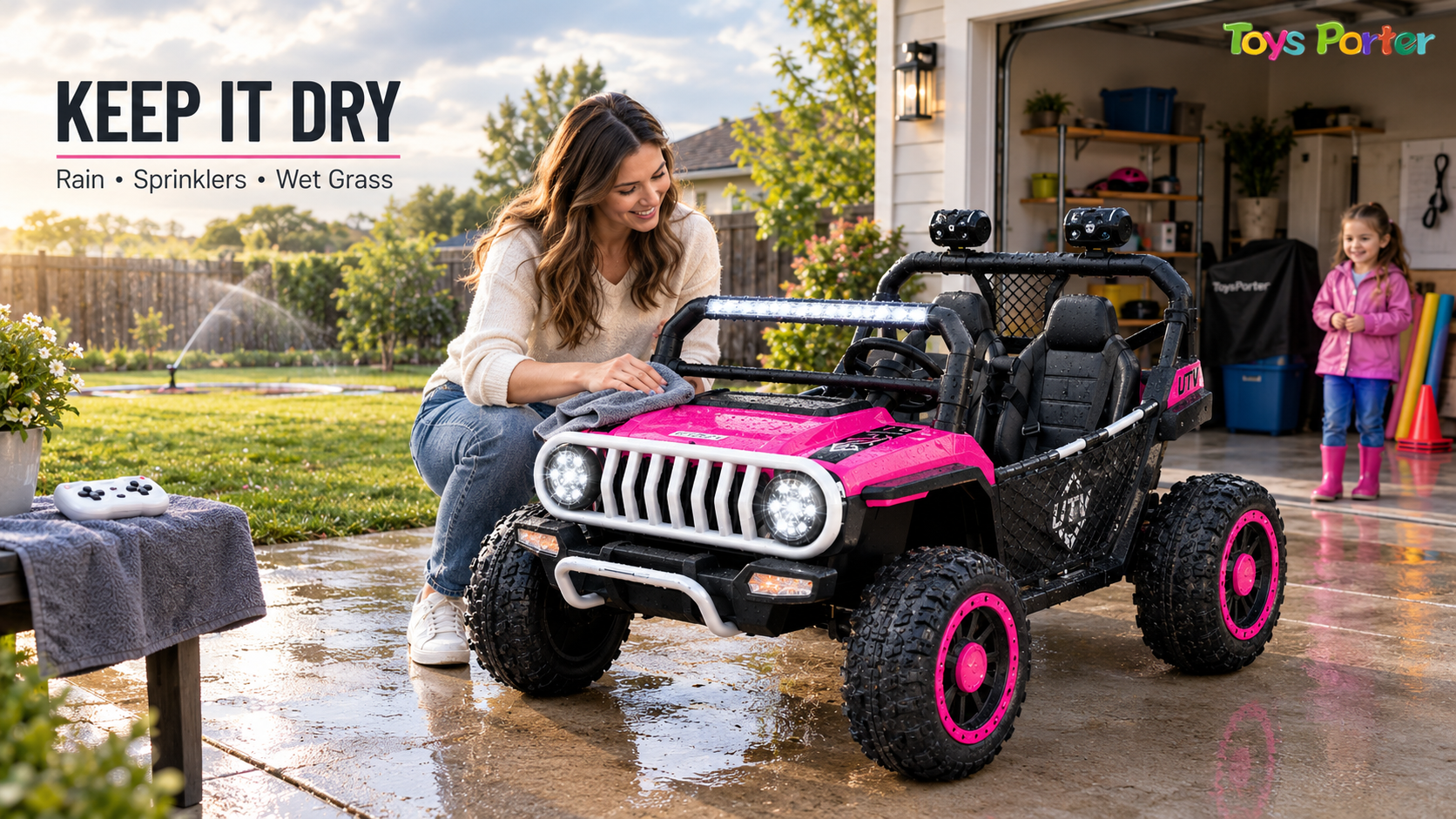
The forecast said sunny. Then, ten minutes into backyard playtime, the sky opens up – and your kid’s ride-on Jeep is sitting in the middle of the lawn, soaking.
The short answer: no, a kids’ electric ride-on Jeep should not get wet, and it isn’t designed to. A few minutes of light rain on a body panel usually isn’t a disaster, but standing water, soaked grass, sprinklers, hoses, and prolonged rain exposure can all reach the battery compartment and wiring, where water and electronics don’t mix well. The good news is that most water exposure is manageable if you know what to check and what to avoid.
This guide walks through exactly what happens when a ride-on Jeep gets wet, what to do in the first hour afterward, how wet-weather riding differs from a quick rain scare, and how to keep a Jeep-style ride-on protected if you live somewhere that gets a lot of rain, humidity, or sprinkler overspray.
Why Water Is a Real Concern for Electric Ride-On Jeeps
A kids’ ride-on Jeep looks rugged – metal-look fenders, chunky tires, an “off-road” name – but underneath the body it’s an electrical device. It runs on a rechargeable battery, a motor, and a network of wiring and connectors that carry power from one to the other. None of that is built to be waterproof, even on models marketed as all-terrain.
Water becomes a problem in three main ways:
Battery compartment intrusion. Most ride-on Jeeps store the battery in a compartment under the seat or hood. If water reaches it, it can cause corrosion on the terminals or, in worse cases, a short circuit.
Connector and wiring corrosion. The small connectors linking the battery, motor, and controls are the most vulnerable point. Corrosion here often shows up weeks later as intermittent power loss rather than an immediate failure.
Motor and control module exposure. Water that works its way to the motor housing or the electronic speed controller can cause it to run erratically or stop responding to the pedal or remote.
None of this means a light drizzle will instantly destroy the vehicle. It means water exposure is a “check before the next ride” situation, not a “shrug it off” one.
Rain vs. Wet Grass vs. Sprinklers vs. Puddles: Not All Water Exposure Is Equal
Parents often lump all wet-weather situations together, but they carry different levels of risk.
Situation
Risk Level
What to Do
A few raindrops during a quick dash inside
Low
Wipe dry, no action needed
Left outside during a rain shower, 15–30 minutes
Moderate
Dry thoroughly, check battery compartment before next ride
Driven through a sprinkler or across wet grass
Moderate
Wipe down undercarriage, dry connectors, avoid repeat exposure
Driven through or parked in standing water/puddles
High
Do not charge until fully dry; inspect battery compartment closely
Left outside overnight in rain
High
Full inspection before use; watch for corrosion over the following weeks
Hosed down to clean off mud
High (if done incorrectly)
Follow the safe-cleaning steps below rather than spraying directly
The pattern here matters more than any single number: brief, incidental contact is manageable; sustained or repeated exposure is what causes lasting damage. This lines up with what Toysporter notes on its own UTV product pages – that these vehicles are designed for grass, packed dirt, gravel, and paved surfaces, but wet surfaces specifically fall outside what’s recommended for regular riding.
What to Do If Your Ride-On Jeep Gets Wet
If your child’s Jeep has already been caught in the rain, driven through a sprinkler, or left out overnight, here’s the order of operations that actually protects the vehicle.
Don’t charge it while it’s wet. This is the single most important step. Charging introduces electrical current into a system that may have moisture sitting in the connectors – that’s when corrosion and shorts are most likely to happen. Let it dry completely first.
Move it somewhere dry and ventilated. A garage, covered porch, or indoor space with airflow works better than a closed plastic bin, which traps moisture rather than letting it evaporate.
Wipe down the exterior and visible seams. Focus on door edges, the seat seam, and any panel gaps where water tends to collect rather than run off.
Open the battery compartment and check for moisture. Most models have a seat that lifts or a compartment door that opens without tools. If you see water or dampness, leave the compartment open to air out.
Dry it for at least 24 hours before the next ride. In humid climates, 48 hours is safer. There’s no harm in waiting an extra day if you’re unsure.
Inspect the battery terminals and connectors for a white or greenish film, which is an early sign of corrosion. A dry cloth is usually enough for light residue; anything more should be checked against the vehicle’s manual or discussed with Toysporter support before charging.
Do a low-speed test ride on a dry, flat surface before letting your child use it normally, so you catch any hesitation, stalling, or intermittent power before it becomes a bigger issue.
If the vehicle won’t power on, runs inconsistently, or the lights flicker after a wet-weather incident, that’s worth troubleshooting properly rather than guessing – Toysporter’stroubleshooting guide for a ride-on Jeep that isn’t working covers the most common causes, several of which overlap with water-related connector issues.
Cleaning a Ride-On Jeep the Safe Way
A ride-on Jeep that’s been through a muddy backyard session needs cleaning, but the instinct to hose it down like a real car is exactly how water ends up where it shouldn’t be. A safer routine:
Use a damp cloth, not a hose or pressure washer, for the body, tires, and wheel wells.
Keep water away from the seat seam, door hinges, and any visible panel gaps near the battery compartment.
Clean mud out of tire treads with a dry brush before it dries into a harder, more stubborn layer.
Dry the vehicle with a towel immediately after cleaning, rather than letting it air-dry outside where it might pick up more moisture from dew or a second rain shower.
Never clean the battery compartment or connectors with a wet cloth – a dry brush or dry cloth only.
This is a good complement to the routine upkeep covered in Toysporter’sride-on UTV and Jeep maintenance guide, which focuses on tires, doors, and battery habits rather than water-specific cleaning.
Riding During or Right After Rain: What’s Actually Safe
A common question is whether it’s okay to let a child ride once the rain has stopped but the ground is still wet. A few practical guardrails:
Wet grass and puddled pavement reduce both traction and braking distance, which is a handling issue as much as a moisture issue – worth pairing with the terrain guidance in Toysporter’sride-on UTV terrain guide.
Avoid driving directly through puddles, even shallow ones, since this is one of the more direct ways water reaches the underside of the vehicle.
A quick ride across a lightly damp driveway is lower-risk than sustained riding on soaked grass, where water sits longer against the undercarriage.
If the forecast shows rain arriving mid-play, it’s worth ending the session early rather than racing to beat the storm – a rushed dash inside is how vehicles get left out “just for a minute” that turns into much longer.
Storage and Climate Considerations for Rainy Regions
Families in consistently wet or humid climates – the Pacific Northwest, the Gulf Coast, parts of the Northeast – deal with this more often than a one-time rain scare, and storage habits matter more here than anywhere else.
Store indoors between rides whenever possible. A garage, shed, or covered patio protects far better than an open driveway, even overnight.
If outdoor storage is unavoidable, use a weatherproof cover designed for ride-on toys or small vehicles, and check underneath it occasionally for trapped condensation, which can be just as damaging as direct rain.
In humid climates, air out the battery compartment periodically even without a specific rain incident, since ambient moisture can accumulate over weeks.
During a rainy stretch, consider bringing the battery indoors separately if your model allows it, which limits exposure without requiring the whole vehicle to be moved.
For general seasonal and off-season storage practices beyond wet-weather specifics, Toysporter’sbattery care, charging, and storage guide goes deeper into keeping the battery healthy long-term.
Warranty and Support: What Water Damage Usually Means
It’s worth setting realistic expectations here: water damage from rain, sprinklers, or improper cleaning is generally treated differently from a manufacturing defect, since it results from exposure after purchase rather than a fault in the vehicle itself. Coverage details vary by product and situation, so if a ride-on Jeep has been exposed to water and isn’t behaving normally afterward, the most reliable next step is checking Toysporter’sFAQs page for current warranty and return-window details or reaching out to support directly, rather than assuming either way.
A Practical Pre-Storm Checklist
Keep this in mind any time rain is in the forecast and the Jeep has been out:
Bring the vehicle indoors or under solid cover before the rain starts, not after.
If it’s already wet, don’t charge it – dry it first.
Check the battery compartment and connectors before the next ride.
Wipe down, don’t hose down, when cleaning off mud or dirt.
Watch for corrosion signs (white or green residue) in the weeks following any significant water exposure.
When in doubt about a specific model’s compartment design, the product listing on theRide-On UTV orElectric Vehicles pages is the most accurate source, since battery placement can vary between models.
The Bottom Line
A kids’ electric ride-on Jeep can survive the occasional rain scare or sprinkler mishap without lasting harm, as long as it’s dried out properly and not charged while wet. What it can’t handle well is sustained exposure – sitting out overnight in a storm, regular puddle-driving, or being hosed down like a real vehicle. Treat water the way you’d treat any other electronic outdoor toy: quick exposure is a minor inconvenience, prolonged exposure is a maintenance problem, and a little bit of dry-storage discipline goes a long way toward getting several riding seasons out of it. For families weighing a purchase, Toysporter’s home page is a good starting point for comparing ride-on Jeep and UTV models built for U.S. backyards and outdoor play.
FAQ
Can a kids’ ride-on Jeep get rained on? Brief rain exposure usually isn’t catastrophic, but it should be dried out before the next charge or ride. Prolonged rain exposure increases the risk of corrosion in the battery compartment and connectors.
Is it safe to drive a ride-on Jeep through a sprinkler? It’s best avoided. Sprinklers can push water directly into panel gaps and the undercarriage, which is more direct exposure than typical rain.
Can I hose off my kid’s ride-on Jeep to clean it? No – use a damp cloth instead. A hose, especially at any pressure, can push water into the battery compartment and electrical connectors, which a light wipe-down won’t.
What should I do if my ride-on Jeep’s battery got wet? Don’t charge it. Let the battery compartment air out fully for at least 24–48 hours, check for corrosion on the terminals, and do a low-speed test ride before returning to normal use.
How do I know if water has damaged my ride-on Jeep? Watch for inconsistent power, flickering lights, unusual stalling, or a vehicle that won’t power on after a wet-weather incident. These symptoms often show up gradually rather than immediately.
Can I store my ride-on Jeep outside if I use a cover? A weatherproof cover helps but isn’t a full substitute for indoor storage, especially in consistently rainy or humid climates. Check under the cover occasionally for trapped moisture.