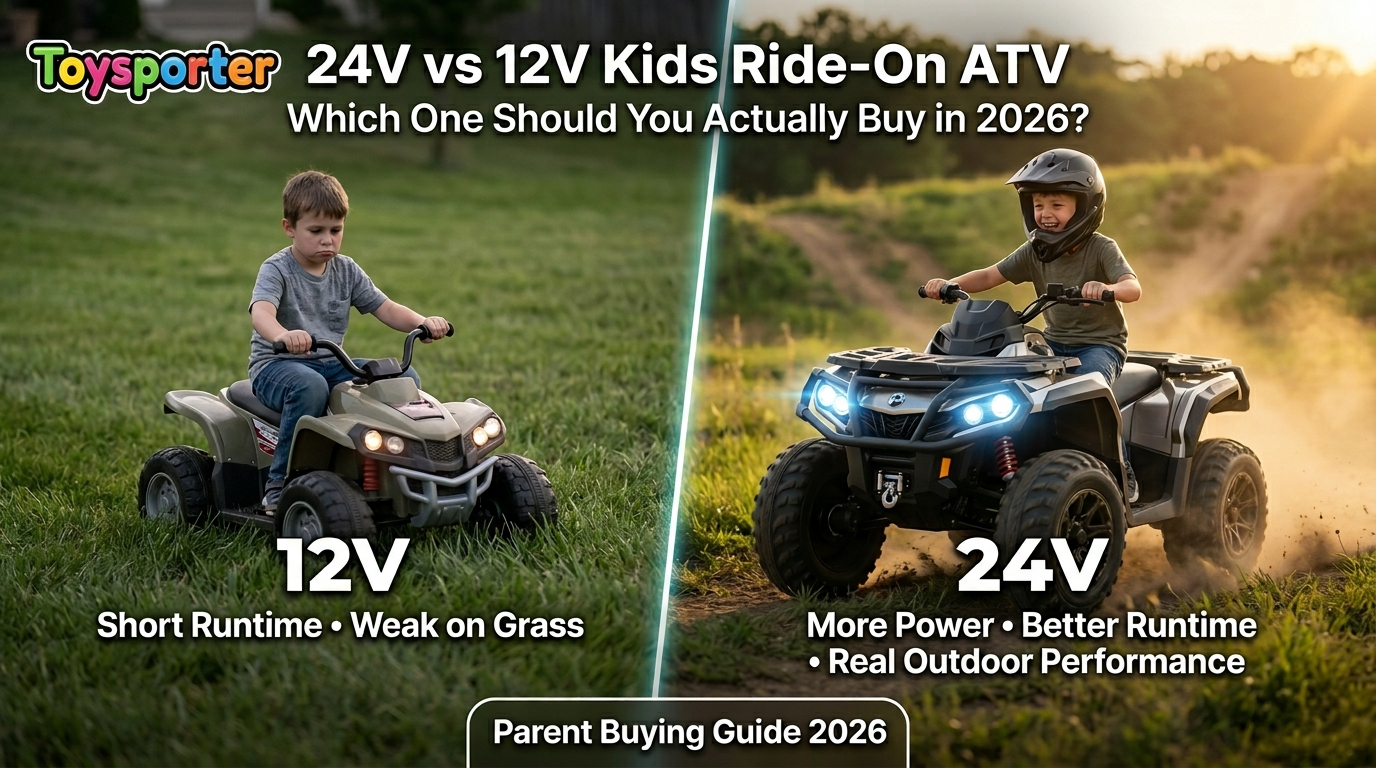
If you’re shopping for a kids’ electric ATV in 2026, you’ll hit the same fork in the road every parent hits: 24V or 12V? It’s the most-searched comparison in the kids’ ride-on category – and for good reason. The voltage decision affects nearly everything that matters about the ride: speed, runtime, terrain capability, and how long your child will keep playing with it before it ends up unused in the garage. Here’s the honest, real-world breakdown of 24v vs 12v kids ride on atv so you can make the right call before you spend $200 on a toy that might get outgrown in six months.
The Short Answer
If your child is over 3 years old or you live anywhere with grass, gravel, dirt paths, or any kind of outdoor terrain – buy 24V. If your child is under 3 and you’ll only ride on smooth flat surfaces like driveways, hardwood floors, or paved sidewalks – 12V is acceptable, though 24V still works fine in low-speed mode.
That’s the verdict. Now let’s look at why.
Battery Power: Where the Real Difference Starts
Voltage is essentially how much electrical “push” the battery delivers to the motor. A 12V battery is fine for low-power use on smooth surfaces. A 24V battery doubles that push – meaning the motor can handle resistance (grass, hills, gravel, the weight of a heavier child) without slowing down or stopping.
Here’s the practical impact:
• 12V on grass: kids’ ATV slows dramatically, often gets stuck
• 24V on grass: ATV powers through smoothly, no slowdown
• 12V on a slight hill: struggles or stops entirely
• 24V on a slight hill: climbs without losing speed
• 12V with a heavier child: noticeably slower acceleration
• 24V with a heavier child: consistent performance
This is the single biggest reason parents who initially bought 12V end up upgrading to 24V within a year. The 24v ATV is genuinely better than 12v for any outdoor use – and it’s the answer to the most common return reason for 12V models.
Runtime: How Long Will Your Kid Actually Ride?
12V batteries typically deliver 45 to 90 minutes of runtime on a full charge. 24V batteries – particularly 24V 10AH packs like the ones in our kids ride-on ATV collection – deliver 2 to 3 hours of continuous riding. That’s roughly twice the playtime per charge.
On a real summer afternoon, that difference matters. A 12V quad runs out before your kid is done playing. A 24V quad lasts the entire afternoon without a recharge – and for parents trying to get kids off screens and outdoors, longer runtime translates directly to more outdoor time per dollar spent.
Top Speed and Speed Settings
12V models top out around 2.5–3 MPH, which feels gentle to a 2-year-old and painfully slow to a 5-year-old. 24V models reach up to 4.9–5.9 MPH, with multiple selectable speed modes so parents can lock the ATV at a beginner-friendly pace and unlock faster speeds as the child grows.
This is crucial: a 24V kids’ ATV grows with your child. A 12V quad gets boring fast because there’s no “level up” – the ride feels the same on day 1 and day 365. Every 24V model in our best sellers includes 3 speed modes so the same toy stays exciting for 3+ years.
Suspension and Comfort
Most 12V kids’ ATVs ship with no suspension or basic foam padding. Most 24V models – including all three in our ATV category – include real spring suspension on all four wheels. The result: 24V quads ride smoother on bumps, lawns, gravel, and uneven ground, while 12V quads jolt the rider on anything other than flat asphalt.
For families with backyards (which is most of them), this is a comfort issue that turns into a daily-use issue. Smoother rides mean kids ride longer and more often.
Price Difference: Less Than You’d Think
Here’s where most parents get surprised. The price gap between 12V and 24V models in 2026 is much smaller than it used to be. A typical 12V kids’ quad costs $130–$180. A premium 24V quad bike for kids – like the POP FRIENDS 24V 4-Wheeler ATV or the Cybertruck-Inspired 24V ATV – currently costs $199.99 in our clearance event. Both originally retailed at $599. That’s a $20–$70 price gap for double the runtime, double the torque, real suspension, parental remote, Bluetooth, and LED headlights.
When you compare value-per-dollar, the 24V upgrade is genuinely the cheapest performance jump in the entire kids’ ride-on category right now.
Age Recommendations: Who Should Buy What
12V is acceptable for:
• Children ages 1–3 who only ride on smooth indoor floors or driveways
• Cautious first-time parents who want maximum simplicity and minimum speed
• Riders under 30 lbs who don’t strain a 12V motor
24V is the right choice for:
• Children ages 3 and up – basically every kid past the toddler stage
• Anyone with a yard, even a small one with patches of grass
• Families with two kids who’ll share the ride (more weight = more motor strain)
• Parents who want one toy that lasts 3–5 years instead of one year
• Anyone living somewhere with rural property, dirt paths, or off-pavement terrain
If you want a comprehensive rundown of features beyond voltage, our Best Ride-On ATV for Kids USA Buying Guide 2026 covers every other spec parents ask about.
The Honest Verdict
If you’re choosing between 24v vs 12v kids ride on atv in 2026, the math is overwhelmingly in favor of 24V. You get double the runtime, real outdoor terrain capability, better suspension, multiple speed modes, and a toy that grows with your child – for an extra $20–$70 versus a comparable 12V model. Every 24V model in our clearance pricing is currently within $20 of cheaper 12V quads from competing brands.
Common 24V vs 12V Questions Parents Ask
Is 24V too fast for a 3-year-old? No. Every 24V quad in our Toysporter best sellers ships with multiple speed modes – the lowest setting is around 1.5–2 MPH, which is genuinely walking pace. Combined with parental remote control, a 24V quad on the lowest speed setting is no faster than a 12V quad on its top speed.
Will a 24V battery last longer overall (years of ownership)? Yes. 24V batteries don’t get pushed as hard because they’re not maxing out on every uphill or grass crossing. A 12V battery working at maximum effort all the time degrades faster than a 24V battery that has headroom. Real-world Toysporter customer reports indicate 24V batteries holding charge well after 18+ months of regular use.
Can I downgrade to 12V if 24V is too much? This is the wrong way to think about the question. Lock the 24V quad to lowest speed mode – it’s now slower than a 12V quad while still benefiting from the better motor torque, suspension, and runtime. You’re never “stuck” with too much power.
Final Recommendation
Browse the full Toysporter ride-on ATV lineup to see all three top-rated 24V models in one place. Every order includes ASTM F963 safety certification, free fast US shipping, and 40-day easy returns. Skip the 12V regret – buy 24V the first time. Your child will get more years of use, more outdoor playtime per session, and a toy that performs on real terrain instead of getting stuck on the first patch of grass.