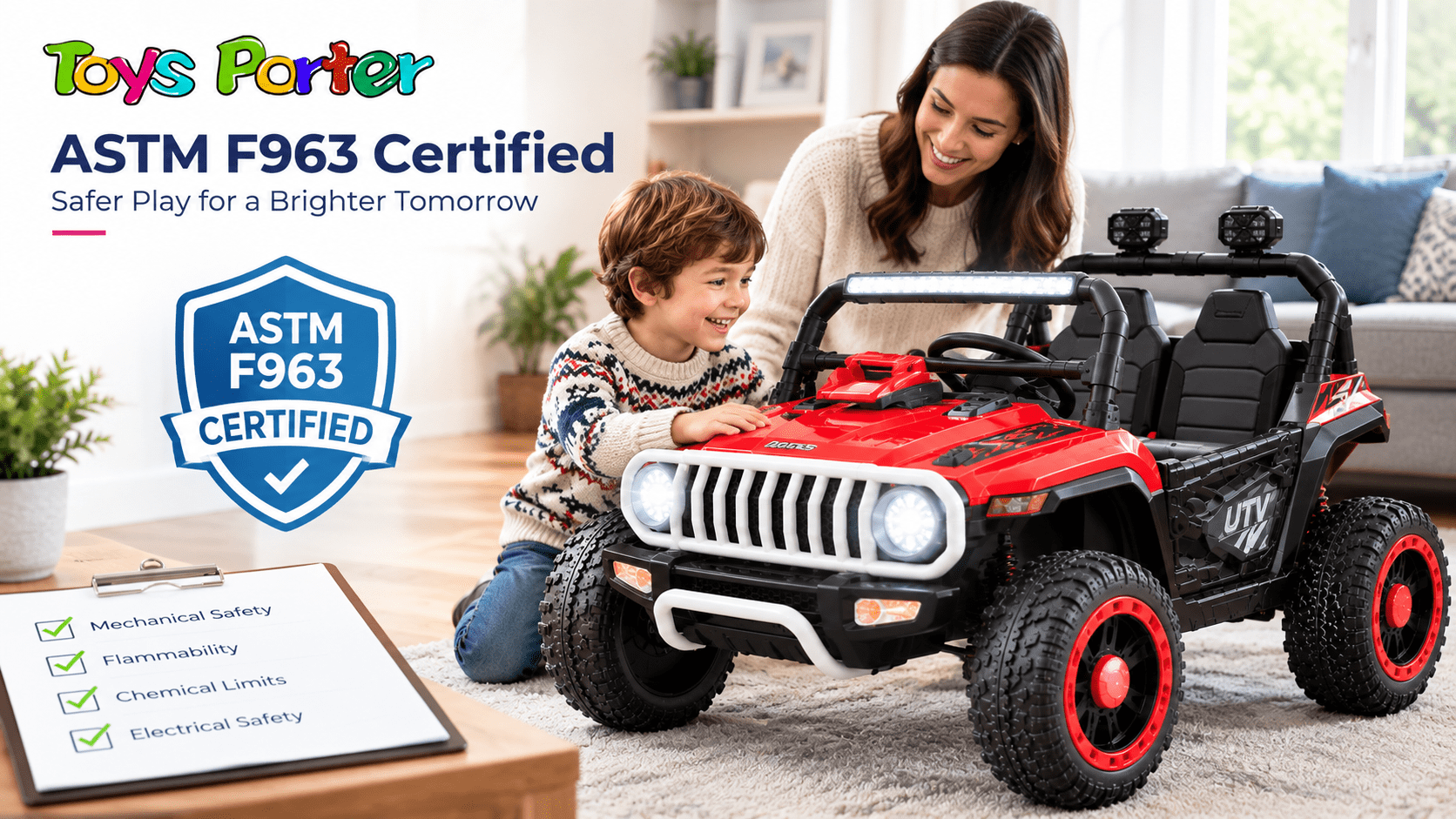
If you’ve shopped for a kids’ ride-on toy recently, you’ve almost certainly seen the phrase “ASTM F963 certified” somewhere on the product page. It shows up as a badge, a bullet point, sometimes right next to the price. Most parents scroll right past it without knowing what it actually means – which is a problem, because it’s one of the few claims on a toy listing that’s backed by an actual legal requirement rather than marketing language.
Quick answer: ASTM F963 is the mandatory federal safety standard for toys sold in the United States, made legally required by the Consumer Product Safety Improvement Act (CPSIA). A ride-on toy that’s ASTM F963 certified has been tested – typically by an independent, CPSC-accepted laboratory – against requirements covering mechanical and physical hazards, flammability, chemical limits (like lead and certain phthalates), and electrical and battery safety. It’s a real, legally enforced standard, not a marketing invention. That said, it doesn’t test everything a parent might assume it does, which is worth understanding before you rely on the badge alone.
What ASTM F963 Actually Tests For
ASTM F963 is a genuinely broad standard, but it breaks down into a handful of core categories:
Mechanical and physical hazards. This covers things like sharp points and edges, small parts that could pose a choking risk, and structural integrity – whether a toy is built to withstand normal (and some abnormal) use without breaking into hazardous pieces.
Flammability. Materials used in the toy are tested to make sure they don’t ignite easily or burn in a way that creates a fire hazard.
Chemical limits. This is one of the most consumer-relevant parts of the standard. Federal law caps the amount of lead allowed in accessible parts of a toy and permanently restricts several specific phthalates (chemical compounds sometimes used to soften plastics) above set concentration limits.
Electrical and battery safety. For a battery-powered ride-on toy specifically, this includes protections against overheating, short circuits, and other electrical hazards tied to the battery and motor system.
Here’s a simplified breakdown of what’s covered:
Category
What It Addresses
Mechanical/physical
Sharp edges, small parts, structural strength
Flammability
Materials that resist easy ignition
Chemical limits
Lead and restricted phthalates in accessible materials
Electrical/battery
Overheating, short-circuit, and battery-related hazards
Is ASTM F963 the Same Thing as CPSIA?
Not quite, and the difference is worth understanding. The CPSIA (Consumer Product Safety Improvement Act) is the federal law. Back in 2008, that law took ASTM F963 – which had previously been a voluntary industry standard – and made compliance with it legally mandatory for toys sold in the U.S. So when you see both terms mentioned together, think of CPSIA as the law and ASTM F963 as the specific technical standard that law requires toys to meet. A product being “ASTM F963 certified” is really shorthand for “tested and found compliant with the standard that federal law requires.”
Is This Self-Reported, or Independently Verified?
This is the part that matters most for trust. For most children’s products, including ride-on toys, manufacturers are required to have their products tested by an independent, third-party laboratory accepted by the Consumer Product Safety Commission (CPSC) – not simply self-declare compliance. A passing result typically leads to a Children’s Product Certificate (CPC), which documents that the specific product has been tested against the applicable requirements. This third-party testing requirement is a meaningful distinction from a lot of other marketing claims you’ll see on a product page, which often have no independent verification behind them at all.
What “ASTM F963 Certified” Does Not Tell You
This is the part most product listings leave out, and it’s genuinely useful to understand before you shop.
It doesn’t evaluate performance claims. A listed top speed, battery run time, or motor power isn’t something ASTM F963 verifies – those are manufacturer-reported specifications, not part of the safety certification itself.
It doesn’t guarantee correct assembly. The standard applies to the product as designed and tested. A ride-on toy assembled incorrectly at home can introduce hazards the certification never accounted for, which is exactly why following the included assembly instructions carefully matters.
It doesn’t replace supervision. Certification addresses the product itself, not how it’s used. A certified toy ridden without supervision, on inappropriate terrain, or by a child outside the intended age and weight range isn’t operating within the conditions the certification assumes.
It doesn’t mean a product has never been recalled. Certification happens before a product goes to market. Products can still be recalled afterward if an issue is discovered later, which is why it’s worth knowing how to check for recalls independently rather than relying on a badge alone (more on that below).
None of this makes the certification meaningless – it’s a real, legally required baseline. It just means the badge answers a narrower question than “is this toy completely safe in every situation,” which nothing can honestly promise.
How to Verify a Ride-On Toy’s Safety Beyond the Badge
A few practical steps go beyond just trusting a certification badge at face value:
Check for active recalls. The U.S. Consumer Product Safety Commission maintains a public, searchable database of recalled products at CPSC.gov, along with a consumer-reporting tool called SaferProducts.gov. Searching a specific product name or brand before buying – and periodically afterward – is a genuinely useful habit.
Match the product to your child’s actual age and weight, not just the age range printed on the box. Toysporter’sguide to Power Wheels weight limitsbreaks down how weight capacity relates to battery voltage class, which matters more for real-world safety than the age range alone.
Follow the assembly instructions exactly, including torque on bolts and correct part orientation – this is where a certified product can still end up unsafe if steps are skipped.
Apply the same supervision and terrain guidelines regardless of certification status. Toysporter’sride-on UTV and off-road Jeep safety guide covers the day-to-day riding practices – supervision, appropriate terrain, seatbelt use – that work alongside, not instead of, the product’s certification.
What This Means When You’re Actually Shopping
Practically speaking, “ASTM F963 certified” is a legitimate, legally meaningful claim worth looking for – it’s not just marketing fluff, and its absence on a listing (for a product that should have it) is a genuine red flag. Toysporter’sride-on ATV,ride-on UTV, andride-on truckcategories all list this certification directly on their product pages, which is the kind of specific, verifiable detail worth looking for on any ride-on toy listing, wherever you’re shopping. But the certification is a floor, not a ceiling – it tells you the product cleared a mandatory legal bar before reaching the market, not that every possible safety consideration has been handled for you. The habits that matter after that – checking recalls, matching the vehicle to your child’s size, following assembly instructions, and supervising actual rides – are still entirely on the parent, certification badge or not.
The Bottom Line
“ASTM F963 certified” isn’t just a sticker – it represents a real, federally mandated testing process covering mechanical safety, flammability, chemical limits, and electrical safety, typically verified by an independent lab rather than self-reported by the manufacturer. Understanding what it does and doesn’t cover turns a vague trust signal into something you can actually evaluate, rather than either dismissing it as marketing or assuming it covers more than it does. For families exploringToysporter’s full ride-on toy collection, that combination – a genuinely certified product, matched correctly to your child, assembled properly, and supervised appropriately – is what actually adds up to a safe riding experience.
FAQ
Is ASTM F963 certification required by law, or is it optional?
It’s legally required. The Consumer Product Safety Improvement Act made compliance with ASTM F963 mandatory for toys sold in the United States, not a voluntary industry choice.
Does ASTM F963 certification mean a product has never been recalled?
No. Certification happens before a product reaches the market. A certified product can still be recalled later if an issue is discovered after release, which is why checking CPSC.gov independently is still worthwhile.
Who actually performs the testing – the manufacturer or an outside lab?
For most children’s products, including ride-on toys, testing is required to be done by an independent, third-party laboratory accepted by the Consumer Product Safety Commission, not self-certified by the manufacturer alone.
Does ASTM F963 cover things like top speed or battery run time?
No. Those are manufacturer-reported performance specifications, not part of the safety certification itself. The standard focuses on mechanical, chemical, flammability, and electrical safety hazards.
If a ride-on toy is certified, does that mean I don’t need to supervise my child while riding?
No. Certification applies to the product itself, not how or where it’s used. Supervision, appropriate terrain, and matching the vehicle to your child’s age and weight all remain the parent’s responsibility regardless of certification status.
How can I check if a specific ride-on toy has ever been recalled?
The Consumer Product Safety Commission maintains a searchable public database at CPSC.gov, and consumers can also search or report issues through SaferProducts.gov