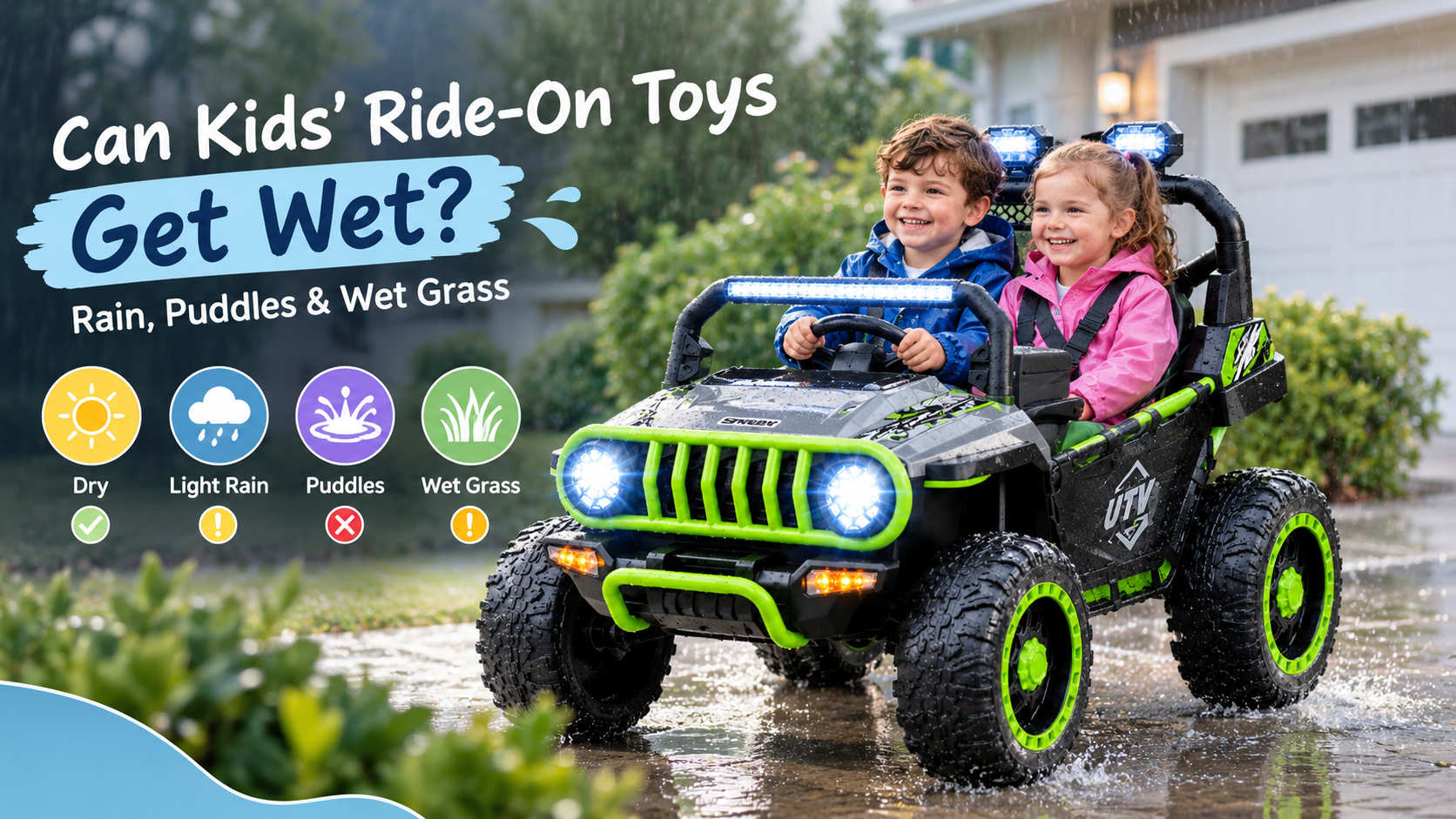
The sky looks fine when your child climbs in, and ten minutes later the first drops land on the seat. Or the lawn is still shining with morning dew and your kid is already buckled in. Most ride-on toy advice is written for dry days, so these moments tend to get decided on the spot.
Short answer: Generally, no. Electric ride-on toys are built for dry outdoor play, not for rain or standing water. Toysporter’s own ride-on UTV and ATV pages say it does not recommend use on wet surfaces, deep mud, sand, or steep slopes. A little dew on the grass is a gray area, where you’re managing risk rather than removing it. Active rain, puddles, and mud are best avoided altogether. Two things are at stake: the electronics, and how well the vehicle grips and stops.
A Quick Traffic-Light Guide to Wet Conditions
This is a practical framework, not a manufacturer rating. Your owner’s manual has the final word.
Condition
Verdict
What to do
Dry pavement or short, dry grass
Go
Normal supervised riding
Morning dew or lightly damp grass
Caution
Wait for the sun if you can. If not, use the lowest speed on flat ground and wipe the vehicle down afterward.
Recently rained, ground still soft or slick
Lean no
Wait. Soft spots and hidden puddles are easy to miss.
Active rain or drizzle
Stop
Bring it under cover
Puddles, standing water, sprinklers, wet decks
Stop
These aren’t conditions ride-ons are built for
Mud, sand, snow, slush
Stop
Matches Toysporter’s published guidance on mud, sand, and wet surfaces
Why Water and Electric Ride-Ons Don’t Mix
What’s Inside That Doesn’t Like Moisture
An electric ride-on runs on a rechargeable battery, one or more motors, wiring, connectors, and control components. Moisture that reaches those parts can cause corrosion or a short circuit. The result can be anything from a vehicle that cuts out unpredictably to one that stops working. The plastic body may shed some water, but the electrical connections are tucked away where you can’t see them. That makes it hard to tell how much water got in.
Water-Resistant Isn’t Waterproof
Unless a product page states a water-resistance rating, assume the vehicle has none. I didn’t see one on the Toysporter category pages I reviewed. Don’t read a safety certification as a weather rating, either. ASTM F963, which Toysporter lists on its products, covers toy-safety hazards. It is not a waterproof rating.
Wet Surfaces Change How It Drives
Even if the electronics were fine, wet ground changes the ride:
Less grip. Tires that handle dry grass or pavement can slide on wet surfaces.
Longer stopping. A parental remote’s emergency brake can cut power, but it can’t restore traction.
Tipping risk on turns. Wet grass can also hide holes and uneven ground.
More effort for the motor. Wet grass adds drag, which can shorten run time.
Toysporter’s listings describe 1 to 2 hours of ride time depending on terrain, rider weight, and speed setting. Wet conditions are one more variable that can pull you toward the lower end. For how dry surfaces like grass and gravel affect traction, see Toysporter’sterrain guide for ride-on UTVs. Wet conditions generally take away whatever margin those surfaces offer.
Dew, Damp Grass, and Light Mist: The Gray Area
Most real-world questions fall here, not in a downpour. Parents want to know whether a damp lawn at 9 a.m. counts. Strictly speaking, Toysporter’s “avoid wet surfaces” guidance covers it. If you choose to ride on lightly damp ground, a few habits lower the risk:
Wait first. Even 30 to 60 minutes of sun can change the surface noticeably.
Use the lowest speed. Toysporter’s UTV listings describe a low-speed beginner mode capped at 2.5 MPH. A slow setting leaves more time to react on a slick patch.
Stay on flat ground. Skip slopes and tight turns on damp grass.
Skip sprinkler zones and puddle edges. The ground may look dry and still be soaked a few feet away.
Wipe it down afterward. A dry towel on the tires, body, and seat is enough.
You may see reviews on any ride-on listing from owners whose kids drove through puddles with no trouble. Those are individual experiences, not a manufacturer endorsement. Moisture damage such as corrosion can also show up later instead of right away.
What to Do If Your Ride-On Gets Caught in the Rain
Immediate Steps
Stop and power it off. Get your child out and switch off the vehicle.
Move it under cover. A garage, porch, or covered patio works.
Dry the outside. Use a towel on the body, seat, and tires. Don’t use a hose or pressure washer.
Check your manual for battery steps. If your model lets you disconnect the battery easily, the manual will say how.
Let it dry completely. Use a dry, ventilated spot. Surfaces dry faster than hidden connectors, so wait longer than feels necessary, and a day or more if it was soaked.
Don’t charge it while it’s damp. Charging a vehicle with moisture in the electrical system is the step most worth avoiding.
Test at low speed, with supervision. Watch how it starts, drives, and stops before letting your child ride normally.
Signs Water May Have Gotten In
Stop using the vehicle and contact the seller or manufacturer if you notice:
Power that cuts in and out
A remote that stops responding or won’t pair
Unusually sluggish or uneven acceleration
A burning or “hot electronics” smell
Visible corrosion or white or green residue on connectors
Don’t open sealed electrical components yourself. The routine checks in Toysporter’sUTV and Jeep maintenance guideare a good baseline for what “normal” looks like on tires, doors, and battery connections, so changes stand out.
Keeping It Dry Between Rides
Most water exposure doesn’t happen during a ride. It happens while the vehicle is parked.
Store it indoors. Toysporter’s UTV page recommends storing the vehicle indoors when not in use to protect the battery from extreme temperatures. A garage keeps it out of the weather as well.
Use a breathable cover if it must stay outside. A cover can shed rain, but a plastic tarp that traps moisture underneath can make things worse.
Don’t leave it on the lawn overnight. Dew and sprinklers do the rest.
Check your sprinkler schedule. Timed sprinklers are a common culprit.
Charge it in a dry indoor spot. Toysporter’s listings describe an 8 to 12 hour full charge, so overnight charging fits easily.
Planning Around Wet Seasons
Wet weather isn’t just a spring problem. Showers, summer afternoon storms, and fall dew and leaf piles all turn up in different parts of the country. A few habits make it easier:
Check the forecast before promising a ride.
Pick a dry window. Late morning after the dew burns off and mid-afternoon between storms work well in many climates.
Keep a back-up activity ready so a rainy day doesn’t feel like a loss.
Keep supervision consistent. Toysporter’sUTV and Jeep safety guide covers the riding-area and supervision habits that matter even more when conditions are less than ideal.
Frequently Asked Questions
Can a kids’ ride-on toy go out in the rain?
Not as a rule. Electric ride-ons are designed for dry outdoor use. Toysporter’sride-on UTV andride-on ATV pages both say it does not recommend use on wet surfaces. Bring the vehicle inside if rain starts.
Are electric ride-on cars waterproof?
Unless the product page states a water-resistance rating, assume they are not. A toy-safety certification is not a waterproof rating, and a plastic body doesn’t protect the wiring and connectors underneath.
Can my child ride on wet grass or morning dew?
It’s a gray area. Wait for the surface to dry if you can. If you can’t, use the lowest speed, stay on flat ground, supervise closely, and wipe the vehicle down afterward.
My ride-on got rained on. Is it ruined?
Not necessarily, but don’t treat it as fine. Dry it thoroughly, don’t charge it while damp, and test at low speed. If you see power cutting out, an unresponsive remote, odd smells, or corrosion, stop using it and contact support.
How long should I let a wet ride-on dry before charging?
There’s no universal number, so check your manual first. Surfaces dry before connectors do, so it’s safer to wait longer than you think necessary, and a day or more if it was soaked.
Can I rinse a ride-on with a hose?
It’s best not to. Use a damp cloth to clean it, then dry it with a towel. A hose or pressure washer can force water into places it shouldn’t be.
Does wet weather shorten battery run time?
It can. Wet grass adds resistance, and terrain, rider weight, and speed setting all affect how long a charge lasts. Toysporter’s listings describe 1 to 2 hours depending on those factors.
Conclusion
Most ride-on trouble in wet weather comes from small decisions made quickly: one more lap on damp grass, a toy left out overnight, a charger plugged in too soon. A traffic-light mindset, a simple after-the-rain routine, and dry storage cover almost every situation. If you’re still comparing models for your yard and climate,Toysporter’s full range of electric ride-on vehicles is a good place to see what’s available.