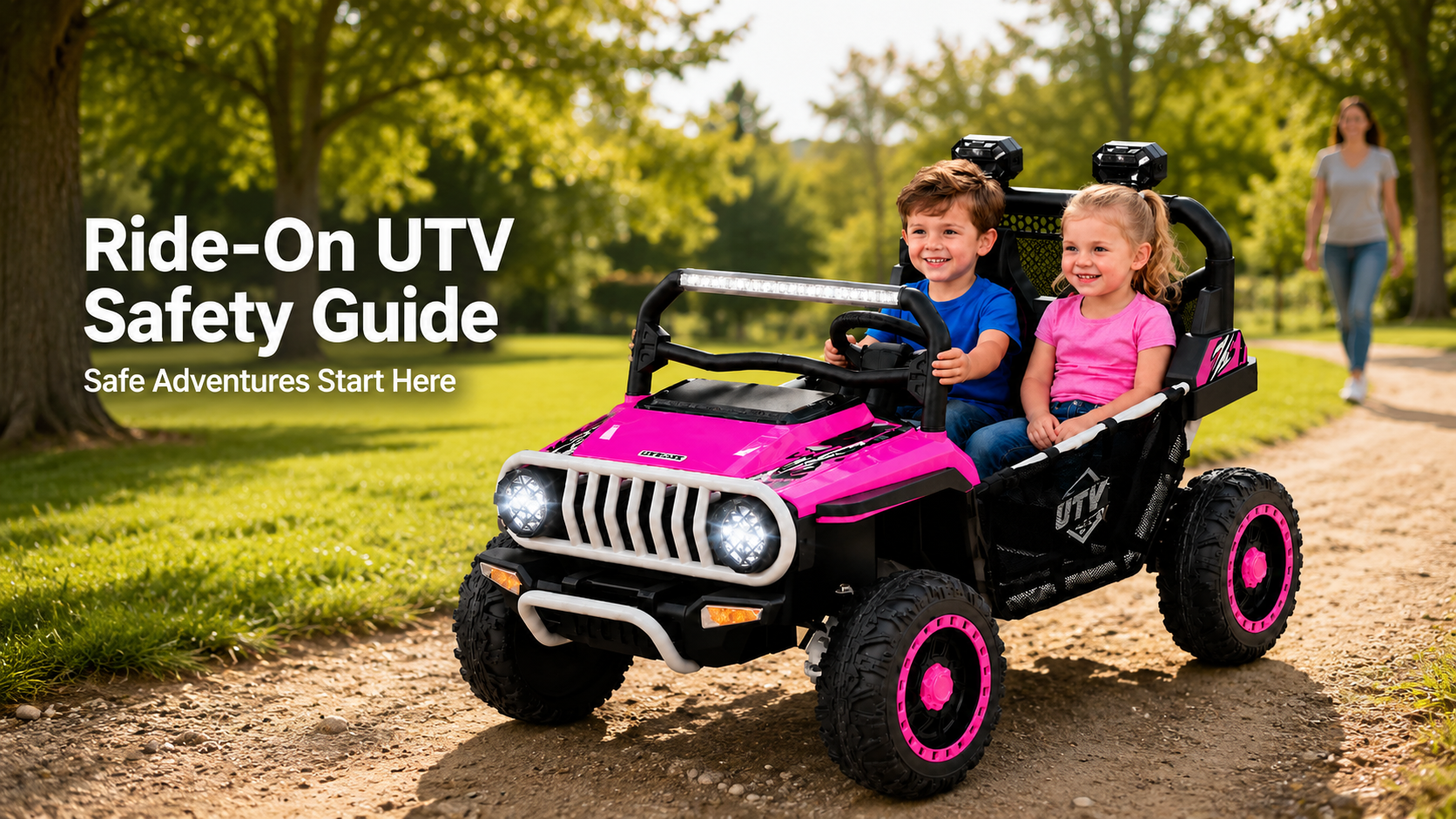
A ride-on UTV brings a different set of safety questions than a standard ride-on car – two kids instead of one, real doors that need to actually work as intended, and enough power to handle a bumpy backyard. None of that means it’s a riskier toy, but it does mean the rules are different, and most parents figure them out through trial and error rather than a clear starting checklist.
This guide covers exactly what to think through before your child’s first ride in aRide-On UTV or off-road Jeep-style two-seater, so you can set expectations once instead of improvising every weekend.
Why UTV Safety Is Different from a Standard Ride-On Car
A UTV’s wider stance and lower center of gravity make it genuinely more stable than a single-rider ATV – tip-overs are much less common, a distinction we cover in more depth in ourKids ATV vs. UTV comparison guide. The real safety considerations shift instead toward passenger behavior: two kids sharing a cab, doors that need to latch properly, and higher-torque motors built for terrain that a basic ride-on car was never meant to cross.
Pre-Ride Safety Checklist
Both seatbelts fastened and adjusted snugly before the vehicle moves, every single ride.
Doors closed and latched – a door that pops open at low speed is startling but manageable; treat it as a stop-and-fix moment every time.
Battery charged and connections secure, so the ride doesn’t cut out mid-session in an inconvenient spot.
Tires free of debris and, if applicable, inflated correctly (some higher-end UTV models use air-filled tires rather than solid ones).
Riding area checked for obstacles, holes, other kids, pets, or standing water.
Speed setting confirmed appropriate for the less-experienced of the two riders, not the more confident one.
Protective Gear: What’s Actually Necessary
Gear
Recommendation
Why
Helmet
Recommended for outdoor, uneven-terrain use
UTVs are more stable than ATVs, but off-road bumps still warrant head protection outside a flat driveway
Closed-toe shoes
Required
Feet near pedals and the ground; sandals are a common source of minor foot injuries
Seatbelts (built-in)
Always used, every ride
The single most effective safety feature already built into the vehicle
Sun protection
Recommended for open-top or soft-top models
Enclosed-cab models offer some shade; soft-tops and open designs don’t
Setting Rules for Two Riders
Side-by-side seating introduces a dynamic that single-rider vehicles don’t have: negotiation. A few rules save a lot of arguments and a few genuine safety issues.
Whoever is driving stays focused on driving – no swapping the wheel mid-ride, even briefly.
The passenger keeps hands and feet inside the cab at all times, especially near doors.
Set a clear, fair turn-taking system for who drives first before the excitement of a new UTV makes that negotiation harder.
If one child is significantly younger, plan for them to ride as a passenger with a parent nearby rather than assuming both kids can safely co-pilot unsupervised right away.
Terrain-Specific Hazards to Watch For
Slopes
Mild slopes are fine for most 24V UTVs, but steeper grades affect braking distance and stability more than flat-ground driving experience would suggest – approach new slopes at the lowest speed setting first.
Standing Water and Mud
Occasional puddles are generally fine for short crossings, but sustained mud or standing water isn’t something most ride-on UTVs are built to handle repeatedly – it affects both traction and the electrical components over time.
Uneven or Root-Covered Ground
This is where 4-wheel suspension earns its keep. Without it, sudden dips and roots translate directly into jolts that can startle young riders more than they’d expect.
Supervision by Age
Age of Younger Rider
Supervision Level
Notes
2-4 years
Direct, within-arm’s-reach supervision at all times
Parental remote should be the primary control method
5-6 years
Close supervision from a consistent vantage point
Manual driving can begin with the remote as backup
7 and up
Periodic check-ins in a familiar, contained space
Appropriate once house rules have been consistently followed
Parental remote control is a supervision tool, not a replacement for it – it lets you intervene instantly, but an adult should still be present, especially in the first several weeks of ownership.
What to Do After a Minor Bump or Fall
Because UTVs are more stable than single-rider ATVs, most incidents are low-speed bumps into fixed objects rather than tip-overs. Stay calm, check for pain when the child bears weight or moves the affected area, and treat it like an ordinary backyard scrape. If a fall keeps happening in the same spot, that’s usually a sign to adjust the riding area rather than a reason to stop riding altogether.
Real-World Scenario: Setting Rules Before the First Ride
A family in Texas with a 5-year-old and an 8-year-old sat both kids down before their new UTV’s first charge finished and agreed on a simple rule: the older child drives for the first ten minutes each session, then they switch, timed on a phone. Two months in, it’s still the system they use, and the “whose turn is it” arguments that they’d braced for never really materialized.
Frequently Overlooked Safety Details
Charging safety applies here just as much as riding safety – charge on a hard, ventilated surface and never let kids handle the charger unsupervised.
Weight limits are safety limits, not just performance specs – check the combined rider weight against the listing on theRide-On UTV orRide-On Truck product page before assuming two kids will fit comfortably and safely.
ASTM F963 certification covers construction, materials, and mechanical safety, but it doesn’t replace the supervision and house-rule habits covered in this guide.
Where to Go From Here
Once your ground rules are set, the next question is usually what your specific yard or neighborhood can actually support – a follow-up guide on UTV terrain capability (grass, gravel, hills, and mud) covers that in detail, and ourFAQs page answers common shipping and product questions that come up after purchase.
FAQ Section
Do kids need a helmet for a ride-on UTV?
It’s recommended for outdoor, uneven-terrain use, even though UTVs are more stable than single-rider ATVs. Flat-driveway, low-speed use is lower-risk, but a helmet habit formed early tends to carry over as kids move to faster vehicles later.
Is it safe for two kids to ride a UTV together?
Yes, when the combined weight limit is respected and both riders wear their seatbelts. The side-by-side design is specifically built for two riders, unlike a single-rider ATV.
What age is appropriate for a ride-on UTV?
Most models suit ages 2 to 8, with supervision level and control method (remote vs. manual) adjusted to the younger rider’s age rather than a single fixed cutoff.
Are ride-on UTVs more or less safe than ATVs?
UTVs are generally more stable due to their wider stance and lower center of gravity, which reduces tip-over risk. They introduce different considerations instead, like door latches and two-rider coordination.
What’s the most common safety mistake parents make with a new UTV?
Not setting clear turn-taking and in-cab rules before the first ride. Most incidents involving two-rider frustration or in-cab movement happen because rules weren’t established up front, not because of a vehicle defect.
Can a ride-on UTV tip over?
It’s uncommon given the wide, low-set design, but steep slopes, high speed settings, and sharp turns taken too fast can still increase the risk. Starting slopes at the lowest speed setting is the simplest prevention.